Category: Disqualification Appeal Process

Check out Disqualification Apeals’ blog posts on the appeal process for law enforcement candidates.

  • Police Polygraph Questions Disqualifiers

    Police Polygraph Questions Disqualifiers

    Police polygraph questions disqualifiers are usually connected to honesty, background history, prior conduct, drug use, employment issues, criminal activity, or inconsistencies in a candidate’s record. For NYPD candidates, the larger issue is not only whether a specific question is asked. It is whether the candidate’s answers match the application, background investigation, medical review, psychological review, and any other records considered during the hiring process.

    For candidates who need to review concerns involving character disqualification, psychological disqualification, and medical disqualification, our team at Disqualification Appeals can help. If a polygraph, background interview, or truthfulness review raises concerns during the New York City Police Department hiring process, the response should focus on the record, the stated issue, and any documentation that may help explain what happened.

    Why Polygraph Questions Matter in Police Hiring

    Police departments place a high value on honesty, judgment, reliability, and consistency. Some law-enforcement agencies may use a polygraph as part of a broader background review, while other agencies may rely on interviews, written forms, records checks, and investigator follow-up.

    For candidates, the practical concern is the same. The agency is looking for answers that are complete, accurate, and consistent with the rest of the file. A concern may arise if a candidate gives one answer on an application, another answer during an interview, and a different explanation when confronted with records.

    That is why candidates should not think of a polygraph as a standalone event. It may be one part of a larger review of the candidate’s character, credibility, and suitability for police work.

    What Are Common Police Polygraph Questions?

    Common police polygraph questions may focus on areas that are already part of the hiring record. These may include prior drug use, criminal conduct, theft, employment discipline, terminations, financial issues, driving history, use of force, dishonesty, or other conduct that could affect law-enforcement suitability.

    A candidate may also be asked about whether they provided complete information during the application process. That can include whether they disclosed prior arrests, summonses, drug use, job discipline, school discipline, military history, medical history, or other issues the agency requested.

    The exact questions can vary by agency and process. Candidates should not rely on a memorized list of questions. A stronger approach is to make sure the application, background forms, and explanations are accurate before the review reaches a more serious stage.

    What Can Become a Polygraph Disqualifier?

    Police polygraph questions disqualifiers may involve more than the conduct itself. A prior mistake, old incident, or explainable issue may be handled differently than an omission, false answer, or inconsistent explanation.

    Potential concerns may include undisclosed criminal history, recent or significant drug use, lying on an application, failure to disclose information, theft from an employer, serious employment misconduct, falsified records, undisclosed financial problems, or answers that conflict with known records.

    The agency may also focus on whether the candidate attempted to minimize or hide the issue. In many character review cases, the concern is not only what happened. The concern is whether the candidate was honest when asked about it.

    How Polygraph Issues Can Connect to Character Disqualification

    A character disqualification often involves the candidate’s judgment, credibility, responsibility, and honesty. If a polygraph or background review raises concerns about truthfulness, the agency may view that issue as part of the candidate’s character assessment.

    For example, a candidate may disclose past drug use late in the process after denying it earlier. Another candidate may explain an employment termination differently from the employer’s records. Another may omit a summons or arrest because they believed it was too old, dismissed, or sealed to matter.

    Those situations can become character concerns because the agency may question the candidate’s reliability. If the issue leads to a Notice of Proposed Disqualification (NOPD), the response needs to explain the full context clearly and address the inconsistency directly.

    What Happens If You Do Not Pass a Police Polygraph?

    Not passing a polygraph does not always mean the same thing in every agency or hiring process. The result may lead to follow-up questions, further review, or a concern about whether the candidate was truthful. In some cases, it may contribute to a disqualification decision.

    The important step is to understand what the agency is actually relying on. Is the concern a specific admission? An inconsistent answer? A comparison between the polygraph response and a background record? A broader concern about honesty? The response should be tied to that issue.

    Candidates should avoid giving a vague explanation or blaming nerves alone unless the record supports that explanation. If the concern involves a specific contradiction, the response should address that contradiction.

    What Should NYPD Candidates Review Before Responding?

    Before responding to a polygraph-related or truthfulness-related concern, candidates should review their application, background forms, interview answers, medical records, psychological review materials, employment history, and any notice they received from the NYPD.

    They should look for differences between what they wrote, what they said, and what the records show. A strong response should identify the issue, explain why the answer was incomplete or inconsistent, and provide documentation when available.

    Candidates in Bronx, Brooklyn, Manhattan, Queens, Staten Island, Nassau County, and Suffolk County may face these issues during NYPD or other law enforcement hiring reviews. The specific agency process matters, but the need for accuracy and consistency remains central.

    Why Disclosure Issues Should Be Taken Seriously

    Disclosure issues can make a candidate’s situation more difficult because they may shift the focus from the original conduct to the candidate’s honesty. A prior mistake may be explainable. A failure to disclose that mistake may create a separate concern.

    This can happen with drug use, employment discipline, arrests, summonses, financial issues, school discipline, or medical and psychological history. If the candidate did not disclose the information when asked, the agency may question whether the candidate can be trusted in a law-enforcement role.

    That is why candidates should review the exact question that was asked. Sometimes an omission happens because the candidate misunderstood the question, believed the issue did not apply, or did not have the full record. Those details matter, but they need to be explained carefully.

    When Should You Speak With an NYPD Disqualification Appeal Lawyer?

    A candidate should consider speaking with an NYPD disqualification appeal lawyer if a polygraph, background investigation, or disclosure issue leads to a proposed disqualification. These concerns can involve overlapping character, psychological, and medical issues, especially when the agency believes the candidate’s answers were incomplete or inconsistent.

    Legal guidance does not guarantee a result. It can help the candidate understand the concern, organize the record, gather relevant documentation, and prepare a response that addresses the agency’s reasoning directly.

    This is especially important if the candidate received a Notice of Proposed Disqualification or is unsure whether the issue is based on the polygraph itself, an admission, a record mismatch, or a broader character concern.

    Get Help With Police Polygraph and Character Disqualification Concerns

    Police polygraph questions disqualifiers should be reviewed as part of the full hiring record, not in isolation. A candidate’s answers may affect how the agency evaluates honesty, judgment, disclosure, and overall suitability for law-enforcement work.

    Disqualification Appeals helps candidates respond to NYPD disqualification concerns involving character disqualification, psychological disqualification, medical disqualification, background investigation issues, and Notice of Proposed Disqualification matters. If a polygraph-related concern or an inconsistent record has affected your candidacy, get in touch with our team to review your next steps.


    RELATED READINGS:

    Police Background Check Errors


    SOURCES:

    NYPD Police Officer Candidate Resource Booklet – https://www.nyc.gov/assets/nypd/downloads/pdf/careers/po-candidate-resource-booklet-v3.pdf


  • NYPD Drug Disqualifications

    NYPD Drug Disqualifications

    Drug history, drug testing, and medication questions can create serious concerns for police candidates. NYPD drug disqualifications may involve a positive drug screening, prior substance use, prescription medication concerns, inconsistent disclosures, or missing information in the application record. For candidates applying to the New York City Police Department, the issue is not always limited to the substance itself. The department may also review whether the candidate was complete, accurate, and consistent during the hiring process.

    Our team at Disqualification Appeals helps candidates review Notice of Proposed Disqualification (NOPD) concerns involving medical disqualification, character disqualification, and psychological disqualification issues. When drug use, drug testing, or medication history becomes part of the record, the response should be careful, specific, and supported by documentation.

    Why Drug Issues Can Affect an NYPD Application

    Police candidates are evaluated for whether they meet the standards required for appointment. Drug-related concerns can appear during the medical review, background investigation, psychological review, or character assessment. A candidate may be questioned about illegal drug use, marijuana history, prescription medication use, steroid use, prior treatment, or inconsistencies between application answers and later records.

    That does not mean every past issue is reviewed the same way. The facts matter. The department may consider what substance was involved, when the use occurred, how often it occurred, whether the candidate disclosed it, whether the candidate passed required screening, and whether the record suggests a current concern.

    For many candidates, the biggest risk is assuming the issue is simple. A drug-related concern may be medical in one case and character-related in another. If the concern involves disclosure, the question may become whether the candidate was truthful and complete during the process.

    Does the NYPD Drug Test Candidates?

    Candidates should expect drug screening to be part of the NYPD hiring process. Official NYPD candidate materials state that applicants must pass a drug screening before appointment. The department’s hiring materials also describe drug testing during Police Academy training, at the end of probation as part of the medical examination, and in certain later circumstances.

    The specific testing method and timing may depend on the stage of the process and the department’s current procedures. Candidates should not rely on assumptions about what will or will not be tested. If drug screening becomes part of a disqualification issue, the exact records, results, notices, and explanations matter.

    What Happens If a Candidate Fails a Drug Screening?

    A failed or refused drug screening can create a serious barrier to appointment. Drug screening issues may be treated as a medical concern, a character concern, or both, depending on the facts and the agency record.

    Candidates should review the notice carefully before responding. The notice may identify whether the concern involves a positive screening, refusal, medication issue, prior drug use, disclosure problem, or another record-based concern. A response should address the specific issue raised, not simply argue that the candidate is otherwise qualified.

    Documentation may matter. Depending on the situation, relevant documents may include prescriptions, medical records, laboratory information, treatment history, employment records, or other materials that help explain the record. The goal is to clarify the issue and respond to the department’s stated concern.

    How Past Marijuana Use May Be Reviewed

    Past marijuana use can create confusion because state laws and workplace policies are not always the same. NYPD hiring materials state that prior substance use, including marijuana, is not automatically disqualifying and may be considered as part of the total background investigation. Those materials also state that candidates must pass drug screening before appointment and that NYPD employees are prohibited from drug use, including marijuana.

    For candidates, the important point is disclosure and context. A candidate should not assume that past marijuana use is irrelevant, and they should not assume that it automatically ends the process. The candidate’s record, timing, frequency of use, disclosure history, and test results may all matter.

    If marijuana history appears in a Notice of Proposed Disqualification, the response should be tied to the concern in the notice. A vague explanation may not be enough if the department is focused on inconsistencies, recent use, missing information, or a failed screening.

    Why Disclosure Can Matter as Much as the Drug History

    Drug-related issues often become more serious when the department believes the candidate did not disclose information fully. A candidate may think an old issue, rare use, dismissed matter, prescription, or prior treatment was not important. The department may instead focus on whether the candidate answered the question accurately.

    This can turn a drug issue into a character issue. If the background record shows information that does not match the candidate’s application, interview answers, or written explanations, the department may question the candidate’s honesty, judgment, or reliability.

    A strong response should address both parts of the issue. It should explain the drug-related concern and explain any disclosure issue connected to it. Ignoring the omission can make the response less useful.

    Prescription Medication, Steroids, and Medical Review

    Drug-related concerns are not limited to illegal substances. Prescription medication, anxiety medication, pain medication, stimulants, or steroid use may become relevant if the department questions whether the candidate can perform required duties or whether the medication was disclosed properly.

    The issue is not always the existence of a medication. The department may consider the diagnosis, treatment history, side effects, stability, dosage, supporting medical records, and whether the candidate followed lawful medical guidance. Misuse of medication or use of a prescription that was not issued to the candidate can raise different concerns.

    If medication history is part of a proposed medical disqualification, candidates should review what the department is actually questioning. The response may need to include medical documentation, prescribing records, treatment notes, or updated professional opinions.

    What Candidates Should Review Before Responding

    Before responding to NYPD drug disqualifications, candidates should review the notice, the stated basis for the concern, the drug screening record, application answers, interview statements, medical documentation, and any background materials tied to the issue.

    They should also look for inconsistencies. Did the candidate disclose the same information throughout the process? Did the candidate give one answer on an application and another answer during an interview? Did medical records or background records reveal something the candidate did not explain?

    These details matter because the response should be built around the actual record. A candidate in Bronx, Brooklyn, Manhattan, Queens, Staten Island, Nassau County, or Suffolk County may need to gather documents quickly if the notice includes a response deadline.

    When Should You Speak With a Lawyer?

    A candidate should consider speaking with an NYPD disqualification appeal lawyer when a drug-related issue leads to a Notice of Proposed Disqualification, a failed screening, a disclosure concern, or a medical or character review issue. These matters can be difficult because the response may need to address testing, past conduct, medical records, and consistency across the application record.

    Legal guidance does not guarantee an outcome. It can help candidates understand what the department is questioning, organize the records, identify relevant documentation, and prepare a response that speaks directly to the concern.

    Get Help With NYPD Drug Disqualification Concerns

    Drug-related disqualification issues should be reviewed carefully before a candidate responds or decides what to do next. A positive test, medication question, past use, or disclosure issue can affect how the New York City Police Department evaluates medical fitness, character, and overall eligibility.

    Disqualification Appeals works with candidates facing or having concerns about NYPD drug disqualifications, psychological disqualifications, character disqualifications, and medical disqualifications. If you received a Notice of Proposed Disqualification or need help understanding the record behind your drug-related disqualification issue, contact our team to discuss your next steps.


    Sources:

    NYPD Police Officer Hiring FAQs

    https://www.nyc.gov/site/nypd/careers/police-officers/OLD-faqs-hiring-pos.page    

    DCAS Police Officer Notice of Examination

    https://www.nyc.gov/assets/dcas/downloads/pdf/noes/20244308000.pdf 

    DCAS Personnel Services Bulletin 100-15

    https://www.nyc.gov/assets/dcas/downloads/pdf/reports/100_15.pdf

  • Steps to File an Appeal After Receiving an NOPD

    Steps to File an Appeal After Receiving an NOPD

    Receiving a Notice of Proposed Disqualification (NOPD) from the New York City Police Department can feel like a final decision. It is not. It is the beginning of a defined process, and understanding the steps to file an appeal at this stage is critical.

    At Disqualification Appeals, we work with candidates who are navigating this exact moment. The steps to file an appeal after receiving an NOPD are time-sensitive and structured, and how you respond can directly affect the outcome. This is not a general appeal process. It is a specific sequence within the NYPD hiring process that requires attention to timing, documentation, and how your case is presented.

    What Happens After You Receive a Notice of Proposed Disqualification?

    A Notice of Proposed Disqualification means the NYPD has identified an issue that may prevent you from moving forward. This could involve a proposed medical disqualification, a proposed psychological disqualification, or a proposed character disqualification.

    At this stage, the department has not issued a final decision. You have the opportunity to respond. This is where the steps to file an appeal begin, even though it is technically considered an administrative response rather than a court appeal.

    The most important factor here is timing. Candidates are generally given a limited window to respond. Missing that window can result in the proposed disqualification becoming final without further review.

    Steps to File an Appeal After Receiving an NOPD

    Understanding the steps to file an appeal in the correct order helps prevent avoidable mistakes. Each step builds on the previous one, and skipping or rushing any part of the process can weaken your position.

    Step 1: Review the Basis for the Proposed Disqualification

    The first step is to carefully review the reason listed in the Notice of Proposed Disqualification. The NYPD will identify the category and provide a general explanation of the concern.

    This is not just informational. The entire appeal process depends on responding directly to the stated reason. A vague or unfocused response can lead to a final disqualification even when supporting information exists.

    Step 2: Gather Supporting Documentation

    Once the basis for the proposed disqualification is clear, the next step is to gather documentation that addresses the issue. This may include medical records, psychological evaluations, employment history, or other supporting materials, depending on the category.

    Documentation must be relevant and organized. Submitting unnecessary or unrelated information does not strengthen an appeal. It can dilute the focus of your response.

    Step 3: Submit Your Administrative Appeal

    The next step in the process is submitting your response within the required timeframe. This is your administrative appeal at the NYPD level.

    This submission for an administrative appeal should:

    • Directly address the reason for the proposed disqualification
    • Include supporting documentation
    • Present a clear and structured explanation

    This is where many candidates make critical mistakes. A rushed or incomplete submission can lead to a final Notice of Disqualification, even if the underlying issue could have been addressed.

    Step 4: Await the NYPD Determination

    After your response is submitted, the NYPD will review your materials and issue a determination. At this point, the department may either reverse the proposed disqualification or uphold the decision and issue a final disqualification.

    If the disqualification is upheld, the process does not necessarily end, but the next steps change significantly.

    What Happens if Your Administrative Appeal Is Denied?

    If the NYPD issues a final disqualification, you may have the option to continue the appeal process through the Civil Service Commission.

    This stage involves a more formal review of your case. It may include additional documentation, written submissions, or a hearing, depending on the circumstances.

    This is still part of the administrative process. It is not yet a court proceeding, but it is a critical step before any judicial review.

    When Does an Article 78 Appeal Apply?

    An Article 78 proceeding is not the next step after receiving an NOPD. It only becomes relevant after all administrative remedies have been exhausted.

    Once a final determination has been issued and administrative appeals have been completed, a candidate may choose to file an Article 78 proceeding in court. This is a legal challenge to the agency’s decision, not a continuation of the internal review process.

    Article 78 filings are subject to strict timelines, typically within four months of the final decision. Missing this deadline can entirely eliminate the option.

    Understanding the distinction between administrative appeals and an Article 78 proceeding is essential. Many candidates assume they can go directly to court after receiving an NOPD. That is not how the process works.

    Common Mistakes When Filing an Appeal

    Candidates often run into problems not because their case lacks merit, but because the process is misunderstood.

    One of the most common issues is treating the response to an NOPD as a formality. It is not. This is the stage where your case is first evaluated in detail.

    Another frequent mistake is submitting incomplete or unfocused documentation. The response must directly address the reason for the proposed disqualification. General statements or unrelated materials do not strengthen your position.

    Timing is also a critical factor. Waiting too long to respond or misunderstanding deadlines can lead to disqualification without a full review.

    Frequently Asked Questions About Appealing an NYPD Disqualification

    What are the steps to file an appeal after receiving an NOPD?

    The steps to file an appeal begin with reviewing the reason for the proposed disqualification, gathering supporting documentation, and submitting a structured response within the required timeframe. This is followed by an NYPD determination and, if necessary, further administrative review.

    How long do you have to respond to a Notice of Proposed Disqualification?

    Candidates are typically given a limited window to respond. The exact timeframe may vary, but it is generally around 30 days. Acting promptly is essential to preserve your ability to appeal.

    What is the difference between an NOPD and a final disqualification?

    A Notice of Proposed Disqualification is not a final decision. It provides an opportunity to respond. A final disqualification occurs after the NYPD reviews your response and decides to uphold the determination.

    Can you appeal a final NYPD disqualification?

    Yes. After a final disqualification, candidates may pursue further administrative review through the Civil Service Commission. If those remedies are exhausted, an Article 78 proceeding may be available.

    What is an Article 78 appeal?

    An Article 78 proceeding is a court action used to challenge a final agency decision. It is not part of the initial appeal process and only applies after administrative options have been completed.

    Understanding Your Next Step

    Knowing the steps to file an appeal after receiving an NOPD is only part of the process. Applying those steps correctly is what determines the outcome.

    At Disqualification Appeals, we assist candidates in evaluating their situation, organizing their response, and understanding how each stage of the NYPD disqualification process applies to their case. Whether the issue involves a proposed medical disqualification, proposed psychological disqualification, or proposed character disqualification, each case depends on how the response is structured and presented.

    Taking action early, staying within deadlines, and focusing on the specific reason for the proposed disqualification can make a meaningful difference in how your case is reviewed. Learn more on our blog or contact us today to learn how we can help you.

  • Lawyer Cost for NYPD Disqualification Appeals: What to Expect

    Lawyer Cost for NYPD Disqualification Appeals: What to Expect

    When candidates receive a Notice of Proposed Disqualification (NOPD) from the New York City Police Department, their first question often revolves around lawyer cost. They question whether hiring an NYPD disqualification appeal lawyer is worth it and what that investment may look like.

    At Disqualification Appeals, a specialty law firm, we work directly with candidates navigating the NYPD disqualification process. We understand how important pricing is at this point. While every case is different, we can explain how lawyer costs are typically structured, what affects pricing, and what candidates should realistically expect.

    How Much Does a Lawyer Cost for an NYPD Disqualification Appeal?

    Lawyer costs can vary depending on the complexity of the case, the type of proposed disqualification, and how far the appeal process goes. Complexity involves the level of work required, from more limited administrative responses to more involved cases that require additional review or multiple stages. There are no fixed prices, only general ranges based on how much work is done.

    We focus on helping candidates understand their options, including possible costs, before they commit to moving forward. This ensures they can make informed decisions about how to proceed.

    What Affects Lawyer Cost in an NYPD Disqualification Case?

    There is no single price for an appeal. Several factors influence how lawyer costs are determined in an NYPD disqualification appeal. Here we explain three common factors that often affect the pricing.

    The Type of Disqualification

    The category of disqualification plays a major role in cost.

    A proposed medical disqualification may require reviewing records, coordinating with medical professionals, and presenting updated evaluations.

    A proposed psychological disqualification often involves detailed report analysis, independent psychological evaluations, and structured responses that address specific findings.

    A proposed character disqualification may require documentation of background history, employment records, and clarification of past issues.

    Each category involves a different level of preparation, which directly affects cost.

    The Stage of the Appeal Process

    Lawyer costs are also affected by how far the case progresses.

    An administrative response to a Notice of Proposed Disqualification is typically more limited in scope than a case that moves to the Civil Service Commission. If the matter proceeds to an Article 78 proceeding, the level of legal work increases significantly.

    This is why cost can vary widely. Some cases are resolved early, while others require multiple stages of review.

    The Complexity of the Case

    Not all cases are equal. Some involve a single issue that can be addressed with targeted documentation. Others involve multiple concerns that require a more comprehensive response.

    Complex cases often require multiple forms of documentation, coordination with outside professionals, and detailed written submissions.

    As the complexity increases, so does the amount of work involved, affecting the overall cost.

    Appeals Lawyer Cost vs. Doing It Alone

    Some candidates consider handling the appeal on their own to avoid legal fees. While that may seem like a way to reduce cost, it is important to understand what is at stake.

    The response to a Notice of Proposed Disqualification is not a simple form submission. It is a structured argument that must directly address the reason for the proposed disqualification.

    An incomplete or unfocused response can lead to a final disqualification, even in cases where supporting evidence exists. Once a final decision is issued, the process becomes more complex and may involve additional costs at later stages.

    We often work with candidates who have attempted to respond on their own and later needed to correct issues in the process. Addressing the situation early can be more efficient than trying to fix it after a denial.

    What Is Included in the Cost of an NYPD Disqualification Appeal Lawyer?

    Lawyer costs typically reflect the scope of work required to prepare and present the appeal. This may include:

    • Reviewing the Notice of Proposed Disqualification
    • Analyzing supporting documentation
    • Coordinating with medical or psychological professionals when needed
    • Preparing written submissions
    • Advising on timelines and next steps

    In more advanced stages, it may also include representation before the Civil Service Commission or preparation for an Article 78 proceeding.

    Each case is evaluated individually to determine what level of involvement is appropriate.

    Is Hiring an NYPD Disqualification Appeal Lawyer Worth It?

    Whether hiring a lawyer is worth it is one of the most common questions candidates ask when considering lawyer costs. The answer depends on the circumstances of the case, but the key factor is what the outcome represents. For many candidates, the appeal determines whether they can continue pursuing a career with the NYPD.

    The NYPD hiring process is structured, and decisions are based on how information is presented and evaluated. Understanding how to respond to a proposed medical disqualification, proposed psychological disqualification, or proposed character disqualification can influence how the case is reviewed.

    We focus on helping candidates understand their positions and determine the most effective way to move forward based on their specific situations.

    How We Approach Cost Transparency at Disqualification Appeals

    We believe candidates should have a clear understanding of lawyer costs before moving forward. While we do not present one-size-fits-all pricing, we explain what factors affect cost and what level of work may be required.

    Our approach is based on evaluating the case first, then outlining what is involved. This allows candidates to decide how to proceed with full awareness of what the process may require.

    Candidates can review their options and contact our team to discuss their situation before making any decisions.

    Frequently Asked Questions About Lawyer Costs

    How much does a lawyer cost for an NYPD disqualification appeal?

    Lawyer costs for an NYPD disqualification appeal can vary based on the type of disqualification and the complexity of the case. Administrative appeals may generally cost less than more complex cases involving additional stages.

    What affects the cost of an appeals lawyer the most?

    The main factors affecting the cost of an appeals lawyer include the type of disqualification, the amount of documentation required, and whether the case remains at the administrative level or progresses to further review.

    Is it more expensive to file an Article 78 appeal?

    An Article 78 proceeding involves court filings and a higher level of legal work. This amount of work typically increases the overall cost compared to an appeal that only requires administrative work.

    Can I handle an NYPD disqualification appeal without a lawyer?

    It is possible to handle an NOPD appeal by yourself. However, the process requires a structured response that directly addresses the reason for the proposed disqualification. Errors or omissions at this stage can affect the outcome, making hiring a lawyer a valid expense.

    Do all NYPD disqualification cases cost the same?

    Because each case is different, not all NYPD disqualification cases cost the same. Pricing depends on the category of disqualification, the complexity, and the stage of the appeal process.

    Understanding Your Next Step

    Lawyer cost is an important consideration, but it is only one part of the decision. The outcome of an appeal can affect whether you are able to continue in the NYPD hiring process.

    At Disqualification Appeals, we provide legal advice to candidates across the Bronx, Brooklyn, Manhattan, Queens, and Staten Island, as well as Nassau County and Suffolk County, to evaluate their cases and explain their options. Whether the issue involves a proposed medical disqualification, a proposed psychological disqualification, or a proposed character disqualification, each situation requires a tailored approach.

    Candidates who want to better understand their position can learn more about the NYPD disqualification process on our blog or contact our team to review their case and discuss next steps.

  • When Should You Hire a Lawyer for a Police Disqualification Appeal?

    When Should You Hire a Lawyer for a Police Disqualification Appeal?

    Becoming a police officer is a lifelong goal for many, but the path isn’t always straightforward. A police officer disqualification can feel like the end of the road, but it doesn’t have to be. Whether you’re facing issues with a psychological evaluation, background check, or academy rejection, knowing when to take legal action is critical. That’s where Disqualification Appeals come in. With deep experience handling NYPD and other law enforcement appeals, their team provides the legal clarity and support needed to challenge unjust decisions and get your application back on track.

    A police officer disqualification can feel like the point where everything changes. For many candidates, it raises immediate questions about whether the decision can be challenged, whether the record is complete, and whether hiring a lawyer may improve the way the response is presented.

    If the disqualification involves the New York City Police Department, those questions often begin after a Notice of Proposed Disqualification (NOPD) is issued. At that stage, candidates are not just trying to understand why the decision was made. They are also trying to determine whether legal help may matter before the disqualification becomes final.

    At Disqualification Appeals, our team assists candidates throughout Bronx, Brooklyn, Manhattan, Queens, and Staten Island, as well as Nassau County and Suffolk County, in evaluating when legal representation may be useful in a police officer disqualification case and what steps should come next.

    Understanding a Police Officer Disqualification

    A police officer disqualification can happen at different stages of the hiring process and for different reasons. In some cases, it arises from a psychological evaluation. In others, it may stem from medical findings, background concerns, or issues that surface during the agency’s review of the application.

    For NYPD candidates, a police officer disqualification may take the form of a proposed psychological disqualification, a proposed medical disqualification, or a proposed character disqualification. Each category creates different response needs, different evidentiary concerns, and different risks if the record is not handled carefully.

    That is why the first question is not always whether a candidate needs to go to court. The first question is usually what stage the case is in and whether the candidate is still responding within the administrative process.

    If you have received a Notice of Proposed Disqualification from the New York City Police Department, you are still in the response stage. That means you may still have an opportunity to challenge the department’s reasoning before a final police officer disqualification decision is made.

    Situations Where Hiring a Lawyer May Matter Most

    Not every police officer disqualification requires the same level of legal involvement. Some matters are narrow and document-driven. Others involve more interpretive or procedural issues, which can make legal guidance much more important.

    A proposed psychological disqualification often requires close attention because the decision may be based on interviews, testing, evaluator impressions, or records that the candidate has not fully seen or addressed. Appealing a psychological disqualification may require coordination with an independent professional and a carefully structured response that speaks directly to the agency’s findings.

    A proposed medical disqualification can also create serious problems when the record is incomplete, outdated, or based on conclusions that do not fully reflect the candidate’s present condition. In those cases, the issue is not just obtaining records. It is making sure the response is organized in a way that addresses the department’s stated concerns clearly and persuasively.

    A proposed character disqualification may involve background issues, employment history, alleged inconsistencies, or concerns raised during an NYPD character assessment. These cases often require more than a simple explanation. They may require documentation, context, and a response strategy that anticipates how the agency is likely to interpret the record.

    In all three situations, a police officer disqualification can become more difficult to challenge when the response is rushed, incomplete, or poorly framed.

    Why the Administrative Stage Matters

    Candidates sometimes assume that if a police officer disqualification is unfair, they can correct the problem later. In reality, the administrative stage often becomes the foundation for everything that follows.

    A response submitted after a Notice of Proposed Disqualification does more than answer the immediate concerns. It helps shape the record that may later be reviewed if the matter becomes final. That is one reason many candidates choose to speak with an NYPD disqualification appeal lawyer before submitting a response, even if they are not yet certain they want full representation.

    The goal at this point is not to overreact. It is to understand whether the disqualification appears straightforward or whether it raises issues that should be handled with greater care.

    A police officer disqualification tied to disputed facts, a complex medical issue, a background concern, or a psychological finding may call for a more deliberate response than a candidate could reasonably prepare alone.

    When You Might Not Need Full Representation Right Away

    There are situations in which a police officer disqualification may not require immediate, full-scale legal intervention. If the issue is narrow, well-documented, and easily corrected, a candidate may decide to begin with a consultation rather than full representation.

    For example, a candidate who was disqualified from the police academy or flagged over a limited documentation issue may simply need help understanding what the agency is asking for and how to respond without creating new problems.

    That said, even an issue that appears small can become more serious if the agency interprets it broadly. A brief legal review can often help determine whether the response is likely to remain simple or whether the matter has enough risk to justify more involved representation.

    What Happens If the Police Officer Disqualification Becomes Final?

    If the agency affirms the disqualification after reviewing the candidate’s response, the posture changes. At that point, the issue is no longer just whether the department can be persuaded internally. It becomes a question of whether the final decision should be challenged further and whether judicial review may be available.

    That analysis is very different from the earlier response stage. It involves reviewing the record, the process, the stated basis for the disqualification, and the legal standards that may apply if the final decision is contested.

    This is another point at which working with an NYPD disqualification appeal lawyer may become especially important. A final police officer disqualification can affect future opportunities, and deadlines may become stricter once the matter moves beyond the initial agency review.

    Candidates in New York City, Nassau County, and Suffolk County

    We have focused on NYPD disqualification matters within the five boroughs of New York City. However, Robert B. Kronenberg also represents candidates in Nassau County and Suffolk County, where separate departments and civil service systems apply their own standards.

    Although the terminology and procedures may vary, similar concerns arise in police officer disqualification cases across these jurisdictions. Medical issues, psychological findings, and character-related concerns can all affect whether a candidate moves forward, and each situation requires careful review of the governing rules and deadlines.

    How Our Team Approaches Police Officer Disqualification Cases

    At Disqualification Appeals, we evaluate the actual posture of the case before recommending a path forward. We do not assume that every police officer disqualification should immediately lead to litigation or that every candidate needs the same level of representation.

    Instead, we review whether the matter involves a proposed psychological disqualification, proposed medical disqualification, or proposed character disqualification, how the New York City Police Department framed its concerns, and what kind of response may be most effective at that stage.

    If you received a police officer disqualification from the NYPD, or if you are trying to decide whether hiring a lawyer makes sense after receiving an NOPD, contact Disqualification Appeals today. We can review your situation and help you determine the next appropriate step.

  • Article 78 Appeal: When and How to Challenge an NYPD Disqualification in Court

    Article 78 Appeal: When and How to Challenge an NYPD Disqualification in Court

    Receiving a Notice of Proposed Disqualification (NOPD) from the New York City Police Department can be unsettling. This is especially true when you are trying to understand whether your next step is an internal appeal or a court proceeding. Many candidates immediately search for information about an Article 78 appeal. They assume that filing in court is the automatic response to an NYPD disqualification. In most cases, it is not.

    The process usually unfolds in two stages. First, the candidate responds within the administrative process. Only after that process is complete, and only if the department issues a final adverse decision, does court review become a possible next step. Understanding that sequence matters because responding to a Notice of Proposed Disqualification and filing an Article 78 proceeding are not the same thing. They also are not used interchangeably.

    At Disqualification Appeals, our team assists candidates throughout New York City, including Bronx, Brooklyn, Manhattan, Queens, and Staten Island. We also represent those in Nassau County and Suffolk County, who need to determine what to do after an NYPD disqualification notice. They want to know whether judicial review may later be appropriate.

    Understanding the Difference Between an Administrative Appeal and Article 78

    Before getting into deadlines and court standards, it helps to understand the core distinction.

    A Notice of Proposed Disqualification is part of the agency’s internal review process. It means the NYPD believes there is a basis to disqualify the candidate, but the decision is still at the proposed stage. The candidate still has an opportunity to respond, submit documentation, and try to persuade the department not to make the disqualification final.

    An Article 78 proceeding is different. It is a legal action filed in the New York State Supreme Court to challenge a final agency decision. It is generally not the first response to a proposed disqualification. Instead, it may become relevant only after the internal process has concluded and the candidate has exhausted available administrative remedies.

    That difference is critical for anyone facing a psychological disqualification, medical disqualification, or character disqualification. The administrative stage focuses on rebutting the basis for the proposed decision. The Article 78 stage focuses on whether the agency’s final action was legally improper.

    The Administrative Stage: Responding to a Notice of Proposed Disqualification

    When the NYPD believes a candidate does not meet its standards, it may issue a Notice of Proposed Disqualification explaining the department’s concerns and providing a deadline to respond. Those concerns may relate to medical findings, psychological evaluations, or issues raised during the NYPD character assessment and background review.

    This stage is still internal to the New York City Police Department. The candidate is not yet asking a court to intervene. Instead, the candidate is responding directly to the agency.

    The response may involve updated medical records, independent psychological evaluations, clarifying background information, supporting letters, or other documentation that addresses the department’s stated concerns. In a proposed medical disqualification matter, that may mean obtaining medical support that explains why the original conclusion was incomplete or overstated. In a proposed psychological disqualification case, it may involve rebuttal material from an independent evaluator. In a proposed character disqualification matter, the response may focus on context, corrections, or supporting records relevant to the background investigation.

    This stage is often where factual development matters most. It is the point at which the department can reconsider its own position before issuing a final determination.

    Because this phase can directly affect whether the disqualification becomes final, many candidates choose to consult an NYPD disqualification appeal lawyer before submitting a response.

    Final Determination and Exhaustion of Remedies

    After reviewing the candidate’s response, the NYPD will issue a final determination. If the department withdraws the proposed disqualification, the issue is resolved within the administrative process. If it affirms the disqualification, the matter typically becomes final at the agency level.

    That finality matters because courts generally expect candidates to exhaust administrative remedies before seeking judicial review. In practical terms, that means a candidate usually cannot skip the internal response process and go straight to court simply because a Notice of Proposed Disqualification was issued.

    This is why the order of operations is so important. The candidate first addresses the proposed determination through the administrative process. If that effort is unsuccessful and the department makes the disqualification final, then the candidate and counsel can evaluate whether an Article 78 proceeding is appropriate.

    How an Article 78 Proceeding Might Help

    An Article 78 proceeding is a special proceeding used to challenge a final determination made by a New York governmental agency or official. In this context, it can be used to challenge a final NYPD disqualification decision after the administrative process has ended.

    The court does not start over and decide the case from scratch as though the agency process never happened. It is not simply a second round of factual submissions. Instead, the court reviews whether the agency acted within the law.

    Depending on the circumstances, the court may review whether the agency acted arbitrarily or capriciously, failed to follow lawful procedure, acted beyond its authority, or made a determination that lacked sufficient evidentiary support under the applicable legal standard.

    That means the focus shifts. During the administrative stage, the emphasis is on persuading the department with evidence and explanation. During the Article 78 stage, the emphasis is on whether the final agency action was legally defective.

    When an Article 78 Should Be Considered

    An Article 78 proceeding is typically considered only after the following sequence has occurred.

    • First, the candidate receives a Notice of Proposed Disqualification.
    • Second, the candidate submits a timely response within the administrative process.
    • Third, the NYPD issues a final determination affirming the disqualification.

    Only then does the question of judicial review usually come into play.

    There is also a filing deadline to consider. Article 78 proceedings are generally subject to a four-month statute of limitations running from the point at which the final determination becomes binding. Missing that deadline can prevent court review, even where substantial concerns exist about the agency’s decision.

    Because the standards, deadlines, and procedural posture are different from the internal appeal process, candidates should not treat an Article 78 proceeding as a routine extension of an administrative response. It is a separate legal remedy that may or may not be appropriate depending on the facts and the final agency record.

    Do Similar Procedures Apply in Other Jurisdictions?

    We have focused on NYPD disqualification matters within the five boroughs of New York City. However, Robert B. Kronenberg represents candidates throughout Nassau County and Suffolk County as well, where separate police departments and civil service systems operate under their own rules.

    Although the procedures and terminology may vary by jurisdiction, many law enforcement hiring systems follow a similar structure. Candidates typically respond to a proposed disqualification within the agency before any judicial review is considered.

    If you are applying outside New York City, the specific deadlines and standards may differ, but the distinction between administrative review and court review is common across many jurisdictions.

    How Our Team Assists at Each Stage

    At Disqualification Appeals, we assist candidates at the stage they are actually in, rather than assuming every matter belongs in court. If a candidate has received a Notice of Proposed Disqualification, our focus is on evaluating the basis for the proposed psychological disqualification, proposed medical disqualification, or proposed character disqualification and preparing the strongest possible administrative response.

    If the department later issues a final adverse determination, we can then assess whether an Article 78 proceeding should be considered based on the record, the procedural history, and the legal issues involved.

    For candidates in New York City, Nassau County, and Suffolk County, understanding that sequence can help prevent rushed decisions and missed deadlines. If you have received a Notice of Proposed Disqualification or a final NYPD disqualification decision, contact us today. Our experienced team can review your situation and help determine the appropriate next step.

  • What Are the NYPD Weight Requirements?

    What Are the NYPD Weight Requirements?

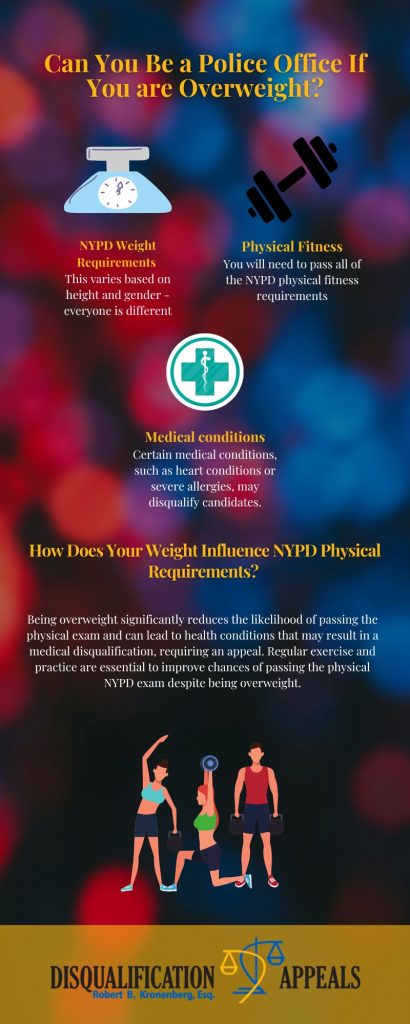
    Can You Become a Police Officer if You are Overweight?

    Many applicants preparing for the NYPD exam ask whether there are official NYPD weight requirements.

    The New York City Police Department evaluates candidates under established medical and physical standards, but it does not publish a strict weight chart that automatically disqualifies applicants. Instead, candidates must demonstrate that they meet NYPD medical standards and can successfully complete the required physical testing.

    Weight alone is rarely the sole deciding factor. What matters is whether a candidate satisfies NYPD health requirements and can safely perform the essential duties of the position.

    At Disqualification Appeals, we regularly assist candidates who receive a Notice of Proposed Disqualification, commonly referred to as an NOPD, after the medical review process. In some cases, weight-related health concerns may contribute to an NYPD medical disqualification.

    Your Weight and the NYPD Physical Fitness Requirements

    All applicants must complete the Physical Ability Test as part of the NYPD exam process. This evaluation measures whether candidates meet NYPD physical fitness requirements and can perform job-related tasks safely and effectively.

    The test includes:

    • Barrier surmount
    • Stair climb
    • Physical restraint simulation
    • Pursuit run
    • Victim rescue
    • Trigger pull assessment

    The focus is functional performance, not appearance. However, if weight significantly affects cardiovascular health, mobility, or endurance, medical examiners may request additional documentation or specialist evaluations before determining whether a candidate satisfies NYPD physical requirements.

    How Weight Can Influence a Proposed Medical Disqualification

    Although there are no fixed NYPD weight requirements, the medical evaluation examines overall health indicators such as blood pressure, cardiac function, and metabolic stability. If weight contributes to underlying medical conditions, including uncontrolled hypertension or cardiac abnormalities, those findings may result in a proposed medical disqualification.

    Candidates typically receive a Notice of Proposed Disqualification outlining the department’s concerns. An NOPD provides an opportunity to respond with supporting documentation before a final determination is made.

    It is important to understand that medical disqualification is only one of three categories candidates may face. Applicants may also receive a proposed psychological disqualification or a proposed character disqualification, depending on the findings during the NYPD character assessment, psychological review, or background investigation.

    Can You Appeal an NYPD Medical Disqualification?

    Yes, you can appeal an NYPD police application disqualification notice. An NYPD medical disqualification is not necessarily final.

    Candidates generally have the right to submit a formal response within a strict deadline. Appealing an NOPD often requires updated medical records, physician evaluations, and a detailed explanation addressing the findings cited by the department.

    Because these deadlines are firm, early review is critical. A carefully prepared appeal can clarify incomplete medical conclusions and demonstrate that you meet NYPD medical standards despite the initial determination.

    Disqualification Appeals assists candidates who are appealing a psychological disqualification, responding to an NYPD medical disqualification, or challenging other forms of NYPD disqualification. We review the proposed determination, analyze the supporting documentation, and prepare a structured response that addresses the department’s concerns directly.

    Do These Standards Apply Outside New York City?

    While this article focuses on NYPD requirements, similar medical and physical standards apply in surrounding jurisdictions. Candidates preparing for Nassau County Civil Service exams, the Nassau County Police exam, or the Suffolk County police exam should also expect medical screening requirements as part of the hiring process.

    Applicants for the Suffolk County police department exam or Nassau County Police test may face comparable review procedures if medical concerns arise.

    Speak With Disqualification Appeals About Your Options

    If you have received a Notice of Proposed Disqualification from the NYPD, or if you are concerned about how weight or health findings may affect your application, it is important to understand your options before the response deadline expires.

    Disqualification Appeals represents candidates throughout the five boroughs of New York City, including Bronx County, Kings County, New York County, Queens County, and Richmond County, as well as Nassau County and Suffolk County.

    Whether you are responding to a proposed medical disqualification, proposed psychological disqualification, or proposed character disqualification, our team evaluates the notice, explains your legal position, and helps prepare a timely and comprehensive appeal.

    If you have received an NOPD or are seeking guidance from an experienced NYPD disqualification appeal lawyer, contact Disqualification Appeals today to discuss your situation and determine the next appropriate step.

    photo of infographic about overweight police officers

    Related Readings 

    Prospective Police Officers and Social Media

    Can I Become an NYPD Officer Without a College Degree

  • Can Police Officers Drink Alcohol?

    Can Police Officers Drink Alcohol?

    If you are pursuing a career in law enforcement, you may find yourself asking a straightforward question. “Can police officers drink alcohol?” On its face, the answer appears simple. Police officers are adults, and adults may legally consume alcohol. However, within the context of law enforcement standards, background investigations, and disciplinary review, the issue becomes far more nuanced.

    At Disqualification Appeals, alcohol-related findings frequently arise in cases involving character determinations, psychological evaluations, or medical reviews. For applicants going through the Civil Service Law Enforcement exam process, as well as current officers facing scrutiny after an incident, alcohol-related conduct is rarely evaluated in isolation. Departments examine judgment, responsibility, candor, and overall fitness for public service.

    In some cases, alcohol-related concerns may be framed as character issues. In others, particularly where dependency or clinical findings are alleged, the matter may intersect with psychological or medical disqualification standards. Understanding how the agency categorizes the issue is often the first step in determining what options may be available.

    Can Police Officers Drink Alcohol Off Duty?

    In most jurisdictions, police officers are permitted to drink alcohol while off duty, provided they are of legal drinking age and comply with state law. There is no blanket prohibition on alcohol consumption simply because someone wears a badge.

    That said, departments commonly impose strict rules for off-duty police officers and drinking. Policies often address situations involving firearms, department-issued vehicles, and public representation of the agency. An officer who is off duty but carrying a weapon may be subject to internal regulations that restrict alcohol use. Similarly, officers attending public events in any official capacity may be limited in what they can consume.

    The distinction between lawful conduct and disqualifying conduct often turns on behavior. Moderate, lawful alcohol use is not inherently problematic. Public intoxication, disorderly behavior, bar fights, social media posts showing reckless conduct, or alcohol-related arrests may trigger internal review.

    For applicants, prior alcohol-related incidents are frequently examined during the background phase. Even if charges were dismissed or reduced, investigators may evaluate the surrounding circumstances. Agencies often consider whether the conduct reflects poor judgment, immaturity, or a pattern that could undermine public trust.

    Can Police Officers Drink on the Job?

    Police drinking on duty is almost universally prohibited. Departments maintain strict policies that forbid police drinking on the job, and violations can result in suspension, termination, or long-term career consequences.

    The reasoning is grounded in safety and public trust. Officers are expected to respond to emergencies, operate vehicles, carry firearms, and make split-second decisions. Alcohol impairs reaction time and judgment. Even minimal consumption while actively working may be considered unacceptable under departmental standards.

    There are limited exceptions in undercover contexts. In rare investigative scenarios, undercover officers may consume small amounts of alcohol to maintain cover. These situations are tightly regulated, documented, and supervised. They are not informal permissions to drink while working.

    If an officer is accused of police drinking on duty outside of such controlled circumstances, the matter typically becomes a serious internal disciplinary issue. For applicants, admissions of prior workplace drinking, even in non-law-enforcement roles, may be explored during character review as part of a broader evaluation of reliability and decision-making.

    Are Police Allowed to Drink in Uniform?

    The question of whether police are allowed to drink in uniform often arises because of public perception concerns. Most departments restrict officers from consuming alcohol while wearing a uniform or any identifiable insignia, even if technically off duty.

    Uniforms symbolize authority and public trust. An officer visibly drinking in uniform may create negative optics, even if no law is being broken. As a result, many agencies prohibit drinking while in uniform, while carrying department-issued equipment, or while representing the department at public functions.

    Applicants should understand that investigators may examine social media content during the background investigation. Photos or videos showing alcohol consumption while dressed in partial uniform or displaying badges can raise questions about judgment and professionalism.

    What About DUI or Alcohol-Related Arrests?

    One of the most significant issues arises when alcohol use results in arrest. Police drunk-driving cases carry serious implications because they directly involve public safety.

    For current officers, a DUI may trigger both criminal proceedings and internal disciplinary review. Departments evaluate whether the incident reflects a lapse in judgment or a broader pattern of misconduct. Sanctions may vary depending on departmental policy, prior record, and the severity of the offense.

    For applicants, a prior DUI can become central to the NYPD character assessment or similar evaluations in other jurisdictions. Agencies often examine factors such as:

    • The age of the applicant at the time of the offense
    • The blood alcohol content level
    • Whether there were injuries or property damage
    • Whether the required programs were completed
    • Whether there have been subsequent incidents

    A single event several years in the past does not automatically result in permanent disqualification. However, multiple alcohol-related arrests, failure to disclose prior charges, or inconsistencies during interviews can significantly complicate the process.

    Alcohol Use and Character Disqualification

    Alcohol consumption itself is not prohibited for police officers. The issue becomes whether the conduct surrounding alcohol reflects integrity, responsibility, and reliability.

    Character disqualification appeals often involve allegations such as a pattern of alcohol-related offenses, public intoxication incidents, domestic disturbances involving alcohol, dishonesty about prior alcohol-related arrests, or inconsistent statements during the background investigation.

    When an agency issues an NYPD disqualification tied to alcohol-related conduct, it is typically framed as a character concern rather than a medical or psychological issue. Unless there is a documented dependency or a clinical diagnosis involved, the matter generally falls under character disqualification appeals.

    This distinction matters. Medical disqualification appeals and NYPD psychological disqualification appeals involve different evidentiary standards, documentation requirements, and review processes. Alcohol-related misconduct without clinical findings usually aligns with character evaluation criteria.

    The Role of Candor During the Application Process

    One of the most common problems applicants face is not the underlying incident, but how it was disclosed.

    During the Civil Service Law Enforcement exam process and subsequent background investigation, applicants are required to provide complete and accurate information. Failure to disclose a prior alcohol-related arrest, even if sealed or dismissed, can create an independent basis for disqualification.

    Agencies frequently emphasize that honesty and transparency are core requirements of law enforcement service. An omission or minimization during the application process may be interpreted as dishonesty, which can weigh more heavily than the original incident itself.

    For this reason, applicants facing NYPD disqualification related to alcohol issues should carefully review the stated grounds before deciding how to proceed.

    When Alcohol Issues Intersect With Psychological or Medical Concerns

    In some cases, alcohol use may intersect with psychological or medical evaluations. For example, if an applicant failed the NYPD oral psych exam and the evaluation referenced substance-misuse concerns, the issue may shift toward NYPD psychological disqualification appeals.

    Similarly, documented alcohol dependency or medical findings could move the matter toward medical disqualification appeals rather than purely character-based review.

    How the agency categorizes the issue influences the type of documentation required and the strategy used in a disqualification appeal proceeding. What begins as an alcohol-related concern may evolve into a broader review of mental-health history or medical fitness, depending on the record.

    Understanding the Appeal Process

    If you received a Notice of Proposed Disqualification (NOPD) tied to alcohol-related conduct, you may have the right to pursue an administrative appeal. In New York law enforcement hiring, an NOPD is the formal document that explains why an agency believes an applicant does not meet the required standards. It outlines the stated grounds for disqualification and provides information about the response timeline.

    An NOPD is a proposed determination, not an automatic final decision. It signals that the agency has identified concerns, often framed under character, psychological, or medical standards, and is proposing to remove you from consideration. The appeal process allows you to respond with documentation, clarification, and supporting evidence before a final determination is issued.

    The appeal stage requires careful preparation and a clear understanding of how the agency reached its conclusion. Each situation depends on its specific facts. A single youthful mistake may be viewed differently from repeated incidents over time. Demonstrated maturity, consistent lawful behavior, and complete candor can become important factors in the review process.

    Disqualification Appeals is led by attorney Robert B. Kronenberg, who focuses on representing candidates in NYPD and civil-service disqualification matters, including character disqualification appeals, NYPD psychological disqualification appeals, and medical disqualification appeals. Each case depends on the record presented and the standards applied by the reviewing agency.

    If you were disqualified following the Civil Service Law Enforcement exam or during the NYPD character assessment process due to alcohol-related concerns, you may benefit from understanding your options before accepting the determination as final. To discuss your situation confidentially, call 631-234-4434 or contact Disqualification Appeals online today.

  • Learn More About NYPD Background Disqualifications Against Character Traits

    Learn More About NYPD Background Disqualifications Against Character Traits

    An NYPD background disqualification often centers on how the New York City Police Department evaluates an applicant’s character traits during the hiring process. When you receive a Notice of Proposed Disqualification, the department is stating that information uncovered during the background investigation raises concerns about your suitability for appointment.

    At Disqualification Appeals, many applicants seek guidance after learning that alleged negative character traits played a role in the proposed decision. Understanding how the NYPD character assessment process works and how those conclusions are formed is essential before deciding how to respond.

    What Is an NYPD Background Disqualification?

    An NYPD background disqualification occurs when investigators conclude that aspects of your history reflect patterns inconsistent with the standards required for law enforcement service. This review is part of the Civil Service Law Enforcement exam process and extends beyond criminal history.

    Investigators examine employment records, educational background, driving history, financial disclosures, prior legal matters, social media activity, and every statement made during the application process. The focus is not only on isolated events. It is on consistency, judgment, candor, and overall reliability.

    The department communicates its findings through a Notice of Proposed Disqualification, often referred to as an NOPD. The NOPD outlines the concerns identified and provides a deadline for response. It is a proposed determination that allows the applicant an opportunity to address the findings before a final decision is issued.

    What Are Character Traits in the NYPD Hiring Context?

    In general terms, character traits are consistent patterns of behavior that reflect personality and values. Positive character traits may include honesty, responsibility, accountability, and reliability. Negative character traits may include dishonesty, impulsivity, financial irresponsibility, or repeated disregard for rules.

    In the NYPD hiring context, however, character traits are not evaluated abstractly. Investigators look for documented behavior that supports or contradicts those traits. For example, an applicant may describe themselves as responsible, but unresolved debt, repeated employment terminations, or inconsistent disclosures may lead investigators to question that claim.

    The department is assessing whether the applicant’s traits and character align with the authority and discretion entrusted to police officers.

    How the NYPD Forms Character-Based Conclusions

    An NYPD character disqualification is rarely based on a single label. Instead, investigators review patterns across multiple areas.

    For example, financial issues may be examined not only for the existence of debt, but for how the applicant addressed it. Was there an effort to resolve obligations? Were there repeated defaults? Were explanations consistent?

    Similarly, prior arrests may be reviewed alongside disclosure behavior. Even if charges were dismissed, failure to disclose the incident during the background investigation may raise concerns about candor.

    In many cases, it is the combination of conduct and an inconsistent explanation that leads to a character finding. The NYPD character assessment often weighs honesty and transparency as heavily as the underlying conduct itself.

    Common Issues Leading to NYPD Character Disqualification

    An NYPD background disqualification tied to character traits is rarely based on a single flaw. It typically reflects a pattern that investigators believe raises questions about judgment, reliability, or candor. During the NYPD character assessment process, the department reviews conduct across multiple areas to determine whether concerns appear isolated or recurring.

    Repeated inconsistencies in disclosure often carry significant weight. When an applicant provides differing accounts of the same incident across written applications and interviews, investigators may interpret that as a lack of candor. Similarly, failing to disclose prior employment issues, arrests, or disciplinary actions, even if they occurred years earlier or were dismissed, can become central to a character-based finding. In many cases, the perceived omission is viewed more seriously than the underlying event.

    Financial history is also examined for patterns. Significant unresolved debt, repeated defaults, or unexplained discrepancies may raise concerns about responsibility and judgment. Social media activity can be evaluated in the same way. Public posts that contradict statements made during the background investigation may undermine credibility.

    The department is not simply identifying negative character traits in isolation. It is assessing whether the totality of the record reflects traits and character consistent with the authority and discretion required of a police officer. A single youthful mistake followed by years of stable conduct may be viewed differently from repeated incidents without evidence of change.

    Candor and Consistency as Central Factors

    One of the most significant factors in an NYPD background disqualification is candor. The department expects complete and accurate disclosure throughout the Civil Service Law Enforcement exam process.

    If an applicant minimizes an incident, fails to disclose prior employment, or provides inconsistent timelines, investigators may interpret that as dishonesty. In many cases, the perceived lack of candor becomes more significant than the original event.

    This is why reviewing the stated findings in the NOPD carefully is critical. Understanding whether the department’s concern is the underlying conduct or the manner in which it was disclosed will shape how a response should be prepared.

    Distinguishing Character from Psychological or Medical Findings

    Not every issue involving personality traits falls under character disqualification. If an applicant failed the NYPD oral psych exam and the evaluation referenced impulse control, emotional regulation, or behavioral stability, the matter may fall under NYPD psychological disqualification appeals rather than a background finding.

    Likewise, certain documented medical conditions may result in medical disqualification appeals instead of a character-based determination.

    The NOPD will typically clarify whether the department categorized the issue as character, psychological, or medical. This distinction affects both the documentation required and the strategy used in responding.

    Responding to a Notice of Proposed Disqualification

    If you receive a Notice of Proposed Disqualification based on character concerns, the first step is to review the stated findings carefully. The NOPD will outline the department’s reasoning and provide a response deadline. In many cases, applicants are given 30 days to submit written materials, although the specific timeframe will be stated in the notice.

    Before preparing a response, it is important to determine whether the department’s concern centers on the underlying conduct, the manner in which it was disclosed, or both. An NYPD background disqualification often turns on how investigators interpreted patterns in the record rather than on a single incident.

    A response should directly address the specific findings listed in the notice. This may involve clarifying factual inaccuracies, providing documentation that demonstrates resolution of past issues, explaining discrepancies in prior statements, or showing consistent lawful behavior since the cited events. The purpose is not to challenge the authority of the New York City Police Department. It is to demonstrate that the record does not support the conclusion that you lack the character traits required for service.

    If the proposed determination is sustained, character disqualification appeals may be available. These appeals require careful analysis of the investigative record and the standards applied in the NYPD background disqualification process. At Disqualification Appeals, cases involving character-based findings are reviewed by examining whether the department’s conclusions accurately reflect the applicant’s current fitness for service.

    Character Disqualification Appeals

    If the department sustains the proposed determination, applicants may pursue character disqualification appeals. These appeals require careful review of the NOPD, the investigative record, and the standards applied by the New York City Police Department.

    At Disqualification Appeals, cases involving NYPD background disqualification findings are evaluated by examining how the department interpreted the applicant’s conduct and whether that interpretation accurately reflects current fitness for service. Disqualification Appeals is led by attorney Robert B. Kronenberg, an NYPD disqualification appeal lawyer who focuses on character, psychological, and medical disqualification matters.

    Each case depends on its specific facts. The review process considers patterns, documentation, timing, and the applicant’s overall record. A structured, evidence-based response is often central to challenging a character-based determination.

    Moving Forward After an NYPD Background Disqualification

    Receiving an NYPD background disqualification based on character traits can feel discouraging. However, a Notice of Proposed Disqualification represents a proposed decision, not an automatic final outcome.

    Understanding how the NYPD evaluated your character traits, how those conclusions were formed, and how the findings are categorized is essential before deciding how to proceed. If you received an NYPD disqualification and are evaluating your options, you may benefit from reviewing the stated grounds carefully and responding within the required timeframe.

    To discuss your situation confidentially, call 631-234-4434 or contact Disqualification Appeals online today.


  • What Is a Notice of Proposed Disqualification (NOPD)?

    What Is a Notice of Proposed Disqualification (NOPD)?

    A notice of proposed disqualification is a formal written letter issued during the New York police hiring process. Often shortened to NOPD, this notice informs a candidate that a law enforcement agency intends to remove them from consideration unless a successful response is submitted within a limited period of time. If you received an NOPD from the New York City Police Department, also referred to as an NYPD disqualification notice, understanding exactly what this document is can mean the difference between becoming a police officer and not realizing your dreams.

    For applicants pursuing a career with the New York City Police Department (NYPD), receiving an NOPD can feel sudden and overwhelming. Many candidates assume that once they pass the Civil Service Law Enforcement exam, physical testing, interviews, and screening steps tied to admission into the NYPD police academy, they are close to joining a class. A notice of proposed disqualification signals that the department has identified concerns that could block that goal unless addressed through a formal appeal.

    Understanding what an NOPD means, why it is issued, and how the process works is essential for protecting your opportunity to move forward in the hiring process.

    At Disqualification Appeals, Robert B. Kronenberg, Esq., represents candidates across New York State who face proposed psychological disqualifications, proposed character disqualifications, or proposed medical disqualifications during the police hiring process. As a former New York City Police Captain and an experienced disqualification appeal attorney, Kronenberg brings operational knowledge and legal strategy to cases involving NYPD hiring decisions and civil service appeals.

    What Does a Notice of Proposed Disqualification Mean?

    A notice of proposed disqualification is not a final ruling. The word proposed matters. It reflects a preliminary determination by the NYPD or another New York civil service agency that a candidate may not meet appointment standards.

    The notice typically outlines:

    • The category or categories of concern
    • A summary of the findings
    • Instructions for submitting a written response
    • Deadlines for filing materials

    For NYPD applicants, this letter often represents the only opportunity to challenge the department’s conclusions before a final Notice of Disqualification is issued.

    Why the NYPD Issues Notices of Proposed Disqualification

    The New York City Police Department maintains strict hiring requirements because officers hold positions of public trust. When issues arise during screening, the department may issue an NOPD rather than immediately closing the application.

    Most notices fall into three major categories.

    Psychological Concerns

    A proposed psychological disqualification may follow interviews, written testing, or clinical evaluations. Factors can include treatment history, medication use, patterns in employment or relationships, or what candidates sometimes refer to as a failed NYPD oral psych exam. Departments evaluate whether an applicant demonstrates judgment, emotional stability, and reliability consistent with policing standards.

    Character and Background Concerns

    A proposed character disqualification usually grows out of the background investigation. These reviews involve background checks, examination of criminal records, honesty during interviews, driving history, employment performance, academic discipline, and financial responsibility. Some background checks might even uncover inconsistencies or omissions that trigger additional scrutiny.

    Some cases center on how past conduct is interpreted rather than on disqualifying behavior itself, which is why careful explanation and documentation often become critical during appeals.

    Medical Concerns

    Medical screening can result in records including information related to hearing or vision, orthopedic conditions, pulmonary or cardiac evaluations, or overall readiness for duty. When those findings lead to a proposed medical determination, candidates may pursue medical disqualification appeals supported by outside physicians or updated testing.

    In every category, the notice of proposed disqualification represents the department’s intent to disqualify unless the applicant can present information that changes that conclusion.

    How Long Do You Have to Respond to an NOPD?

    For most NYPD candidates, the deadline to respond to a notice of proposed disqualification is thirty days from the date of the letter.

    That window closes quickly when medical records, psychological evaluations, employment histories, or written explanations must be gathered. Missing the deadline often causes the proposed determination to become final, which can make it far harder to continue pursuing a career with the NYPD or another New York agency.

    Because of this, candidates should treat an NOPD as a serious legal matter rather than a routine administrative letter.

    What Happens After You Submit Your Response?

    After an NOPD response is filed, the hiring agency reviews the materials and decides whether to withdraw the proposed disqualification or proceed toward a final decision.

    If the NYPD issues a final Notice of Disqualification, additional administrative remedies may exist through the civil service commission review board. In some cases, matters proceed to hearings before commissions or boards that evaluate whether the department followed proper procedures and standards.

    Applicants from other jurisdictions across the state, including those tied to county departments or Nassau County Civil Service exams, may encounter similar structures.

    This multi-stage process is why the initial submission carries so much weight. A well-prepared response shapes how the case unfolds at every later phase.

    Why a Notice of Proposed Disqualification Should Never Be Ignored

    Some candidates assume the department has already made up its mind. Others hesitate because they are unsure how to respond or what documentation matters most.

    An NOPD formally opens the appeal window. Failing to act, submitting incomplete materials, or overlooking critical explanations can allow the proposed determination to become permanent.

    For candidates who invested months preparing for academy admission, ignoring a notice of proposed disqualification can mean losing the chance to begin the police career they worked toward.

    How Disqualification Appeals and Robert Kronenberg Help NYPD Candidates

    Once the foundation of the process is understood, candidates often seek legal guidance to navigate the complexity that follows.

    At Disqualification Appeals, Robert B. Kronenberg, Esq., represents applicants across New York State who face proposed psychological, character, and medical determinations during the hiring process for police officers. As a former New York City Police Captain and an experienced police disqualification attorney, Kronenberg understands how agencies evaluate applicants and what documentation and arguments carry weight during review.

    His work frequently involves analyzing the NOPD in detail, coordinating independent medical or psychological evaluations when appropriate, preparing written submissions, and ensuring deadlines are met. In complex cases, he may represent candidates during interviews or later administrative proceedings tied to NYPD disqualification challenges.

    Does an NOPD Apply Only to the NYPD?

    Although the term is most closely associated with the New York City Police Department, notices of proposed disqualification are used throughout New York civil service hiring systems.

    Municipal agencies, county departments, and other law enforcement organizations across the state rely on similar procedures. Whether a candidate is seeking a career with the NYPD or another agency, the need for a prompt and carefully prepared response remains the same.

    Speak With a Disqualification Appeal Attorney About Your NOPD

    If you have received a notice of proposed disqualification or an NOPD from the NYPD or another New York law enforcement agency, acting quickly can protect your opportunity to continue in the hiring process.

    Disqualification Appeals represents candidates facing:

    • A proposed psychological disqualification
    • A proposed character disqualification
    • Any medical disqualification determinations

    Robert Kronenberg works with qualified medical and psychological professionals when needed and prepares each case with the precision these matters demand.

    Call us at 631-234-4434 or contact us online today to schedule a free phone consultation and get additional information regarding how Disqualification Appeals can help you pursue the NYPD career you worked toward.