Category: Medical Disqualifications

  • NYPD Drug Disqualifications

    NYPD Drug Disqualifications

    Drug history, drug testing, and medication questions can create serious concerns for police candidates. NYPD drug disqualifications may involve a positive drug screening, prior substance use, prescription medication concerns, inconsistent disclosures, or missing information in the application record. For candidates applying to the New York City Police Department, the issue is not always limited to the substance itself. The department may also review whether the candidate was complete, accurate, and consistent during the hiring process.

    Our team at Disqualification Appeals helps candidates review Notice of Proposed Disqualification (NOPD) concerns involving medical disqualification, character disqualification, and psychological disqualification issues. When drug use, drug testing, or medication history becomes part of the record, the response should be careful, specific, and supported by documentation.

    Why Drug Issues Can Affect an NYPD Application

    Police candidates are evaluated for whether they meet the standards required for appointment. Drug-related concerns can appear during the medical review, background investigation, psychological review, or character assessment. A candidate may be questioned about illegal drug use, marijuana history, prescription medication use, steroid use, prior treatment, or inconsistencies between application answers and later records.

    That does not mean every past issue is reviewed the same way. The facts matter. The department may consider what substance was involved, when the use occurred, how often it occurred, whether the candidate disclosed it, whether the candidate passed required screening, and whether the record suggests a current concern.

    For many candidates, the biggest risk is assuming the issue is simple. A drug-related concern may be medical in one case and character-related in another. If the concern involves disclosure, the question may become whether the candidate was truthful and complete during the process.

    Does the NYPD Drug Test Candidates?

    Candidates should expect drug screening to be part of the NYPD hiring process. Official NYPD candidate materials state that applicants must pass a drug screening before appointment. The department’s hiring materials also describe drug testing during Police Academy training, at the end of probation as part of the medical examination, and in certain later circumstances.

    The specific testing method and timing may depend on the stage of the process and the department’s current procedures. Candidates should not rely on assumptions about what will or will not be tested. If drug screening becomes part of a disqualification issue, the exact records, results, notices, and explanations matter.

    What Happens If a Candidate Fails a Drug Screening?

    A failed or refused drug screening can create a serious barrier to appointment. Drug screening issues may be treated as a medical concern, a character concern, or both, depending on the facts and the agency record.

    Candidates should review the notice carefully before responding. The notice may identify whether the concern involves a positive screening, refusal, medication issue, prior drug use, disclosure problem, or another record-based concern. A response should address the specific issue raised, not simply argue that the candidate is otherwise qualified.

    Documentation may matter. Depending on the situation, relevant documents may include prescriptions, medical records, laboratory information, treatment history, employment records, or other materials that help explain the record. The goal is to clarify the issue and respond to the department’s stated concern.

    How Past Marijuana Use May Be Reviewed

    Past marijuana use can create confusion because state laws and workplace policies are not always the same. NYPD hiring materials state that prior substance use, including marijuana, is not automatically disqualifying and may be considered as part of the total background investigation. Those materials also state that candidates must pass drug screening before appointment and that NYPD employees are prohibited from drug use, including marijuana.

    For candidates, the important point is disclosure and context. A candidate should not assume that past marijuana use is irrelevant, and they should not assume that it automatically ends the process. The candidate’s record, timing, frequency of use, disclosure history, and test results may all matter.

    If marijuana history appears in a Notice of Proposed Disqualification, the response should be tied to the concern in the notice. A vague explanation may not be enough if the department is focused on inconsistencies, recent use, missing information, or a failed screening.

    Why Disclosure Can Matter as Much as the Drug History

    Drug-related issues often become more serious when the department believes the candidate did not disclose information fully. A candidate may think an old issue, rare use, dismissed matter, prescription, or prior treatment was not important. The department may instead focus on whether the candidate answered the question accurately.

    This can turn a drug issue into a character issue. If the background record shows information that does not match the candidate’s application, interview answers, or written explanations, the department may question the candidate’s honesty, judgment, or reliability.

    A strong response should address both parts of the issue. It should explain the drug-related concern and explain any disclosure issue connected to it. Ignoring the omission can make the response less useful.

    Prescription Medication, Steroids, and Medical Review

    Drug-related concerns are not limited to illegal substances. Prescription medication, anxiety medication, pain medication, stimulants, or steroid use may become relevant if the department questions whether the candidate can perform required duties or whether the medication was disclosed properly.

    The issue is not always the existence of a medication. The department may consider the diagnosis, treatment history, side effects, stability, dosage, supporting medical records, and whether the candidate followed lawful medical guidance. Misuse of medication or use of a prescription that was not issued to the candidate can raise different concerns.

    If medication history is part of a proposed medical disqualification, candidates should review what the department is actually questioning. The response may need to include medical documentation, prescribing records, treatment notes, or updated professional opinions.

    What Candidates Should Review Before Responding

    Before responding to NYPD drug disqualifications, candidates should review the notice, the stated basis for the concern, the drug screening record, application answers, interview statements, medical documentation, and any background materials tied to the issue.

    They should also look for inconsistencies. Did the candidate disclose the same information throughout the process? Did the candidate give one answer on an application and another answer during an interview? Did medical records or background records reveal something the candidate did not explain?

    These details matter because the response should be built around the actual record. A candidate in Bronx, Brooklyn, Manhattan, Queens, Staten Island, Nassau County, or Suffolk County may need to gather documents quickly if the notice includes a response deadline.

    When Should You Speak With a Lawyer?

    A candidate should consider speaking with an NYPD disqualification appeal lawyer when a drug-related issue leads to a Notice of Proposed Disqualification, a failed screening, a disclosure concern, or a medical or character review issue. These matters can be difficult because the response may need to address testing, past conduct, medical records, and consistency across the application record.

    Legal guidance does not guarantee an outcome. It can help candidates understand what the department is questioning, organize the records, identify relevant documentation, and prepare a response that speaks directly to the concern.

    Get Help With NYPD Drug Disqualification Concerns

    Drug-related disqualification issues should be reviewed carefully before a candidate responds or decides what to do next. A positive test, medication question, past use, or disclosure issue can affect how the New York City Police Department evaluates medical fitness, character, and overall eligibility.

    Disqualification Appeals works with candidates facing or having concerns about NYPD drug disqualifications, psychological disqualifications, character disqualifications, and medical disqualifications. If you received a Notice of Proposed Disqualification or need help understanding the record behind your drug-related disqualification issue, contact our team to discuss your next steps.


    Sources:

    NYPD Police Officer Hiring FAQs

    https://www.nyc.gov/site/nypd/careers/police-officers/OLD-faqs-hiring-pos.page    

    DCAS Police Officer Notice of Examination

    https://www.nyc.gov/assets/dcas/downloads/pdf/noes/20244308000.pdf 

    DCAS Personnel Services Bulletin 100-15

    https://www.nyc.gov/assets/dcas/downloads/pdf/reports/100_15.pdf

  • What Are the NYPD Weight Requirements?

    What Are the NYPD Weight Requirements?

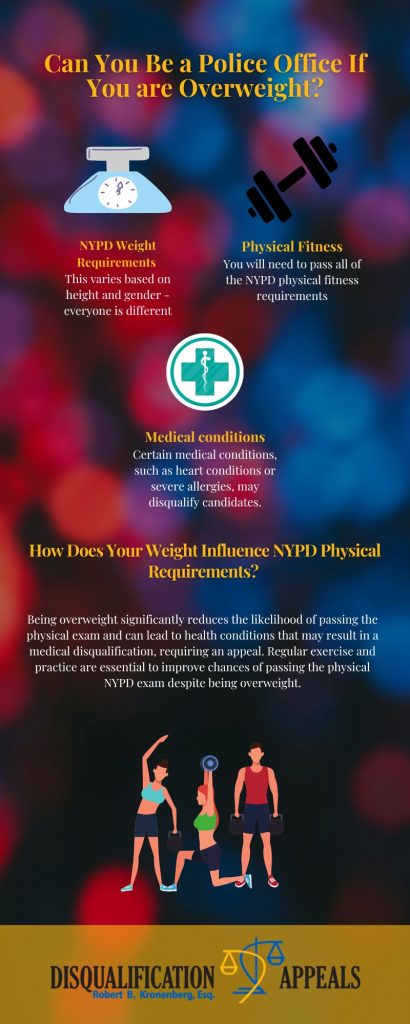
    Can You Become a Police Officer if You are Overweight?

    Many applicants preparing for the NYPD exam ask whether there are official NYPD weight requirements.

    The New York City Police Department evaluates candidates under established medical and physical standards, but it does not publish a strict weight chart that automatically disqualifies applicants. Instead, candidates must demonstrate that they meet NYPD medical standards and can successfully complete the required physical testing.

    Weight alone is rarely the sole deciding factor. What matters is whether a candidate satisfies NYPD health requirements and can safely perform the essential duties of the position.

    At Disqualification Appeals, we regularly assist candidates who receive a Notice of Proposed Disqualification, commonly referred to as an NOPD, after the medical review process. In some cases, weight-related health concerns may contribute to an NYPD medical disqualification.

    Your Weight and the NYPD Physical Fitness Requirements

    All applicants must complete the Physical Ability Test as part of the NYPD exam process. This evaluation measures whether candidates meet NYPD physical fitness requirements and can perform job-related tasks safely and effectively.

    The test includes:

    • Barrier surmount
    • Stair climb
    • Physical restraint simulation
    • Pursuit run
    • Victim rescue
    • Trigger pull assessment

    The focus is functional performance, not appearance. However, if weight significantly affects cardiovascular health, mobility, or endurance, medical examiners may request additional documentation or specialist evaluations before determining whether a candidate satisfies NYPD physical requirements.

    How Weight Can Influence a Proposed Medical Disqualification

    Although there are no fixed NYPD weight requirements, the medical evaluation examines overall health indicators such as blood pressure, cardiac function, and metabolic stability. If weight contributes to underlying medical conditions, including uncontrolled hypertension or cardiac abnormalities, those findings may result in a proposed medical disqualification.

    Candidates typically receive a Notice of Proposed Disqualification outlining the department’s concerns. An NOPD provides an opportunity to respond with supporting documentation before a final determination is made.

    It is important to understand that medical disqualification is only one of three categories candidates may face. Applicants may also receive a proposed psychological disqualification or a proposed character disqualification, depending on the findings during the NYPD character assessment, psychological review, or background investigation.

    Can You Appeal an NYPD Medical Disqualification?

    Yes, you can appeal an NYPD police application disqualification notice. An NYPD medical disqualification is not necessarily final.

    Candidates generally have the right to submit a formal response within a strict deadline. Appealing an NOPD often requires updated medical records, physician evaluations, and a detailed explanation addressing the findings cited by the department.

    Because these deadlines are firm, early review is critical. A carefully prepared appeal can clarify incomplete medical conclusions and demonstrate that you meet NYPD medical standards despite the initial determination.

    Disqualification Appeals assists candidates who are appealing a psychological disqualification, responding to an NYPD medical disqualification, or challenging other forms of NYPD disqualification. We review the proposed determination, analyze the supporting documentation, and prepare a structured response that addresses the department’s concerns directly.

    Do These Standards Apply Outside New York City?

    While this article focuses on NYPD requirements, similar medical and physical standards apply in surrounding jurisdictions. Candidates preparing for Nassau County Civil Service exams, the Nassau County Police exam, or the Suffolk County police exam should also expect medical screening requirements as part of the hiring process.

    Applicants for the Suffolk County police department exam or Nassau County Police test may face comparable review procedures if medical concerns arise.

    Speak With Disqualification Appeals About Your Options

    If you have received a Notice of Proposed Disqualification from the NYPD, or if you are concerned about how weight or health findings may affect your application, it is important to understand your options before the response deadline expires.

    Disqualification Appeals represents candidates throughout the five boroughs of New York City, including Bronx County, Kings County, New York County, Queens County, and Richmond County, as well as Nassau County and Suffolk County.

    Whether you are responding to a proposed medical disqualification, proposed psychological disqualification, or proposed character disqualification, our team evaluates the notice, explains your legal position, and helps prepare a timely and comprehensive appeal.

    If you have received an NOPD or are seeking guidance from an experienced NYPD disqualification appeal lawyer, contact Disqualification Appeals today to discuss your situation and determine the next appropriate step.

    photo of infographic about overweight police officers

    Related Readings 

    Prospective Police Officers and Social Media

    Can I Become an NYPD Officer Without a College Degree

  • Police Disqualification Appeal Beyond NYPD: Your Next Steps

    Police Disqualification Appeal Beyond NYPD: Your Next Steps

    Table of Contents

    • Where Appeals Happen Outside NYPD
    • Why Disqualifications Happen, and What Can Be Appealed
    • Step-By-Step to Start Your Appeal
    • Local Planning for NYC, Long Island, North Jersey, and Western CT
    • Q&A
    • Your Next Steps With Disqualification Appeals


    A police disqualification appeal is a formal response when a city, county, or state agency decides you are not moving forward. This guide focuses on agencies beyond the NYPD in the NYC region and nearby states, and it explains where appeals happen and how to start. Many medical or psychological exams occur after a conditional offer, which is why results late in the process can be decisive. That timing aligns with guidance from ADA.gov. Disqualification Appeals helps candidates understand deadlines, venues, and the records needed to present a clear case.

    Where Appeals Happen Outside NYPD

    New York City Region, but Beyond the NYPD

    The NYC Civil Service Commission hears disqualification appeals from city agencies, not only the police department. The Commission must receive your appeal within 30 days of the date on your notice, and your letter explains how to file. You can submit by mail, in person, or online. If you have questions, the NYC CSC Appeal FAQ is a helpful reference.

    New Jersey (for Nearby Applicants)

    The New Jersey Civil Service Commission accepts appeals for list removals and medical or psychological disqualifications. Many filings are due within 20 days unless your notice states a different timetable. Use the state’s portal to confirm your category and follow the steps exactly as listed on your letter.

    Pennsylvania (Eastern Counties Near the NYC Corridor)

    The Pennsylvania State Civil Service Commission confirms that job seekers may appeal and provides current forms and instructions. These resources explain what can be appealed and how a hearing works. Upload or include a copy of your notice and any exhibits the form requests so your record is complete from the start.

    Connecticut Municipal Commissions

    Some Connecticut cities hold civil service hearings on police exam disqualifications. The Bridgeport Civil Service Commission publishes public minutes that document appeals related to psychological and background decisions. Procedures can vary by city, so read your local notice closely before filing.

    GEO planning tip. Hearings and appointments may be near 1 Police Plaza in Lower Manhattan, PATH stations in Jersey City and Newark, or county buildings in Mineola, White Plains, and Bridgeport. Plan for traffic and security, bring printed packets, and leave a buffer in case a short-notice appearance is scheduled.

    Why Disqualifications Happen, and What Can Be Appealed

    Common issues include integrity concerns, psychological suitability calls, medical fitness questions, and background discrepancies. Different offices use different rules, so your letter and the venue’s page should guide each step.

    NYC also posts examples of determinations on the NYC Civil Service Commission Disqualification Determinations page, which can help you understand what reviewers considered and what you can submit to clarify the record. Use neutral phrasing like police officer disqualifications, police disqualifications, disqualifications for becoming a police officer, and disqualifications for police officers to frame the issue without assuming a single standard.

    Because many exams take place after a conditional offer, late results may trigger a police disqualification appeal rather than an early rejection.

    Step-By-Step to Start Your Appeal

    First 48 hours

    Start by reading the notice carefully and putting the deadline on your calendar. In NYC, the NYC Civil Service Commission often sets a 30-day window. In New Jersey, the New Jersey Civil Service Commission shows many actions within 20 days. Your notice controls the clock. Request your file if allowed, identify the venue, and confirm the format and delivery method before you write your statement.

    Build a Focused Packet

    Write a short cover letter that states the decision and the reason quoted from your notice. Attach proof that clarifies or corrects the record, such as court dispositions, updated medical or psychological notes, or job references. Keep dates and addresses consistent across every page.

    For context, you can review NYPD disqualification, NYPD psych disqualification reasons, and NYPD character assessment on the client site, but do not copy NY rules into another state’s appeal.

    Submit and Track

    Use the venue’s required form, address, and format. Track mailing or delivery and save copies of everything you send. When you complete the portal or cover sheet, select the option labeled appeal disqualification if that matches your notice, and follow the venue’s filing steps exactly.

    The Pennsylvania State Civil Service Commission and the New Jersey Civil Service Commission provide official forms and portals you can review for structure and exhibit labels, which can help you organize a clean submission even if you are filing in another venue.

    Local Planning for NYC, Long Island, North Jersey, and Western CT

    Know where your hearing might be and budget extra travel time. NYC hearings may occur near the Civic Center, while Nassau and Suffolk have county offices that follow their own civil service rules. Suffolk County publishes Rule 8 on disqualification through the Suffolk County Department of Civil Service. Westchester County posts its civil service framework through Westchester County Human Resources. These pages explain local structures without promising outcomes.

    Q&A

    Do Appeals Exist for Police Disqualifications Outside the NYPD?

    Yes. The NYC Civil Service Commission, the New Jersey Civil Service Commission, and the Pennsylvania State Civil Service Commission all provide paths to appeal. Some Connecticut cities, like the Bridgeport Civil Service Commission, do too. Your notice sets the deadline and filing method for your case.

    How Fast Do I Need to File a Police Disqualification Appeal?

    Deadlines are short. The NYC Civil Service Commission must receive your appeal within 30 days of the date on your notice. The New Jersey Civil Service Commission shows many actions with a 20-day filing window. File early, keep proof of delivery, and follow the venue’s instructions line by line.

    Can Cities Like Bridgeport Hold Police Appeal Hearings?

    Yes. The Bridgeport Civil Service Commission publishes minutes that show appeals of police exam disqualifications, including psychological and background cases. This confirms that local appeal systems exist in nearby Connecticut cities. Check your city’s site for meeting schedules and filing instructions.

    Your Next Steps With Disqualification Appeals

    If your notice came from an agency beyond NYPD and you need a plan, Disqualification Appeals can review your packet and map next steps that match your venue’s rules. Speak with an experienced NYPD disqualification appeal lawyer who knows how to present evidence clearly across jurisdictions. This is the safest way to appeal a police disqualification without missing key steps.

    Contact Disqualification Appeals today for a free consultation to review your notice, build a focused police disqualification appeal, and plan next steps across NYC, Long Island, North Jersey, and nearby Connecticut and Pennsylvania. For clear guides on appeals, psych reviews, and timelines, read the Disqualification Appeals blog.

  • Does Being Prescribed ADHD Medication Affect NYPD Eligibility?

    Does Being Prescribed ADHD Medication Affect NYPD Eligibility?

    Taking ADHD medication does not automatically disqualify you from joining the NYPD. However, it can trigger a closer review during the NYPD psychological evaluation ADHD process. Eligibility often depends on your overall medical history, how well your condition is managed, and whether the medication affects your ability to perform essential duties.

    Disqualification Appeals helps applicants facing ADHD prescription and NYPD disqualification issues protect their eligibility and appeal unfair rejections.

    Table of Contents

    • How the NYPD Views ADHD and Medication Use
    • When ADHD Medication Could Affect Eligibility
    • NYPD Psychological Evaluation for ADHD
    • ADHD and Law Enforcement Careers Beyond the NYPD
    • Steps to Take If You’re Facing an ADHD-Related Disqualification
    • How Disqualification Appeals Can Help
    • Final Thoughts and Next Steps

    How the NYPD Views ADHD and Medication Use

    The NYPD does not have a blanket ban against applicants who take ADHD medication, but they do review these cases carefully. 

    Instead, evaluators look closely at how the condition is currently managed, whether it interferes with judgment or performance, and if medication is being used responsibly. 

    In most cases, the main question isn’t whether ADHD medication disqualifies you from the NYPD, but rather whether your condition and treatment impact your ability to serve effectively. What matters most is whether an applicant can demonstrate stability and the ability to perform under the demands of the job.

    When ADHD Medication Could Affect Eligibility

    While many applicants with ADHD pass the hiring process, there are situations where ADHD medication could raise concerns:

    • A recent diagnosis with limited stability on treatment.
    • Side effects that affect performance or safety.
    • Incomplete or inconsistent medical documentation.
    • History of related mental health issues.

    These factors can lead to a police job disqualification decision due to ADHD medication unless addressed with thorough evidence and expert testimony.

    NYPD Psychological Evaluation for ADHD

    The NYPD psychological evaluation and ADHD review are part of the standard hiring process. It typically includes reviewing your medical history and prescription records, speaking with your treating physician, conducting psychological tests to assess decision-making, stress management, and focus, and evaluating your overall suitability for the demands of police work.

    An NYPD disqualification can occur if evaluators believe ADHD treatment impacts your readiness for duty, even if you disagree with their conclusion.

    ADHD and Law Enforcement Careers Beyond the NYPD

    ADHD and law enforcement careers are not mutually exclusive. Many agencies evaluate candidates based on performance rather than diagnosis alone. Stable, well-managed ADHD is often not a barrier. 

    Clear documentation from medical professionals can strengthen your application. If you can illustrate a strong work history, training performance, and positive references, these items can often outweigh medication concerns.

    This means even if you encounter challenges with the NYPD, other law enforcement agencies may still find you eligible.

    Steps to Take If You’re Facing an ADHD-Related Disqualification

    If you’ve been told that ADHD medication could impact your eligibility:

    • Request Your Records: Get copies of the NYPD’s evaluation and any notes on the decision.
    • Get a Physician’s Statement: Ask your doctor to provide a detailed letter on your stability and functional ability.
    • Collect Performance References: Use letters from past employers or instructors to show reliability and competence.
    • Seek Legal Representation: An NYPD disqualification appeal lawyer can guide you through the appeal process and help counter unfair conclusions.

    How Disqualification Appeals Can Help

    Disqualification Appeals has extensive experience helping applicants challenge ADHD prescriptions and NYPD disqualification decisions.

    Their team can review your medical and psychological evaluation for errors, connect you with medical experts for updated assessments, and prepare a compelling appeal package for maximum impact.

    By combining medical evidence with legal strategy, they help applicants protect their eligibility for law enforcement careers.

    Final Thoughts and Next Steps

    Taking ADHD medication does not mean you’re automatically disqualified from the NYPD. The key is showing that your condition is stable, well-managed, and does not interfere with your ability to perform police duties.

    Key takeaways:

    • The NYPD evaluates cases individually. There’s no automatic disqualification for ADHD medication.
    • Detailed medical documentation can make the difference.
    • Legal representation can strengthen your appeal and protect your career.

    If you’ve been told that ADHD medication could impact your eligibility, contact us at Disqualification Appeals today. For more insights on law enforcement eligibility and appeal strategies, check out our blog for more information.

  • Can You Be a Police Officer With Hearing Loss?

    Can You Be a Police Officer With Hearing Loss?

    Hearing is a vital sense in law enforcement, but many aspiring candidates wonder: Can you be a police officer with hearing loss? The answer isn’t always simple, and it often depends on the severity of the hearing loss, whether it’s correctable, and how individual agencies interpret medical standards.

    At Disqualification Appeals, we work with candidates who’ve been told their hearing disqualifies them from serving, especially in competitive departments like the NYPD. This guide breaks down the medical hearing requirements, your rights as an applicant, and what to do if you’re facing disqualification because of a hearing issue.

    Why Hearing Is Essential in Law Enforcement

    Effective hearing is critical to safe and responsive policing. Officers must be able to detect sounds like approaching vehicles, shouted commands, and subtle auditory cues during high-stress encounters. Because of this, most departments enforce strict police hearing requirements to ensure candidates are physically prepared for the job.

    The minimum hearing requirements for police are intended to guarantee that officers can perform key duties in dynamic and potentially dangerous environments. Whether responding to a call for backup or conducting a roadside stop, clear auditory processing can directly impact public and officer safety.

    If you’re pursuing a career as a police officer with hearing loss, understanding how these requirements apply to your situation is the first step in preparing for the application process.

    How Departments Test Hearing for Police Candidates

    Every police department, including the NYPD, uses a standardized medical screening process to evaluate candidates. Among these evaluations is a comprehensive hearing test for police officers, which typically includes pure-tone audiometry to assess hearing sensitivity across various frequencies.

    The goal is to determine whether a candidate’s hearing meets the minimum hearing requirements for police, both with and without the use of hearing aids or assistive devices. Results that fall below acceptable levels may trigger a police officer’s medical disqualification, even if the candidate feels fully capable of performing the role.

    Departments vary in how they interpret these test results. For example, during the NYPD exam, an audiological review is part of the larger medical exam and may result in an NYPD medical disqualification if hearing thresholds do not meet departmental standards. But being disqualified doesn’t always mean the end of your journey, especially if your condition is manageable or misclassified.

    Can You Be a Police Officer With Hearing Loss?

    Yes, in many cases, you can still become a police officer with hearing loss, depending on the degree of your condition and the accommodations available. Departments across the country are increasingly open to applicants who use hearing aids or have undergone corrective procedures as long as their performance meets essential job standards.

    The key question is: Can you be a police officer with hearing loss and still safely and effectively perform the required duties? If the answer is yes, then many departments, including the NYPD, may allow you to proceed through the application process pending medical approval.

    Some candidates use hearing aids to meet the necessary thresholds during the NYPD exam, while others may pass the initial tests but later face scrutiny during follow-up screenings. Regardless of where you are in the process, it’s important to know your rights and not give up if your hearing is manageable with support.

    When Hearing Loss Triggers a Disqualification

    Unfortunately, not all cases of hearing loss are viewed equally during the application process. Some candidates may receive a medical rejection, even if they believe they can meet all job demands. An NYPD disqualification due to hearing loss can stem from test results that fall below the set thresholds or from an incomplete understanding of a candidate’s assistive devices or treatment history.

    Departments often issue an NYPD medical disqualification based on a strict interpretation of audiometric data without considering whether the hearing loss is correctable or whether the applicant has functioned successfully in similar roles. That’s why it’s so important to respond quickly and knowledgeably when a disqualification notice is issued.

    At Disqualification Appeals, we regularly represent clients who’ve been told they can’t be police officers with hearing loss, helping them gather the necessary documentation to prove otherwise and challenge the decision through formal appeals.

    How to Appeal a Hearing-Based Disqualification

    Receiving a disqualification due to hearing loss can be frustrating, but it doesn’t have to be final. If you’ve been disqualified from the NYPD exam or another department due to hearing standards, you have the legal right to appeal. This process involves submitting updated medical evaluations, documentation from certified audiologists, and legal arguments demonstrating your fitness for duty.

    Navigating an appeal successfully requires more than just paperwork. It requires a clear strategy. Working with an experienced NYPD disqualification appeal lawyer can significantly improve your chances of overturning a decision, especially if the original disqualification was based on misinterpreted or outdated information.

    Disqualification Appeals has extensive experience helping clients challenge decisions related to medical and hearing-based disqualifications. Whether you’re at the beginning of the process or responding to a recent rejection, we’re here to guide you every step of the way.

    Take the Next Step: Don’t Let Hearing Loss Stop You

    Being a police officer with hearing loss is possible—and in many cases, disqualifications can be challenged and overturned. If you’ve been told your hearing makes you ineligible, don’t give up without understanding your rights and options.

    At Disqualification Appeals, we believe every qualified candidate deserves a fair review. If you’re facing a medical disqualification, contact us today to discuss your case and start the appeal process with experienced legal guidance.

    For more information on medical disqualifications, hearing standards, and the NYPD exam, check out our blog for expert insights and up-to-date resources designed to help you protect your future in law enforcement.

  • Can You Be a Police Officer With Bad Vision?

    Can You Be a Police Officer With Bad Vision?

    Becoming a police officer with bad vision is a common concern for applicants hoping to serve in law enforcement. Vision is a critical component of the job, and agencies like the NYPD and others nationwide enforce strict medical standards during the recruitment process. But does having less-than-perfect eyesight mean your dream is over?

    At Disqualification Appeals, we help candidates navigate complex disqualification issues, especially those related to vision and medical exams. If you’ve been told your eyesight might hold you back, don’t give up. This guide explains what to expect, what’s required, and how you can fight back if you’re unfairly disqualified due to vision concerns.

    Why Vision Standards Matter in Law Enforcement

    Whether it’s reading license plates from a distance, assessing threats in fast-moving situations, or accurately identifying suspects, law enforcement officers rely on their vision every day. That’s why vision standards for law enforcement are taken seriously across agencies nationwide.

    The job requires clear, reliable eyesight under a range of conditions. Even with technological support, an officer’s ability to see accurately and respond quickly can be the difference between a safe resolution and a dangerous outcome. Meeting the police officer’s vision requirements isn’t just about checking a box. It’s about ensuring you’re fully capable of handling the responsibilities of the role.

    If you have bad vision and you’re pursuing a career as a police officer, understanding how these standards apply to your situation is the first step toward overcoming potential obstacles.

    Understanding the Vision Requirements for Police Officers

    Every law enforcement agency sets its own criteria, but most follow similar guidelines when it comes to eyesight. In general, candidates must meet a minimum standard of uncorrected and corrected vision, both to ensure personal safety and to fulfill job duties effectively.

    For example, the NYPD exam includes a thorough medical screening, where vision is tested under strict protocols. Many agencies require a minimum of 20/40 vision in each eye, corrected to 20/20 with glasses or contact lenses. Some departments may disqualify candidates who don’t meet the minimum vision for police without corrective surgery or if they have specific eye conditions.

    Whether you’re dealing with nearsightedness, farsightedness, or astigmatism, understanding the eyesight requirements for police officers will help you prepare and know what to expect during your eye exam and police application process.

    Can You Become a Police Officer With Bad Vision?

    Yes, in many cases, you can still become a police officer as long as your eyesight is correctable to meet departmental standards. Most agencies, including the NYPD, allow the use of glasses or contact lenses to reach the required visual acuity. Many officers on the job today rely on corrective lenses daily.

    However, some conditions, like severe amblyopia or certain degenerative eye diseases, can raise red flags during the police vision test. In these cases, candidates may be medically disqualified, even if their vision is somewhat correctable. That’s where procedures like LASIK or PRK come into play. Many departments accept applicants who have undergone corrective eye surgery, provided they meet recovery and stability requirements.

    If you’re unsure about your eligibility, don’t assume the worst. Agencies have differing interpretations of what qualifies as disqualifying, and applicants often get denied based on misreadings or overly strict reviews. That’s where Disqualification Appeals can step in to protect your rights and help you challenge unfair decisions.

    When Vision Issues Lead to Disqualification

    Even with correctable vision, some candidates find themselves facing disqualification during the hiring process. Whether it’s due to a failed police vision test, outdated prescriptions, or medical misunderstandings, being labeled unfit can feel like a career-ending blow.

    This is especially true in cases involving an NYPD disqualification. The NYPD applies strict medical screening standards, and any failure to meet them, especially during the eye exam police application, can result in a disqualifying letter. However, not all disqualifications are final, and many are based on technicalities, incomplete documentation, or misinterpretations of medical records.

    At Disqualification Appeals, we’ve assisted countless candidates who were told, “You can’t become a police officer with bad vision,” by helping them challenge the decision successfully. Understanding your rights and acting quickly is critical if you believe your disqualification was unjustified.

    How to Appeal a Vision-Based Police Disqualification

    If you’ve been disqualified due to a vision-related issue, you have the right to appeal, and doing so with the right support can make all the difference. The appeals process involves submitting updated medical documentation, expert evaluations, and a formal challenge to the agency’s initial determination.

    For those facing an NYPD disqualification, timing is everything. You’ll need to act quickly and thoroughly to gather supporting evidence, correct any errors, and present your case. Working with an experienced NYPD disqualification appeal lawyer ensures that your appeal is both professionally prepared and strategically framed.

    At Disqualification Appeals, we specialize in representing candidates who’ve been unfairly denied a law enforcement career. From challenging NYPD exam results to advocating for clients who were told they couldn’t be police officers with bad vision, our legal team is here to fight for your future.

    Don’t Let Vision Disqualify Your Future in Law Enforcement

    If you’ve been told you can’t become a police officer with bad vision, don’t assume that’s the end of the road. Many disqualifications are challengeable, especially when based on outdated information, inconsistent evaluations, or a misunderstanding of your medical condition.

    At Disqualification Appeals, we believe that qualified, dedicated candidates deserve a fair shot, regardless of vision challenges. If you’ve received a medical disqualification or failed the police vision test, contact us today to discuss your options. Disqualification Appeals has helped candidates just like you appeal decisions, correct records, and move forward in the hiring process.

    For more guidance on navigating police disqualifications, check out our blog for updates, expert advice, and helpful resources on the NYPD exam, vision appeals, and more.


    Related Readings: 

  • Mental Health Resources for NYPD Members

    Mental Health Resources for NYPD Members

    NYPD officers face unique challenges that can impact their mental well-being. The high-stress nature of police work, plus exposure to traumatic incidents, contributes to anxiety, depression, and post-traumatic stress disorder (PTSD).

    Access to mental health resources is essential. It ensures officers receive the support they need to maintain their well-being and perform their duties effectively. Disqualification Appeals understands the importance of mental health care and how it can impact an officer’s career.

    What Mental Health Resources Are Available for NYPD Officers?

    NYPD members have access to a variety of mental health resources. This includes internal department services and external programs designed specifically for law enforcement personnel. The NYPD offers peer support networks, crisis intervention teams, and wellness programs. These programs were created to assist officers in managing job-related stress.

    Additionally, officers can access independent mental health professionals who specialize in working with first responders. Many of these services provide confidential support, ensuring that officers feel safe seeking help without fear of career repercussions.

    Officers can also benefit from specialized workshops that focus on stress management, emotional resilience, and effective coping strategies. These sessions, often led by mental health professionals experienced in working with law enforcement, help officers process their experiences. They also help the officers develop techniques for managing on-the-job stress more effectively.

    How Can NYPD Officers Access Confidential Counseling?

    Confidentiality is a critical aspect of mental health care. This is especially true for law enforcement officers who may fear stigma or job-related consequences. The NYPD Employee Assistance Unit (EAU) provides free, confidential counseling services to officers and their families.

    Additionally, organizations such as CopLine offer 24/7 crisis hotlines staffed by retired officers. Their experience helps them understand the challenges of the job. Independent therapy options are also available. These sessions allow officers a greater degree of privacy.

    For officers looking for more flexibility, online counseling platforms that cater to law enforcement provide another form of support. These services enable officers to connect with licensed therapists via video calls or messaging. Being online makes it easier to access professional help discreetly and on their own schedules.

    Why Is Mental Health Support Important for NYPD Members?

    Policing in a city as dynamic as New York presents significant psychological challenges. Officers routinely encounter high-pressure situations, from violent crimes to large-scale emergencies. Without proper mental health care, these experiences can lead to burnout, substance use, and long-term psychological distress.

    Mental health resources help officers to be more resilient, have better decision-making skills, and they also help them maintain their ability to serve the public safely and effectively.

    Recognizing the emotional toll of police work, some departments have started integrating mindfulness training and stress-reduction techniques into their professional development programs. Teaching officers how to manage stress before it escalates can lead to better mental health outcomes. It can also help with overall job satisfaction.

    What Programs Help NYPD Officers Manage Stress?

    The NYPD offers several stress management initiatives designed to support officer wellness. The department’s peer support program connects officers with colleagues trained to provide emotional support and guidance.

    Mindfulness and resilience training programs teach officers techniques for managing stress and improving overall well-being. Fitness and wellness initiatives, including exercise programs and nutrition guidance, also play a crucial role in promoting mental health. By using these programs daily, officers can better cope with the demands of the job.

    Some officers also find relief in alternative stress management techniques. These techniques can include yoga, meditation, and breathing exercises. Each of these methods has been shown to help reduce anxiety and improve focus. Providing access to these resources helps officers develop personalized stress management strategies tailored to their unique needs.

    Are There PTSD Resources Specifically for NYPD Officers?

    PTSD is a significant concern for law enforcement officers, particularly those who have experienced traumatic events on duty. The NYPD provides access to trauma-informed therapists who specialize in treating first responders.

    Officers with PTSD can seek support through organizations such as Blue H.E.L.P.. This organization focuses on suicide prevention and mental health advocacy for law enforcement personnel. Crisis intervention services and structured therapy programs help officers process trauma and develop coping strategies to mitigate its effects.

    Support groups for officers with PTSD provide a community where individuals can share their experiences. They can also find additional coping strategies in a safe environment. These groups allow officers to connect with others facing similar challenges, fostering a sense of understanding and representation.

    Get the Support You Need With Disqualification Appeals

    Mental health evaluations can sometimes lead to disqualifications that impact an officer’s career. Disqualification Appeals specializes in psychological, character, and medical disqualifications, helping law enforcement professionals challenge unfair decisions. Attorney Robert B. Kronenberg, Esq. has extensive experience assisting NYPD officers with the appeals process. If you need guidance on protecting your career, contact us online or call 631-234-4434 for a consultation.

  • The Thin Blue Line – Police and Mental Health

    The Thin Blue Line – Police and Mental Health

    Police officers face immense challenges on the job, from responding to high-stress situations to witnessing traumatic events. These experiences can take a significant toll on mental health, affecting both job performance and personal well-being.

    Addressing mental health in law enforcement is critical for maintaining officer wellness and ensuring public safety. Disqualification Appeals understands the importance of mental health evaluations and how they can impact an officer’s career.

    Why Is Mental Health Important for Police Officers?

    The nature of police work exposes officers to high levels of stress, trauma, and unpredictable danger. Over time, untreated mental health issues can lead to burnout, anxiety, depression, and even post-traumatic stress disorder (PTSD). 

    Poor mental health can also affect decision-making, reaction times, and relationships with colleagues and the community. Prioritizing mental health helps officers remain effective in their roles while improving their overall well-being.

    What Mental Health Challenges Do Police Officers Face?

    Police officers frequently encounter traumatic situations, such as violent crimes, fatal accidents, and life-threatening encounters. These experiences can result in cumulative stress that appear as post-traumatic stress disorder (PTSD), anxiety disorders, depression, emotional exhaustion, and substance use as a coping mechanism.

    Sleep disorders and chronic fatigue are also common among officers who experience prolonged exposure to high-stress situations. Unfortunately, often, the stigma surrounding mental health in law enforcement prevents officers from seeking the support they need.

    Many officers struggle with hypervigilance, a state of heightened alertness that makes it difficult to relax even when off duty. This can lead to chronic stress, affecting both their personal and professional lives.

    The unpredictable nature of police work also contributes to emotional detachment, as officers may suppress emotions to remain composed in difficult situations. Over time, these coping mechanisms can negatively impact mental well-being, relationships, and overall job satisfaction.

    How Can Police Departments Support Officer Mental Health?

    Law enforcement agencies play a crucial role in fostering a culture of mental wellness. Departments can support officers by implementing mental health training programs that educate personnel on stress management and resilience. Encouraging peer support networks allows officers to openly discuss challenges with colleagues who understand their experiences. 

    Confidential counseling services ensure that officers have access to professional mental health resources without fear of repercussions. Additionally, routine mental health screenings help detect and address concerns before they escalate, improving both officer well-being and workplace morale.

    Departments should also prioritize family support initiatives, as the impact of a police officer’s stress extends beyond the workplace. Programs that involve families in mental health awareness can help create a stronger support system at home, making it easier for officers to manage stress.

    Providing supervisors with training on recognizing signs of mental health struggles can also enhance early intervention efforts and create a healthier work environment.

    What Resources Are Available for Police Mental Health?

    Several organizations and programs provide mental health support for law enforcement personnel. The National Alliance on Mental Illness (NAMI) offers mental health resources and support groups, while CopLine operates a confidential crisis hotline for officers needing immediate assistance.

    The Fraternal Order of Police (FOP) provides wellness programs and mental health training. Many agencies offer Employee Assistance Programs (EAPs) to support their personnel, including the Employee Assistance Unit at the NYPD. These resources help officers manage stress, address trauma, and seek professional help when needed.

    For officers seeking a more individualized approach, some organizations provide specialized therapy tailored to the unique experiences of law enforcement personnel. Programs like resiliency training and stress debriefing sessions can equip officers with tools to better handle the psychological demands of their jobs.

    How Does PTSD Affect Law Enforcement Officers?

    PTSD is a common yet often overlooked issue among police officers. Constant exposure to traumatic events can lead to intrusive thoughts, flashbacks, and emotional distress. Officers experiencing PTSD may struggle with hypervigilance, difficulty sleeping, and avoidance behaviors.

    Left untreated, PTSD can have serious consequences on an officer’s career, relationships, and quality of life. Seeking professional help, engaging in therapy, and utilizing peer support can significantly improve an officer’s ability to cope with PTSD. Agencies that prioritize PTSD awareness and treatment help create a healthier work environment for their personnel.

    PTSD can also manifest in physical symptoms, such as chronic headaches, muscle tension, and digestive issues. These physiological responses to stress can further impact an officer’s ability to function effectively on the job. Addressing PTSD through early intervention and evidence-based treatments can help officers regain stability and continue serving their communities with confidence.

    Protecting Your Career With Disqualification Appeals

    Mental health evaluations can sometimes lead to disqualifications, affecting an officer’s ability to serve. Disqualification Appeals specializes in psychological, character, and medical disqualifications, helping law enforcement professionals challenge unfair decisions. Attorney Robert B. Kronenberg, Esq. has extensive experience assisting officers with the appeals process. If you need guidance on protecting your career, contact us online or call 631-234-4434 for a consultation.

  • Can You Become a Police Officer With PTSD?

    Can You Become a Police Officer With PTSD?

    For individuals with post-traumatic stress disorder (PTSD), pursuing a career in law enforcement may seem daunting. PTSD, a mental health condition triggered by traumatic events, can affect an individual’s emotional well-being, decision-making, and stress management. Naturally, candidates with PTSD may wonder whether their condition will disqualify them from joining the police force, especially an agency like the NYPD.

    Below, Disqualification Appeals explores whether you can become a police officer with PTSD, the types of PTSD that may affect eligibility, and steps applicants can take to improve their chances of success.

    What Is PTSD?

    Post-traumatic stress disorder (PTSD) develops in individuals who have experienced or witnessed a traumatic event, such as combat, abuse, or a life-threatening accident. Symptoms of PTSD often include flashbacks, anxiety, hypervigilance, and difficulty concentrating. There are several types of PTSD, each with varying impacts on an individual’s mental health:

    • Acute PTSD: Symptoms last less than three months.
    • Chronic PTSD: Symptoms persist for longer than three months.
    • Complex PTSD: Arises from prolonged trauma, often involving abuse or neglect.
    • Comorbid PTSD: Occurs alongside other mental health disorders, such as depression or anxiety.

    Understanding these distinctions is important when evaluating how PTSD may affect one’s suitability for a career in law enforcement.

    Can You Become a Police Officer With PTSD?

    The short answer is yes. Having PTSD does not automatically disqualify you from becoming a police officer. However, the condition must be well-managed, and it should not impair your ability to perform the essential duties of the role. Law enforcement agencies, including the NYPD, require all candidates to undergo psychological evaluations as part of the hiring process. These evaluations assess mental fitness, including the ability to handle stress, make sound decisions, and interact effectively with the public.

    For applicants with PTSD, agencies will evaluate whether the condition is under control through treatment, such as therapy or medication. Demonstrating effective coping mechanisms and a stable mental state is crucial to passing the psychological evaluation.

    How Does PTSD Affect Law Enforcement Work?

    Police work involves high-pressure situations that can exacerbate PTSD symptoms, such as hypervigilance or difficulty managing stress. Officers must remain calm and focused during emergencies, interact with diverse communities, and handle emotionally charged situations. PTSD could pose challenges in these areas if not properly managed.

    However, many individuals with PTSD develop resilience and coping strategies that make them highly effective in stressful environments. For example, therapy and stress management techniques can help applicants prepare for the demands of the job.

    Steps to Take If You Have PTSD

    If you have PTSD and aspire to become a police officer, there are proactive steps you can take to strengthen your application:

    • Seek Professional Treatment: Work with a licensed therapist or counselor to manage your symptoms effectively. Consistent treatment demonstrates your commitment to mental health.
    • Document Your Progress: Keep records of your treatment and progress, including any evaluations from mental health professionals. This documentation can be valuable during the hiring process.
    • Develop Coping Mechanisms: Techniques such as mindfulness, exercise, and stress reduction can improve your ability to manage PTSD symptoms in high-stress situations.
    • Be Honest and Transparent: Disclose your condition during the application process and explain how you manage it. Attempting to conceal PTSD can lead to disqualification if it is discovered later.
    • Consider a Pre-Application Evaluation: An independent psychological evaluation can help identify areas for improvement and provide evidence of your fitness for duty.

    Types of Psychological Disqualifications

    While PTSD itself is not an automatic disqualification, candidates may be deemed unfit for duty if their condition severely impairs their ability to perform essential job functions. Common psychological disqualifications in law enforcement include:

    • Untreated or severe anxiety disorders
    • Impulsivity or poor decision-making
    • Inability to handle criticism or adapt to high-pressure environments

    By addressing these concerns proactively, applicants can improve their chances of success.

    What to Do if You Receive a Psychological Disqualification

    Now you know the answer to, “Can you become a police officer with PTSD?” This means you also know if you receive a psychological disqualification due to PTSD or another condition, you have the right to appeal. Agencies like the NYPD often allow candidates to challenge disqualifications by providing additional documentation or undergoing independent evaluations. Consulting with a professional specializing in psychological disqualification appeals can significantly improve your chances of overturning the decision.

    How Disqualification Appeals Can Help

    At Disqualification Appeals, Robert B. Kronenberg, Esq., and his team specialize in helping applicants navigate the complexities of psychological, character, and medical disqualification appeals. Our experienced team understands the unique challenges faced by candidates with PTSD and can guide you in presenting a strong case for your fitness to serve in law enforcement.

    If you’ve received a psychological disqualification, don’t give up on your dreams. Contact Disqualification Appeals online today to learn how we can help you take the next step toward your career goals. With the right support and preparation, you can overcome these challenges and achieve your dream of serving your community.

  • Mental Health and the NYPD: The Importance of Psychological Fitness in Law Enforcement

    Mental Health and the NYPD: The Importance of Psychological Fitness in Law Enforcement

    Though physical fitness of police officers is highly integral, the importance of psychological fitness in law enforcement cannot be overstated. For NYPD officers, psychological fitness is a cornerstone of their ability to serve and protect the public effectively. The unique demands of police work, including exposure to high-stress situations, life-threatening scenarios, and the need to make split-second decisions, make mental health a critical component of their overall readiness.

    Psychological fitness is not just about being free from mental illness. Your mental psyche encompasses the ability to manage stress, demonstrate emotional resilience, and maintain sound judgment under pressure. In this blog, Disqualification Appeals will explore why psychological fitness is essential for potential NYPD officers, the steps taken to evaluate candidates, and the importance of mental health support throughout their careers.

    The Role of Psychological Fitness in Law Enforcement

    Police officers face challenges that few other professions encounter. They are required to de-escalate volatile situations, manage traumatic events, and interact with individuals from diverse backgrounds, all while maintaining professionalism and composure. For NYPD officers, psychological fitness ensures they can perform these duties effectively without compromising their well-being or public safety.

    Mental health challenges, if left unaddressed, can impair an officer’s ability to make critical decisions, communicate effectively, or handle stress. This underscores the need for a robust psychological evaluation process during recruitment. The NYPD’s hiring process understands the importance of psychological fitness in law enforcement. This is why the hiring process includes comprehensive psychological screenings to identify candidates who possess the emotional stability and resilience necessary for the job.

    How Psychological Evaluations Work

    The psychological evaluation process for the NYPD is designed to assess a candidate’s mental and emotional readiness for the demands of police work. Applicants undergo a series of tests, including written assessments and face-to-face interviews with licensed psychologists. These evaluations measure various traits, such as emotional stability, stress tolerance, impulse control, and decision-making ability.

    The evaluation process is rigorous because the stakes are high. Police officers must be able to navigate high-pressure situations while remaining calm and focused. Traits like resilience, empathy, and the ability to handle criticism constructively are particularly valued. Candidates who demonstrate these qualities are more likely to succeed in the demanding environment of law enforcement.

    Common Mental Health Challenges for Officers

    Even after passing the initial psychological evaluation, NYPD officers are not immune to mental health challenges. The nature of police work exposes them to traumatic events, high stress levels, and prolonged periods of uncertainty. Over time, these factors can lead to conditions such as anxiety, depression, or post-traumatic stress disorder (PTSD).

    To mitigate these risks, the NYPD offers resources and programs to support officers’ mental health. These include peer support initiatives, counseling services, and stress management training. Encouraging officers to seek help when needed is vital for maintaining a healthy and effective police force.

    The Importance of Ongoing Mental Health Support

    Psychological fitness is not a one-time assessment. Being mentally prepared as an officer of the law requires continuous attention throughout one’s career. Regular mental health check-ins and access to supportive resources can help officers manage the unique challenges of their profession. By fostering a culture that prioritizes mental health, the NYPD can ensure that its officers remain resilient and capable of serving their communities effectively.

    Seeking Help After a Psychological Disqualification

    For candidates who face psychological disqualification during the hiring process, it is important to know that this does not necessarily mark the end of their law enforcement aspirations. Many applicants successfully appeal disqualifications by providing additional documentation or undergoing independent psychological evaluations. With the right guidance and preparation, candidates can demonstrate their readiness to serve.

    Attorney Robert B. Kronenberg and his team at Disqualification Appeals specializes in helping applicants navigate the appeal process for psychological, character, and medical disqualifications. Our experienced team understands the unique challenges of the NYPD hiring process and can guide you in presenting a strong case to overturn your disqualification.

    Take the Next Step With Disqualification Appeals

    If you’ve been disqualified due to psychological concerns, Disqualification Appeals can help you take the necessary steps to challenge the decision. Our team is committed to helping you overcome these obstacles and achieve your career goals in law enforcement. Contact us online today to learn how we can assist you in navigating the appeal process and demonstrating your readiness to serve your community.


    SOURCE:

    National Institutes of Health (NIH) – Mental Disorders and Mental Health Promotion in Police Officers