Category: NYPD Blog

Check out Disqualification Appeals’ blog posts concerning the NYPD.

  • Can I Become an NYPD Officer without a College Degree

    Can I Become an NYPD Officer without a College Degree

    What Are the NYPD College Requirements? 

    When it comes time to decide on a career, some people may determine that the traditional route of going to college and getting a degree is not best for them. Another thing that may occur is that they choose to go to college and realize that a career change is the best option for them. Whatever the case may be, if someone decides to apply to be an NYPD police officer, then they may be asking what the NYPD college requirements are. Disqualification Appeals New York is here to answer any questions you may have on the subject. Continue on reading to learn more from our NYPD disqualification appeal lawyer. 

    Are There Any NYPD College Degrees? 

    There are no specific college degrees to become a police officer in the NYPD. However, some college degrees could help you along the way. For example, a degree in criminal justice or psychology often has students learn skills that could easily translate to a career in law enforcement. Also, many colleges and universities have ROTC programs that give members of these organizations valuable skills that translate to a successful career like discipline and the importance of a regimented routine, which could make your application more competitive. Earning a college degree is useful outside of law enforcement as well, so anyone unsure of what their career may be is recommended to attend college or university if possible. 

    60 College Credits and the NYPD 

    While there is no specific NYPD college degree, the NYPD college requirements for applicants detail that they need at least 60 credits to be considered for NYPD employment. 60 college credits roughly translate to a candidate earning their Associates’ Degree. Our police disqualification attorney also notes that candidates that wish to climb the ranks of the NYPD need to attain more college credits to get considered for higher positions. A prospective sergeant will need 64 credits, a lieutenant will need 96, while Captains and above are required to have a Bachelor’s Degree. 

    Do Most Police Departments Require Officers to Have a College Degree?

    When it comes to law enforcement, the eligibility criteria for aspiring police officers vary among different departments, including the New York Police Department (NYPD). While possessing a college degree is often considered advantageous and may enhance an individual’s prospects, it is not universally mandated across all police departments. The NYPD, for instance, acknowledges the significance of education but does not explicitly require candidates to hold a college degree. Instead, the department emphasizes a holistic evaluation process, considering factors such as relevant experience, aptitude, and personal qualities. 

    What Makes You Qualified to Become a Police Officer?

    Can I become an NYPD officer without a college degree? What makes you qualified to become a police officer? As a seasoned Disqualification Appeals lawyer specializing in cases related to candidates disqualified from the NYPD, we understand the intricacies of the selection process. The offices of Robert B. Kronenberg would like to point out that when it comes to candidates pursuing a career as a police officer, demonstrating a strong educational background can be advantageous. A college degree not only signifies academic achievement but may also contribute to a candidate’s analytical and communication skills. However, police departments recognize the diversity of backgrounds and experiences that individuals bring to the force, and formal education is just one aspect of the comprehensive assessment process.

    Do You Need to Go to College to Be a Cop in New York?

    Yes, as stated above, you will need to go to college to become a police officer in New York City. Since the requirement is 60 credits, candidates will need to get an associate’s degree or half of a bachelor’s degree. 

    Why Are the Educational Requirements to Become a Police Officer Important?

    Educational requirements for becoming a police officer serve as a crucial component in the overall assessment of candidates and play a pivotal role in shaping the quality and professionalism of law enforcement personnel. A formal education, especially at the college level, equips individuals with a broader knowledge base and a range of skills. This can include critical thinking, communication, and problem-solving skills, which are essential in the complex and varied situations encountered by police officers. In fact, not being able to handle complex and varied situations is one of the most common New York State police disqualifiers, and getting a degree signals the candidate’s ability to handle them. 

    More About Disqualification Appeals 

    So, do you need to go to college to be a cop in New York? Yes, candidates will need to complete some higher learning before considering employment with the NYPD.  In this case, they will need to file their character disqualification appeals, psychological disqualification appeals, or medical disqualification appeals. Robert B. Kronenberg can assist prospective candidates to fight their character, medical or NYPD psychological disqualification so they could achieve their goal of becoming NYPD police officers. Contact us today to learn more about how our police disqualification lawyer could help you today. 
    Related Readings 

    What Causes an NYPD Medical Disqualification?

    How to Prepare for the NYPD Physical Exam

  • Can You Be a Police Officer With a Criminal Record?

    Can You Be a Police Officer With a Criminal Record?

    Have you ever thought about becoming an officer of the law and wondered, “Can you be a police officer with a criminal record?” There are few jobs as consequential to the public as police officers. Becoming a police officer requires a stringent check on your psychological makeup, physical fitness, and overall character. However, it is not uncommon for candidates with criminal records to eventually become members of the NYPD.

    If you are curious if police officers can have criminal records in the NYPD, our NYPD disqualification appeal lawyer can answer your question. Continue reading below to learn the answer to this question while also learning things such as what an NYPD Certificate of Good Conduct is and the main reason why police officer job applicants are rejected.

    Can You Become a Police Officer With a Criminal Record in the NYPD? 

    Being convicted of a criminal record in the NYPD can seem like it could hinder your chances. The reality is a bit more complex. Once someone in the State of New York has a criminal record, they lose the right to hold a public position, including the privilege of becoming a public servant like a police officer. However, the State of New York allows those with a criminal record and who have properly gotten their life together to circumvent this roadblock by obtaining a certificate of good conduct. 

    What Is an NYPD Certificate of Good Conduct?

    An NYPD certificate of good conduct is a certificate that removes legal disabilities from people convicted of offenses in New York. That differs from record sealing because it does not hide a person’s record. Rather, it restores certain rights they have lost because of their criminal record. It should be noted that just because someone obtains a certificate of good conduct does not mean they are guaranteed to become a police officer. That is because they are still subject to NYPD character disqualifications, psychological disqualifications, or medical disqualifications.

    In this case, they will need the assistance of a police disqualification attorney like Robert B. Kronenberg to help them with the appeals process. Can you be a police officer with a criminal record? It depends on the nature of their crime and how they have responded to it as time passed by. 

    What Is the Main Reason Police Officer Job Applicants Are Rejected?

    The primary reason for rejection often ties back to character disqualifications, including issues related to honesty, integrity, and past criminal behavior. Departments seek candidates who exemplify trustworthiness and moral fortitude.

    Will Bad Credit Disqualify Me From the Police?

    While not an automatic disqualifier, bad credit can raise concerns about financial responsibility and integrity. Departments consider the circumstances leading to bad credit and assess overall financial behavior.

    Is It Hard to Be Hired as a Police Officer?

    Yes, it can be challenging due to the competitive selection process, rigorous background checks, and high standards for physical, psychological, and moral fitness. Candidates must demonstrate exemplary character and commitment to public service.

    What Is the Number One Reason That Candidates Do Not Get Into Law Enforcement?

    Character issues are the top reason candidates fail to enter law enforcement. This encompasses a broad range of concerns, from past criminal activities to behaviors that question an individual’s honesty, integrity, and ability to uphold the law impartially.

    More About Disqualification Appeals New York 

    Our legal practice helps NYPD applicants who have been rejected with their NYPD disqualification appeals. We have years of experience with various appeal types, including character disqualification appeals, psychological disqualification appeals, and medical disqualification appeals. To learn more, read articles on our informative blog or contact us today. 


    Related Readings 

    How Is the NYPD Hiring Process?

    How Deep Do Police Background Checks Investigate You?

  • How Deep do Police Background Checks Investigate You

    How Deep do Police Background Checks Investigate You

    How Is the Police Background Investigation Process? 

    Everyone who wishes to become a police officer in New York will need to undergo a police background investigation process. In fact, starting a job in law enforcement is a notoriously extensive process that requires any candidate to be of the highest quality because of the responsibilities that police officers carry. One of the most common disqualifiers from becoming a police officer in New York is the candidate failing a background check. If you are interested in becoming a police officer, you will need to understand how the police background investigation works so that you can take the challenge head-on from a disqualification appeal attorney. 

    What Will Disqualify You From Being a Police Officer in New York? 

    When agencies conduct their background checks, they look into much more than your criminal history. In fact, for many agencies, a background check involves speaking with family and friends to determine what kind of person they are taking into consideration. Agencies will commonly visit where you and your family live to investigate and even conduct interviews. If the investigator deems anything as inappropriate or a red flag, this will hurt the status of your application. This is one of the aspects of an investigation that goes into a psychological or character disqualification, which may require a character disqualification appeal or psychological disqualification appeal. 

    Law enforcement agencies will also typically look into your employment history to determine your work ethic and attitude towards employment. A detailed list of common disqualifiers is listed below: 

    • Felony convictions
    • Serious misdemeanors
    • Current or past drug abuse 
    • Bad credit history 
    • History of domestic violence
    • Poor employment record 

    How Long Do Police Background Investigations Take?

    Since police background checks are rather extensive, applicants could expect to wait two weeks to several months for agencies to finish their background checks. 

    Can You Work in Law Enforcement With a Misdemeanor? 

    Applicants who have a misdemeanor conviction are encouraged to admit that they have one rather than hoping that it slips through the cracks. It is much better to admit a minor misdemeanor than having one appear on a background check. However, if you are convicted of domestic violence, you will not be able to become a police officer. If you find yourself disqualified because of a misdemeanor after applying for the NYPD, it might be best to partner with an NYPD disqualification appeal lawyer. 

    About Disqualification Appeals 

    Disqualification Appeals is a legal office in New York headed by a police disqualification attorney that assists people who are applying for positions in New York law enforcement to fight their disqualification. Contact us to learn more about our psychological, character, or medical disqualification appeal today.

    Related Readings:

  • What Disqualifies Applicants From the NYPD?

    What Disqualifies Applicants From the NYPD?

    Common NYPD Disqualifications

    Applicants who want to become NYPD officers face a high bar for entry because they hold such an important role when hired. While this can be frustrating at first, it also means successful applicants will hold all of the benefits of being a public servant, along with competitive pay and a pension. Prospective NYPD officers need to know some factors that could potentially result in an NYPD disqualification so that they can be prepared to confront them or work to correct them. Below, Mr. Robert. B. Kronenberg, an experienced disqualification appeal attorney, examines some of the most pertinent factors that may lead to an NYPD disqualification. 

    What are Popular NYPD Disqualifications? 

    NYPD disqualifications occur when the NYPD believes that an applicant should be disqualified based on their medical history (medical disqualification), psychological history (psychological disqualification), or character (character disqualification). 

    A disqualification based on medical history usually occurs thanks to a facet of an applicant’s health that hinders their ability to perform the regular duties of an NYPD officer. These could be pulmonary issues, physical disabilities, not meeting weight requirements, and more. An applicant who receives a medical disqualification is recommended to get a second opinion from another medical professional before or during the medical disqualification appeal process. 

    Another kind of disqualification that applicants typically receive is psychological disqualification. Police officers are under immense pressure, especially in a jurisdiction such as New York, so applicants need to be deemed psychologically fit to manage the pressure and anxiety that accompany the job. Public servants, including NYPD officers, undergo both oral and written assessments to determine if they are anxious, depressed, or exhibit poor judgment. When applicants feel that they need to start the psychological disqualification appeal process, they should get a second opinion from a professional and partner with a police disqualification attorney like Mr. Kronenberg. 

    The final disqualification appeal that candidates should be aware of is an NYPD character disqualification. A character disqualification is based on the candidate’s arrest history, financial history, or driving history. Someone who has had their candidacy disqualified should look to undergo the process of a character disqualification appeal with the help of an experienced lawyer like Robert B. Kronenberg. 

    Robert B. Kronenberg is an experienced NYPD disqualification appeal lawyer who is ready to help applicants appeal the decision to disqualify their application. Contact us today to learn more. 

  • What are Promotional Exams Like for NYPD?

    What are Promotional Exams Like for NYPD?

    NYPD Promotional Exams

    Members of the NYPD that want to move into higher positions need to undergo the NYPD promotions process. Like all promotions, candidates can expect their performance to be scrutinized and to undergo an examination. Employees of the NYPD that are looking to move from cadet to police officer must pass a police officer written exam. This exam measures a candidate’s cognitive ability, observational skills, and mental acuity. Those who want to be promoted to sergeant should be prepared for a multiple-choice examination, and in some cases, there may be an oral interview. The multiple-choice exam will test what skills they have honed as a police officer. As an NYPD disqualification appeal lawyer, Robert. B Kronenberg understands the inner workings of the NYPD and other New York institutions. Below, we go into further detail on what candidates for promotions could expect during their examination so they could be better prepared moving forward.

    What Are Popular Police Promotion Interview Questions? 

    Members of the NYPD, Nassau police department, or New York Correctional Institution who is in charge of police promotions sometimes require that candidates undergo an oral interview. Some of the popular questions during this interview involve you showcasing your supervisory concepts, leadership skills, and even some difficult situations that you have had to deal with in the past. Here, candidates interested in a police officer promotion should prepare what they are going to do in advance so they can position themselves as the best candidate possible. 

    Most NYPD promotions interviews also end with any closing statements that allow candidates to further make their case. 

    What Are NYPD Sergeant Promotions Like? 

    Prospective NYPD sergeants need to have three years of experience as police officers to take the NYPD Sergeant’s Promotional Exam. After obtaining at least a 70 percent on the exam, candidates need to later accumulate a total of five years of service as a police officer to be promoted to Lieutenant. The final requirement for this kind of NYPD promotion is to have attained 64 credits from an accredited college or university. 

    About Robert B. Kronenberg and Disqualification Appeals 

    Often, candidates that want to become police officers have to deal with medical, character, or psychological disqualifications. Aside from giving useful advice on NYPD promotions, Robert B. Kronenberg is a disqualification appeal attorney that provides people that are vying for a position in the NYPD with medical disqualification appeals, NYPD character appeals, psychological disqualification appeals. Contact us today for more information. 

  • What to Expect at the NYPD Police Academy

    What to Expect at the NYPD Police Academy

    What Can I Expect at the NYPD Police Academy?

    What Can You Expect?

    After completing and passing the various components of the New York Police Department (NYPD) application process, candidates proceed to do training with the NYPD Police Academy. The academy provides both uniformed and civilian candidates with academic and physical training to ensure they enter the department fully prepared. Our offices wanted to discuss what to expect once at the NYPD Police Academy so that candidates can enter feeling prepared and ready for the work ahead. 

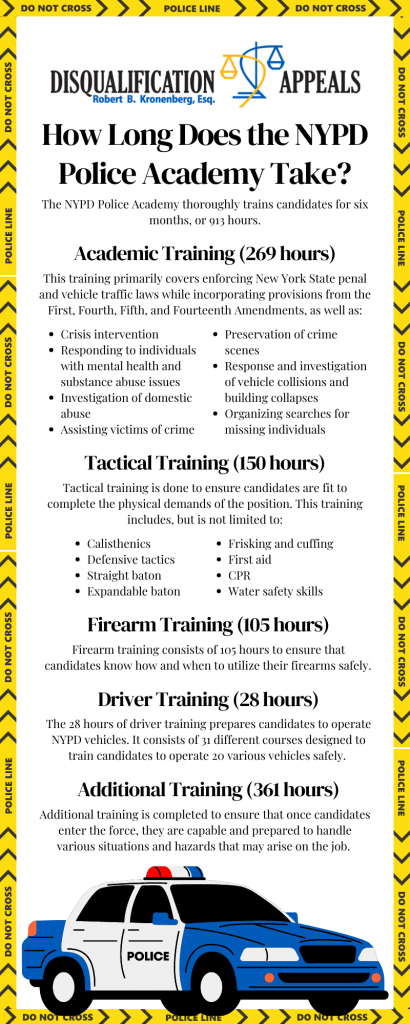
    How Long Does the NYPD Police Academy Take?

    The NYPD Police Academy is one of the most lengthy and arduous academies in the country, which makes sense when considering it is the largest police department in the nation, and responsible for the health and safety of an estimated nine million New Yorker residents plus millions of tourists and visitors each year. 

    The NYPD Police Academy is a training program that takes six months to complete. During these six months, candidates complete 913 hours of training. 

    What Is Covered at the NYPD Police Academy?

    As mentioned above, the academy concerns itself with preparing candidates with academic and physical training, but how is the time used? Of the 913 hours of training:

    • 269 of these hours are used for academic training
    • 150 hours on tactical training (previously referred to as physical training)
    • 105 hours on firearm training
    • 28 hours on driver training
    • 361 hours are used for additional add-on training and presentations 

    What Does Academic Training Entail?

    During the 269 hours of academic training, various areas of study are covered. The main areas of focus for this training include enforcement of the New York State penal and vehicle traffic laws. It also contains the provisions of the First, Fourth, Fifth, and Fourteenth Amendments. The academic portions also include training on, but are not limited to:

    • Crisis intervention
    • Proper responses to individuals with mental health and substance abuse issues
    • Proper investigation of domestic abuse
    • Assisting victims of crime
    • Preservation of crime scenes
    • Response and investigation of vehicle collisions and building collapses
    • Organizing searches for missing individuals

    What Does Tactical Training Entail?

    Tactical training is done to ensure candidates are fit to complete the physical demands of the position. This training includes, but is not limited to:

    • Calisthenics
    • Defensive tactics
    • Straight baton
    • Expandable baton
    • Frisking and cuffing
    • First aid
    • Cardiopulmonary resuscitation (CPR) 
    • Water safety skills

    What Does Firearm Training Entail?

    Firearm training consists of 105 hours to ensure that candidates know how and when to utilize their firearms safely. 

    What Does Driver Training Entail?

    The 28 hours of driver training prepares candidates to operate NYPD vehicles. It consists of 31 different courses designed to train candidates to operate 20 various vehicles safely. 

    Additional Training 

    Additional training is completed to ensure that once candidates enter the force, they are capable and prepared to handle various situations and hazards that may arise on the job. 

    Entering the NYPD Police Academy

    To qualify for the NYPD Police Academy, applicants must complete and pass several exams, as well as medical, character, and psychological screenings. Our offices can assist candidates who were disqualified due to medical, character, or psychological reasons. 

    For nearly two decades, our disqualification appeals attorney, Robert B. Kronenberg, has represented law enforcement candidates wrongfully disqualified. If you, or someone you know, has received a disqualification letter from the NYPD or Nassau County Police Department, contact us today to begin your appeal process. 


    Related Readings:

    Career Advancements in the NYPD

    What Are the Benefits of Becoming an NYPD Officer?