Tag: Notice of Proposed Disqualification

  • NYPD Drug Disqualifications

    NYPD Drug Disqualifications

    Drug history, drug testing, and medication questions can create serious concerns for police candidates. NYPD drug disqualifications may involve a positive drug screening, prior substance use, prescription medication concerns, inconsistent disclosures, or missing information in the application record. For candidates applying to the New York City Police Department, the issue is not always limited to the substance itself. The department may also review whether the candidate was complete, accurate, and consistent during the hiring process.

    Our team at Disqualification Appeals helps candidates review Notice of Proposed Disqualification (NOPD) concerns involving medical disqualification, character disqualification, and psychological disqualification issues. When drug use, drug testing, or medication history becomes part of the record, the response should be careful, specific, and supported by documentation.

    Why Drug Issues Can Affect an NYPD Application

    Police candidates are evaluated for whether they meet the standards required for appointment. Drug-related concerns can appear during the medical review, background investigation, psychological review, or character assessment. A candidate may be questioned about illegal drug use, marijuana history, prescription medication use, steroid use, prior treatment, or inconsistencies between application answers and later records.

    That does not mean every past issue is reviewed the same way. The facts matter. The department may consider what substance was involved, when the use occurred, how often it occurred, whether the candidate disclosed it, whether the candidate passed required screening, and whether the record suggests a current concern.

    For many candidates, the biggest risk is assuming the issue is simple. A drug-related concern may be medical in one case and character-related in another. If the concern involves disclosure, the question may become whether the candidate was truthful and complete during the process.

    Does the NYPD Drug Test Candidates?

    Candidates should expect drug screening to be part of the NYPD hiring process. Official NYPD candidate materials state that applicants must pass a drug screening before appointment. The department’s hiring materials also describe drug testing during Police Academy training, at the end of probation as part of the medical examination, and in certain later circumstances.

    The specific testing method and timing may depend on the stage of the process and the department’s current procedures. Candidates should not rely on assumptions about what will or will not be tested. If drug screening becomes part of a disqualification issue, the exact records, results, notices, and explanations matter.

    What Happens If a Candidate Fails a Drug Screening?

    A failed or refused drug screening can create a serious barrier to appointment. Drug screening issues may be treated as a medical concern, a character concern, or both, depending on the facts and the agency record.

    Candidates should review the notice carefully before responding. The notice may identify whether the concern involves a positive screening, refusal, medication issue, prior drug use, disclosure problem, or another record-based concern. A response should address the specific issue raised, not simply argue that the candidate is otherwise qualified.

    Documentation may matter. Depending on the situation, relevant documents may include prescriptions, medical records, laboratory information, treatment history, employment records, or other materials that help explain the record. The goal is to clarify the issue and respond to the department’s stated concern.

    How Past Marijuana Use May Be Reviewed

    Past marijuana use can create confusion because state laws and workplace policies are not always the same. NYPD hiring materials state that prior substance use, including marijuana, is not automatically disqualifying and may be considered as part of the total background investigation. Those materials also state that candidates must pass drug screening before appointment and that NYPD employees are prohibited from drug use, including marijuana.

    For candidates, the important point is disclosure and context. A candidate should not assume that past marijuana use is irrelevant, and they should not assume that it automatically ends the process. The candidate’s record, timing, frequency of use, disclosure history, and test results may all matter.

    If marijuana history appears in a Notice of Proposed Disqualification, the response should be tied to the concern in the notice. A vague explanation may not be enough if the department is focused on inconsistencies, recent use, missing information, or a failed screening.

    Why Disclosure Can Matter as Much as the Drug History

    Drug-related issues often become more serious when the department believes the candidate did not disclose information fully. A candidate may think an old issue, rare use, dismissed matter, prescription, or prior treatment was not important. The department may instead focus on whether the candidate answered the question accurately.

    This can turn a drug issue into a character issue. If the background record shows information that does not match the candidate’s application, interview answers, or written explanations, the department may question the candidate’s honesty, judgment, or reliability.

    A strong response should address both parts of the issue. It should explain the drug-related concern and explain any disclosure issue connected to it. Ignoring the omission can make the response less useful.

    Prescription Medication, Steroids, and Medical Review

    Drug-related concerns are not limited to illegal substances. Prescription medication, anxiety medication, pain medication, stimulants, or steroid use may become relevant if the department questions whether the candidate can perform required duties or whether the medication was disclosed properly.

    The issue is not always the existence of a medication. The department may consider the diagnosis, treatment history, side effects, stability, dosage, supporting medical records, and whether the candidate followed lawful medical guidance. Misuse of medication or use of a prescription that was not issued to the candidate can raise different concerns.

    If medication history is part of a proposed medical disqualification, candidates should review what the department is actually questioning. The response may need to include medical documentation, prescribing records, treatment notes, or updated professional opinions.

    What Candidates Should Review Before Responding

    Before responding to NYPD drug disqualifications, candidates should review the notice, the stated basis for the concern, the drug screening record, application answers, interview statements, medical documentation, and any background materials tied to the issue.

    They should also look for inconsistencies. Did the candidate disclose the same information throughout the process? Did the candidate give one answer on an application and another answer during an interview? Did medical records or background records reveal something the candidate did not explain?

    These details matter because the response should be built around the actual record. A candidate in Bronx, Brooklyn, Manhattan, Queens, Staten Island, Nassau County, or Suffolk County may need to gather documents quickly if the notice includes a response deadline.

    When Should You Speak With a Lawyer?

    A candidate should consider speaking with an NYPD disqualification appeal lawyer when a drug-related issue leads to a Notice of Proposed Disqualification, a failed screening, a disclosure concern, or a medical or character review issue. These matters can be difficult because the response may need to address testing, past conduct, medical records, and consistency across the application record.

    Legal guidance does not guarantee an outcome. It can help candidates understand what the department is questioning, organize the records, identify relevant documentation, and prepare a response that speaks directly to the concern.

    Get Help With NYPD Drug Disqualification Concerns

    Drug-related disqualification issues should be reviewed carefully before a candidate responds or decides what to do next. A positive test, medication question, past use, or disclosure issue can affect how the New York City Police Department evaluates medical fitness, character, and overall eligibility.

    Disqualification Appeals works with candidates facing or having concerns about NYPD drug disqualifications, psychological disqualifications, character disqualifications, and medical disqualifications. If you received a Notice of Proposed Disqualification or need help understanding the record behind your drug-related disqualification issue, contact our team to discuss your next steps.


    Sources:

    NYPD Police Officer Hiring FAQs

    https://www.nyc.gov/site/nypd/careers/police-officers/OLD-faqs-hiring-pos.page    

    DCAS Police Officer Notice of Examination

    https://www.nyc.gov/assets/dcas/downloads/pdf/noes/20244308000.pdf 

    DCAS Personnel Services Bulletin 100-15

    https://www.nyc.gov/assets/dcas/downloads/pdf/reports/100_15.pdf

  • Lawyer Cost for NYPD Disqualification Appeals: What to Expect

    Lawyer Cost for NYPD Disqualification Appeals: What to Expect

    When candidates receive a Notice of Proposed Disqualification (NOPD) from the New York City Police Department, their first question often revolves around lawyer cost. They question whether hiring an NYPD disqualification appeal lawyer is worth it and what that investment may look like.

    At Disqualification Appeals, a specialty law firm, we work directly with candidates navigating the NYPD disqualification process. We understand how important pricing is at this point. While every case is different, we can explain how lawyer costs are typically structured, what affects pricing, and what candidates should realistically expect.

    How Much Does a Lawyer Cost for an NYPD Disqualification Appeal?

    Lawyer costs can vary depending on the complexity of the case, the type of proposed disqualification, and how far the appeal process goes. Complexity involves the level of work required, from more limited administrative responses to more involved cases that require additional review or multiple stages. There are no fixed prices, only general ranges based on how much work is done.

    We focus on helping candidates understand their options, including possible costs, before they commit to moving forward. This ensures they can make informed decisions about how to proceed.

    What Affects Lawyer Cost in an NYPD Disqualification Case?

    There is no single price for an appeal. Several factors influence how lawyer costs are determined in an NYPD disqualification appeal. Here we explain three common factors that often affect the pricing.

    The Type of Disqualification

    The category of disqualification plays a major role in cost.

    A proposed medical disqualification may require reviewing records, coordinating with medical professionals, and presenting updated evaluations.

    A proposed psychological disqualification often involves detailed report analysis, independent psychological evaluations, and structured responses that address specific findings.

    A proposed character disqualification may require documentation of background history, employment records, and clarification of past issues.

    Each category involves a different level of preparation, which directly affects cost.

    The Stage of the Appeal Process

    Lawyer costs are also affected by how far the case progresses.

    An administrative response to a Notice of Proposed Disqualification is typically more limited in scope than a case that moves to the Civil Service Commission. If the matter proceeds to an Article 78 proceeding, the level of legal work increases significantly.

    This is why cost can vary widely. Some cases are resolved early, while others require multiple stages of review.

    The Complexity of the Case

    Not all cases are equal. Some involve a single issue that can be addressed with targeted documentation. Others involve multiple concerns that require a more comprehensive response.

    Complex cases often require multiple forms of documentation, coordination with outside professionals, and detailed written submissions.

    As the complexity increases, so does the amount of work involved, affecting the overall cost.

    Appeals Lawyer Cost vs. Doing It Alone

    Some candidates consider handling the appeal on their own to avoid legal fees. While that may seem like a way to reduce cost, it is important to understand what is at stake.

    The response to a Notice of Proposed Disqualification is not a simple form submission. It is a structured argument that must directly address the reason for the proposed disqualification.

    An incomplete or unfocused response can lead to a final disqualification, even in cases where supporting evidence exists. Once a final decision is issued, the process becomes more complex and may involve additional costs at later stages.

    We often work with candidates who have attempted to respond on their own and later needed to correct issues in the process. Addressing the situation early can be more efficient than trying to fix it after a denial.

    What Is Included in the Cost of an NYPD Disqualification Appeal Lawyer?

    Lawyer costs typically reflect the scope of work required to prepare and present the appeal. This may include:

    • Reviewing the Notice of Proposed Disqualification
    • Analyzing supporting documentation
    • Coordinating with medical or psychological professionals when needed
    • Preparing written submissions
    • Advising on timelines and next steps

    In more advanced stages, it may also include representation before the Civil Service Commission or preparation for an Article 78 proceeding.

    Each case is evaluated individually to determine what level of involvement is appropriate.

    Is Hiring an NYPD Disqualification Appeal Lawyer Worth It?

    Whether hiring a lawyer is worth it is one of the most common questions candidates ask when considering lawyer costs. The answer depends on the circumstances of the case, but the key factor is what the outcome represents. For many candidates, the appeal determines whether they can continue pursuing a career with the NYPD.

    The NYPD hiring process is structured, and decisions are based on how information is presented and evaluated. Understanding how to respond to a proposed medical disqualification, proposed psychological disqualification, or proposed character disqualification can influence how the case is reviewed.

    We focus on helping candidates understand their positions and determine the most effective way to move forward based on their specific situations.

    How We Approach Cost Transparency at Disqualification Appeals

    We believe candidates should have a clear understanding of lawyer costs before moving forward. While we do not present one-size-fits-all pricing, we explain what factors affect cost and what level of work may be required.

    Our approach is based on evaluating the case first, then outlining what is involved. This allows candidates to decide how to proceed with full awareness of what the process may require.

    Candidates can review their options and contact our team to discuss their situation before making any decisions.

    Frequently Asked Questions About Lawyer Costs

    How much does a lawyer cost for an NYPD disqualification appeal?

    Lawyer costs for an NYPD disqualification appeal can vary based on the type of disqualification and the complexity of the case. Administrative appeals may generally cost less than more complex cases involving additional stages.

    What affects the cost of an appeals lawyer the most?

    The main factors affecting the cost of an appeals lawyer include the type of disqualification, the amount of documentation required, and whether the case remains at the administrative level or progresses to further review.

    Is it more expensive to file an Article 78 appeal?

    An Article 78 proceeding involves court filings and a higher level of legal work. This amount of work typically increases the overall cost compared to an appeal that only requires administrative work.

    Can I handle an NYPD disqualification appeal without a lawyer?

    It is possible to handle an NOPD appeal by yourself. However, the process requires a structured response that directly addresses the reason for the proposed disqualification. Errors or omissions at this stage can affect the outcome, making hiring a lawyer a valid expense.

    Do all NYPD disqualification cases cost the same?

    Because each case is different, not all NYPD disqualification cases cost the same. Pricing depends on the category of disqualification, the complexity, and the stage of the appeal process.

    Understanding Your Next Step

    Lawyer cost is an important consideration, but it is only one part of the decision. The outcome of an appeal can affect whether you are able to continue in the NYPD hiring process.

    At Disqualification Appeals, we provide legal advice to candidates across the Bronx, Brooklyn, Manhattan, Queens, and Staten Island, as well as Nassau County and Suffolk County, to evaluate their cases and explain their options. Whether the issue involves a proposed medical disqualification, a proposed psychological disqualification, or a proposed character disqualification, each situation requires a tailored approach.

    Candidates who want to better understand their position can learn more about the NYPD disqualification process on our blog or contact our team to review their case and discuss next steps.

  • Article 78 Appeal: When and How to Challenge an NYPD Disqualification in Court

    Article 78 Appeal: When and How to Challenge an NYPD Disqualification in Court

    Receiving a Notice of Proposed Disqualification (NOPD) from the New York City Police Department can be unsettling. This is especially true when you are trying to understand whether your next step is an internal appeal or a court proceeding. Many candidates immediately search for information about an Article 78 appeal. They assume that filing in court is the automatic response to an NYPD disqualification. In most cases, it is not.

    The process usually unfolds in two stages. First, the candidate responds within the administrative process. Only after that process is complete, and only if the department issues a final adverse decision, does court review become a possible next step. Understanding that sequence matters because responding to a Notice of Proposed Disqualification and filing an Article 78 proceeding are not the same thing. They also are not used interchangeably.

    At Disqualification Appeals, our team assists candidates throughout New York City, including Bronx, Brooklyn, Manhattan, Queens, and Staten Island. We also represent those in Nassau County and Suffolk County, who need to determine what to do after an NYPD disqualification notice. They want to know whether judicial review may later be appropriate.

    Understanding the Difference Between an Administrative Appeal and Article 78

    Before getting into deadlines and court standards, it helps to understand the core distinction.

    A Notice of Proposed Disqualification is part of the agency’s internal review process. It means the NYPD believes there is a basis to disqualify the candidate, but the decision is still at the proposed stage. The candidate still has an opportunity to respond, submit documentation, and try to persuade the department not to make the disqualification final.

    An Article 78 proceeding is different. It is a legal action filed in the New York State Supreme Court to challenge a final agency decision. It is generally not the first response to a proposed disqualification. Instead, it may become relevant only after the internal process has concluded and the candidate has exhausted available administrative remedies.

    That difference is critical for anyone facing a psychological disqualification, medical disqualification, or character disqualification. The administrative stage focuses on rebutting the basis for the proposed decision. The Article 78 stage focuses on whether the agency’s final action was legally improper.

    The Administrative Stage: Responding to a Notice of Proposed Disqualification

    When the NYPD believes a candidate does not meet its standards, it may issue a Notice of Proposed Disqualification explaining the department’s concerns and providing a deadline to respond. Those concerns may relate to medical findings, psychological evaluations, or issues raised during the NYPD character assessment and background review.

    This stage is still internal to the New York City Police Department. The candidate is not yet asking a court to intervene. Instead, the candidate is responding directly to the agency.

    The response may involve updated medical records, independent psychological evaluations, clarifying background information, supporting letters, or other documentation that addresses the department’s stated concerns. In a proposed medical disqualification matter, that may mean obtaining medical support that explains why the original conclusion was incomplete or overstated. In a proposed psychological disqualification case, it may involve rebuttal material from an independent evaluator. In a proposed character disqualification matter, the response may focus on context, corrections, or supporting records relevant to the background investigation.

    This stage is often where factual development matters most. It is the point at which the department can reconsider its own position before issuing a final determination.

    Because this phase can directly affect whether the disqualification becomes final, many candidates choose to consult an NYPD disqualification appeal lawyer before submitting a response.

    Final Determination and Exhaustion of Remedies

    After reviewing the candidate’s response, the NYPD will issue a final determination. If the department withdraws the proposed disqualification, the issue is resolved within the administrative process. If it affirms the disqualification, the matter typically becomes final at the agency level.

    That finality matters because courts generally expect candidates to exhaust administrative remedies before seeking judicial review. In practical terms, that means a candidate usually cannot skip the internal response process and go straight to court simply because a Notice of Proposed Disqualification was issued.

    This is why the order of operations is so important. The candidate first addresses the proposed determination through the administrative process. If that effort is unsuccessful and the department makes the disqualification final, then the candidate and counsel can evaluate whether an Article 78 proceeding is appropriate.

    How an Article 78 Proceeding Might Help

    An Article 78 proceeding is a special proceeding used to challenge a final determination made by a New York governmental agency or official. In this context, it can be used to challenge a final NYPD disqualification decision after the administrative process has ended.

    The court does not start over and decide the case from scratch as though the agency process never happened. It is not simply a second round of factual submissions. Instead, the court reviews whether the agency acted within the law.

    Depending on the circumstances, the court may review whether the agency acted arbitrarily or capriciously, failed to follow lawful procedure, acted beyond its authority, or made a determination that lacked sufficient evidentiary support under the applicable legal standard.

    That means the focus shifts. During the administrative stage, the emphasis is on persuading the department with evidence and explanation. During the Article 78 stage, the emphasis is on whether the final agency action was legally defective.

    When an Article 78 Should Be Considered

    An Article 78 proceeding is typically considered only after the following sequence has occurred.

    • First, the candidate receives a Notice of Proposed Disqualification.
    • Second, the candidate submits a timely response within the administrative process.
    • Third, the NYPD issues a final determination affirming the disqualification.

    Only then does the question of judicial review usually come into play.

    There is also a filing deadline to consider. Article 78 proceedings are generally subject to a four-month statute of limitations running from the point at which the final determination becomes binding. Missing that deadline can prevent court review, even where substantial concerns exist about the agency’s decision.

    Because the standards, deadlines, and procedural posture are different from the internal appeal process, candidates should not treat an Article 78 proceeding as a routine extension of an administrative response. It is a separate legal remedy that may or may not be appropriate depending on the facts and the final agency record.

    Do Similar Procedures Apply in Other Jurisdictions?

    We have focused on NYPD disqualification matters within the five boroughs of New York City. However, Robert B. Kronenberg represents candidates throughout Nassau County and Suffolk County as well, where separate police departments and civil service systems operate under their own rules.

    Although the procedures and terminology may vary by jurisdiction, many law enforcement hiring systems follow a similar structure. Candidates typically respond to a proposed disqualification within the agency before any judicial review is considered.

    If you are applying outside New York City, the specific deadlines and standards may differ, but the distinction between administrative review and court review is common across many jurisdictions.

    How Our Team Assists at Each Stage

    At Disqualification Appeals, we assist candidates at the stage they are actually in, rather than assuming every matter belongs in court. If a candidate has received a Notice of Proposed Disqualification, our focus is on evaluating the basis for the proposed psychological disqualification, proposed medical disqualification, or proposed character disqualification and preparing the strongest possible administrative response.

    If the department later issues a final adverse determination, we can then assess whether an Article 78 proceeding should be considered based on the record, the procedural history, and the legal issues involved.

    For candidates in New York City, Nassau County, and Suffolk County, understanding that sequence can help prevent rushed decisions and missed deadlines. If you have received a Notice of Proposed Disqualification or a final NYPD disqualification decision, contact us today. Our experienced team can review your situation and help determine the appropriate next step.

  • NYPD FAQ Page: What Candidates Need to Know About Disqualification and Appeals

    NYPD FAQ Page: What Candidates Need to Know About Disqualification and Appeals

    Candidates preparing for the NYPD exam often search for an NYPD FAQ page when they need clarity about the hiring process. That search becomes even more urgent after receiving a Notice of Proposed Disqualification, commonly referred to as an NOPD.

    While the New York City Police Department provides general hiring information, it does not fully explain what to do if you are facing a proposed psychological disqualification, proposed medical disqualification, or proposed character disqualification. Understanding what the notice means, what deadlines apply, and how to respond properly can make a significant difference in your next steps.

    Our team at Disqualification Appeals works with candidates throughout Bronx, Brooklyn, Manhattan, Queens, and Staten Island, as well as Nassau County and Suffolk County, who need guidance on responding to an NYPD disqualification. Below are answers to the most common questions about the process.

    What assessments are required to join the NYPD?

    Candidates must complete a medical assessment, a psychological assessment, and a character or background investigation. Each review is designed to determine whether a candidate meets the standards required for service. If concerns arise, the department may issue a Notice of Proposed Disqualification.

    What does the medical assessment include?

    The medical assessment evaluates overall physical health and fitness for duty. It may include vision and hearing testing, blood pressure evaluation, cardiac screening such as an EKG, and a full physical examination. Findings related to mobility, endurance, or underlying health conditions may factor into a proposed medical disqualification.

    What does the psychological assessment include?

    The psychological assessment typically involves written testing and an interview with a department psychologist. The review focuses on decision-making, emotional stability, stress tolerance, and overall suitability for law enforcement responsibilities. Concerns raised during this process may lead to a proposed psychological disqualification.

    What does the character assessment include?

    The character assessment involves a detailed background investigation. This review may include employment history, academic records, prior legal issues, and overall personal conduct. The goal is to determine whether the candidate meets the ethical and integrity standards expected by the New York City Police Department. Issues identified here may result in a proposed character disqualification.

    What happens after receiving a Notice of Proposed Disqualification?

    A Notice of Proposed Disqualification (NOPD) is not the same as a final denial, nor is it a final decision. It outlines the department’s concerns and provides an opportunity to respond within a strict deadline. Candidates may submit documentation, explanations, or additional evaluations to address the findings.

    How long do I have to respond to an NOPD?

    The response deadline is typically limited and strictly enforced. In many cases, candidates have approximately 30 days to submit their response. Missing this deadline can significantly limit the ability to challenge the proposed disqualification.

    What should I include in my response?

    A response may include medical records, psychological evaluations, professional opinions, or documentation that addresses the department’s concerns directly. The goal is to present a clear and structured response that explains why the proposed disqualification should not become final.

    Do I need a lawyer to respond to an NYPD disqualification?

    You are not required to have legal representation. However, many candidates choose to work with an NYPD disqualification appeal lawyer because the process can be procedural and detail-driven. A structured response supported by appropriate documentation can make a meaningful difference.

    How long does the appeals process take?

    The timeline varies depending on the type of disqualification and the complexity of the case. Some responses are reviewed within a few weeks, while others may take longer if additional documentation or evaluation is required.

    Will I need to go to court?

    Most NYPD disqualification matters are handled through an administrative review process rather than a court. In some situations, further legal action may be available after a final determination, depending on the circumstances.

    What documentation will I need for an appeal?

    Candidates should gather all materials related to their case, including the Notice of Proposed Disqualification, correspondence from the department, and any supporting records such as medical documentation or character references.

    Do similar standards apply in Nassau County and Suffolk County?

    Yes. While procedures vary by jurisdiction, candidates applying to departments in Nassau County and Suffolk County may also undergo medical, psychological, and character evaluations as part of their hiring process.

    What should I do if I receive a proposed disqualification?

    If you receive a Notice of Proposed Disqualification from the NYPD or another department, it is important to carefully review the basis of the determination and understand your deadline.

    At Disqualification Appeals, we help candidates throughout Bronx County, Kings County, New York County, Queens County, Richmond County, Nassau County, and Suffolk County evaluate their options.

    Whether you are responding to a proposed psychological disqualification, a proposed medical disqualification, or a proposed character disqualification, we focus on building a structured response designed to address the department’s findings directly.

    If you have received a Notice of Proposed Disqualification or have questions about the NYPD exam process, get in touch with our team at Disqualification Appeals to review your situation and determine your next steps.

  • What Are the NYPD Weight Requirements?

    What Are the NYPD Weight Requirements?

    Can You Become a Police Officer if You are Overweight?

    Many applicants preparing for the NYPD exam ask whether there are official NYPD weight requirements.

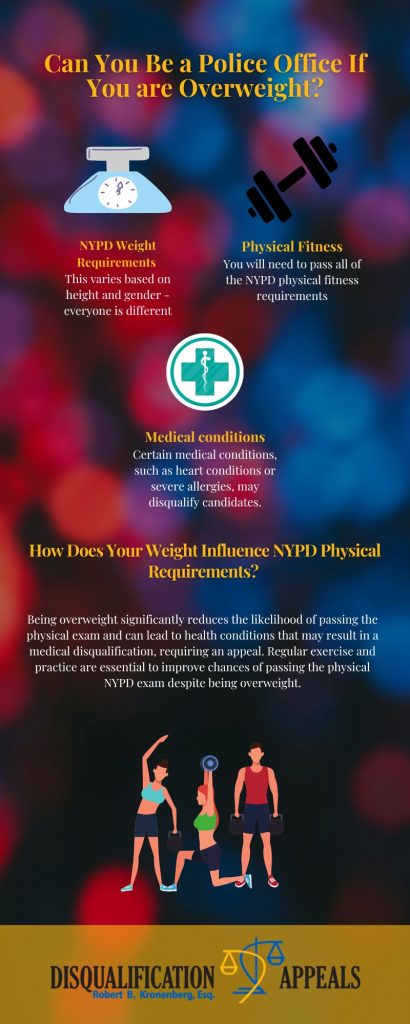
    The New York City Police Department evaluates candidates under established medical and physical standards, but it does not publish a strict weight chart that automatically disqualifies applicants. Instead, candidates must demonstrate that they meet NYPD medical standards and can successfully complete the required physical testing.

    Weight alone is rarely the sole deciding factor. What matters is whether a candidate satisfies NYPD health requirements and can safely perform the essential duties of the position.

    At Disqualification Appeals, we regularly assist candidates who receive a Notice of Proposed Disqualification, commonly referred to as an NOPD, after the medical review process. In some cases, weight-related health concerns may contribute to an NYPD medical disqualification.

    Your Weight and the NYPD Physical Fitness Requirements

    All applicants must complete the Physical Ability Test as part of the NYPD exam process. This evaluation measures whether candidates meet NYPD physical fitness requirements and can perform job-related tasks safely and effectively.

    The test includes:

    • Barrier surmount
    • Stair climb
    • Physical restraint simulation
    • Pursuit run
    • Victim rescue
    • Trigger pull assessment

    The focus is functional performance, not appearance. However, if weight significantly affects cardiovascular health, mobility, or endurance, medical examiners may request additional documentation or specialist evaluations before determining whether a candidate satisfies NYPD physical requirements.

    How Weight Can Influence a Proposed Medical Disqualification

    Although there are no fixed NYPD weight requirements, the medical evaluation examines overall health indicators such as blood pressure, cardiac function, and metabolic stability. If weight contributes to underlying medical conditions, including uncontrolled hypertension or cardiac abnormalities, those findings may result in a proposed medical disqualification.

    Candidates typically receive a Notice of Proposed Disqualification outlining the department’s concerns. An NOPD provides an opportunity to respond with supporting documentation before a final determination is made.

    It is important to understand that medical disqualification is only one of three categories candidates may face. Applicants may also receive a proposed psychological disqualification or a proposed character disqualification, depending on the findings during the NYPD character assessment, psychological review, or background investigation.

    Can You Appeal an NYPD Medical Disqualification?

    Yes, you can appeal an NYPD police application disqualification notice. An NYPD medical disqualification is not necessarily final.

    Candidates generally have the right to submit a formal response within a strict deadline. Appealing an NOPD often requires updated medical records, physician evaluations, and a detailed explanation addressing the findings cited by the department.

    Because these deadlines are firm, early review is critical. A carefully prepared appeal can clarify incomplete medical conclusions and demonstrate that you meet NYPD medical standards despite the initial determination.

    Disqualification Appeals assists candidates who are appealing a psychological disqualification, responding to an NYPD medical disqualification, or challenging other forms of NYPD disqualification. We review the proposed determination, analyze the supporting documentation, and prepare a structured response that addresses the department’s concerns directly.

    Do These Standards Apply Outside New York City?

    While this article focuses on NYPD requirements, similar medical and physical standards apply in surrounding jurisdictions. Candidates preparing for Nassau County Civil Service exams, the Nassau County Police exam, or the Suffolk County police exam should also expect medical screening requirements as part of the hiring process.

    Applicants for the Suffolk County police department exam or Nassau County Police test may face comparable review procedures if medical concerns arise.

    Speak With Disqualification Appeals About Your Options

    If you have received a Notice of Proposed Disqualification from the NYPD, or if you are concerned about how weight or health findings may affect your application, it is important to understand your options before the response deadline expires.

    Disqualification Appeals represents candidates throughout the five boroughs of New York City, including Bronx County, Kings County, New York County, Queens County, and Richmond County, as well as Nassau County and Suffolk County.

    Whether you are responding to a proposed medical disqualification, proposed psychological disqualification, or proposed character disqualification, our team evaluates the notice, explains your legal position, and helps prepare a timely and comprehensive appeal.

    If you have received an NOPD or are seeking guidance from an experienced NYPD disqualification appeal lawyer, contact Disqualification Appeals today to discuss your situation and determine the next appropriate step.

    photo of infographic about overweight police officers

    Related Readings 

    Prospective Police Officers and Social Media

    Can I Become an NYPD Officer Without a College Degree

  • What Is a Notice of Proposed Disqualification (NOPD)?

    What Is a Notice of Proposed Disqualification (NOPD)?

    A notice of proposed disqualification is a formal written letter issued during the New York police hiring process. Often shortened to NOPD, this notice informs a candidate that a law enforcement agency intends to remove them from consideration unless a successful response is submitted within a limited period of time. If you received an NOPD from the New York City Police Department, also referred to as an NYPD disqualification notice, understanding exactly what this document is can mean the difference between becoming a police officer and not realizing your dreams.

    For applicants pursuing a career with the New York City Police Department (NYPD), receiving an NOPD can feel sudden and overwhelming. Many candidates assume that once they pass the Civil Service Law Enforcement exam, physical testing, interviews, and screening steps tied to admission into the NYPD police academy, they are close to joining a class. A notice of proposed disqualification signals that the department has identified concerns that could block that goal unless addressed through a formal appeal.

    Understanding what an NOPD means, why it is issued, and how the process works is essential for protecting your opportunity to move forward in the hiring process.

    At Disqualification Appeals, Robert B. Kronenberg, Esq., represents candidates across New York State who face proposed psychological disqualifications, proposed character disqualifications, or proposed medical disqualifications during the police hiring process. As a former New York City Police Captain and an experienced disqualification appeal attorney, Kronenberg brings operational knowledge and legal strategy to cases involving NYPD hiring decisions and civil service appeals.

    What Does a Notice of Proposed Disqualification Mean?

    A notice of proposed disqualification is not a final ruling. The word proposed matters. It reflects a preliminary determination by the NYPD or another New York civil service agency that a candidate may not meet appointment standards.

    The notice typically outlines:

    • The category or categories of concern
    • A summary of the findings
    • Instructions for submitting a written response
    • Deadlines for filing materials

    For NYPD applicants, this letter often represents the only opportunity to challenge the department’s conclusions before a final Notice of Disqualification is issued.

    Why the NYPD Issues Notices of Proposed Disqualification

    The New York City Police Department maintains strict hiring requirements because officers hold positions of public trust. When issues arise during screening, the department may issue an NOPD rather than immediately closing the application.

    Most notices fall into three major categories.

    Psychological Concerns

    A proposed psychological disqualification may follow interviews, written testing, or clinical evaluations. Factors can include treatment history, medication use, patterns in employment or relationships, or what candidates sometimes refer to as a failed NYPD oral psych exam. Departments evaluate whether an applicant demonstrates judgment, emotional stability, and reliability consistent with policing standards.

    Character and Background Concerns

    A proposed character disqualification usually grows out of the background investigation. These reviews involve background checks, examination of criminal records, honesty during interviews, driving history, employment performance, academic discipline, and financial responsibility. Some background checks might even uncover inconsistencies or omissions that trigger additional scrutiny.

    Some cases center on how past conduct is interpreted rather than on disqualifying behavior itself, which is why careful explanation and documentation often become critical during appeals.

    Medical Concerns

    Medical screening can result in records including information related to hearing or vision, orthopedic conditions, pulmonary or cardiac evaluations, or overall readiness for duty. When those findings lead to a proposed medical determination, candidates may pursue medical disqualification appeals supported by outside physicians or updated testing.

    In every category, the notice of proposed disqualification represents the department’s intent to disqualify unless the applicant can present information that changes that conclusion.

    How Long Do You Have to Respond to an NOPD?

    For most NYPD candidates, the deadline to respond to a notice of proposed disqualification is thirty days from the date of the letter.

    That window closes quickly when medical records, psychological evaluations, employment histories, or written explanations must be gathered. Missing the deadline often causes the proposed determination to become final, which can make it far harder to continue pursuing a career with the NYPD or another New York agency.

    Because of this, candidates should treat an NOPD as a serious legal matter rather than a routine administrative letter.

    What Happens After You Submit Your Response?

    After an NOPD response is filed, the hiring agency reviews the materials and decides whether to withdraw the proposed disqualification or proceed toward a final decision.

    If the NYPD issues a final Notice of Disqualification, additional administrative remedies may exist through the civil service commission review board. In some cases, matters proceed to hearings before commissions or boards that evaluate whether the department followed proper procedures and standards.

    Applicants from other jurisdictions across the state, including those tied to county departments or Nassau County Civil Service exams, may encounter similar structures.

    This multi-stage process is why the initial submission carries so much weight. A well-prepared response shapes how the case unfolds at every later phase.

    Why a Notice of Proposed Disqualification Should Never Be Ignored

    Some candidates assume the department has already made up its mind. Others hesitate because they are unsure how to respond or what documentation matters most.

    An NOPD formally opens the appeal window. Failing to act, submitting incomplete materials, or overlooking critical explanations can allow the proposed determination to become permanent.

    For candidates who invested months preparing for academy admission, ignoring a notice of proposed disqualification can mean losing the chance to begin the police career they worked toward.

    How Disqualification Appeals and Robert Kronenberg Help NYPD Candidates

    Once the foundation of the process is understood, candidates often seek legal guidance to navigate the complexity that follows.

    At Disqualification Appeals, Robert B. Kronenberg, Esq., represents applicants across New York State who face proposed psychological, character, and medical determinations during the hiring process for police officers. As a former New York City Police Captain and an experienced police disqualification attorney, Kronenberg understands how agencies evaluate applicants and what documentation and arguments carry weight during review.

    His work frequently involves analyzing the NOPD in detail, coordinating independent medical or psychological evaluations when appropriate, preparing written submissions, and ensuring deadlines are met. In complex cases, he may represent candidates during interviews or later administrative proceedings tied to NYPD disqualification challenges.

    Does an NOPD Apply Only to the NYPD?

    Although the term is most closely associated with the New York City Police Department, notices of proposed disqualification are used throughout New York civil service hiring systems.

    Municipal agencies, county departments, and other law enforcement organizations across the state rely on similar procedures. Whether a candidate is seeking a career with the NYPD or another agency, the need for a prompt and carefully prepared response remains the same.

    Speak With a Disqualification Appeal Attorney About Your NOPD

    If you have received a notice of proposed disqualification or an NOPD from the NYPD or another New York law enforcement agency, acting quickly can protect your opportunity to continue in the hiring process.

    Disqualification Appeals represents candidates facing:

    • A proposed psychological disqualification
    • A proposed character disqualification
    • Any medical disqualification determinations

    Robert Kronenberg works with qualified medical and psychological professionals when needed and prepares each case with the precision these matters demand.

    Call us at 631-234-4434 or contact us online today to schedule a free phone consultation and get additional information regarding how Disqualification Appeals can help you pursue the NYPD career you worked toward.

  • Most Common Police Officer Disqualifications

    Most Common Police Officer Disqualifications

    Many people pursue law enforcement because they want to serve their community, build a stable career, and join a respected profession. Candidates pursuing a career with the New York City Police Department (NYPD) often spend months preparing for exams, background investigation steps, medical screening, psychological evaluation, and physical testing. Then, sometimes late in the process, the application stops moving forward when an NYPD disqualification notice is received, often due to one of the most common police officer disqualifications.

    At Disqualification Appeals, Robert B. Kronenberg, Esq., represents police candidates across New York State who face disqualifications during hiring. As a former New York City Police Captain and an experienced police disqualification attorney, Kronenberg understands how agencies evaluate candidates and how to respond when a determination threatens a candidate’s future.

    This guide explains the most common reasons candidates are disqualified, how agencies typically evaluate those issues, and why the first response matters. In some cases, the first formal notice is a notice of proposed disqualification, also known as an NOPD, which signals the agency’s intent to disqualify unless the candidate responds effectively and on time.

    Why Police Candidates Get Disqualified

    Disqualification decisions rarely come from one single detail viewed in isolation. Police departments screen for suitability across multiple areas at once, including honesty, judgment, reliability, medical readiness, psychological fitness, and physical capability.

    A disqualification can appear as a final decision, or it can begin as a proposed determination. For example, a candidate may receive a proposed psychological disqualification tied to mental health findings or a proposed medical disqualification related to a previous or existing medical condition. In both scenarios, the underlying issue is usually how the agency interprets risk, credibility, and readiness for duty.

    Background Investigation Disqualifiers

    Background investigation issues are among the most common drivers of police officer disqualifications. Departments look well beyond whether someone has ever been arrested. The review board looks for patterns of conduct over time, and they pay close attention to credibility.

    A background investigation can raise concerns when there are inconsistencies in the application, omissions, conflicting statements, problematic employment history, repeated disciplinary issues in school or work settings, a history of domestic violence, or financial instability that suggests poor judgment. Agencies also evaluate whether an applicant’s statements match what is uncovered through background checks, including driving history and prior interactions with law enforcement.

    When background investigation findings create doubts about honesty or overall suitability, a candidate may face a proposed character disqualification, even when there is no single automatic disqualifier in the file.

    Criminal Records and Police Hiring

    Questions about criminal records are common, and the answer is almost always fact-specific. The type of offense, the age of the offense, the circumstances, and the pattern of conduct that follows all matter. Agencies also evaluate whether the applicant disclosed everything clearly and consistently.

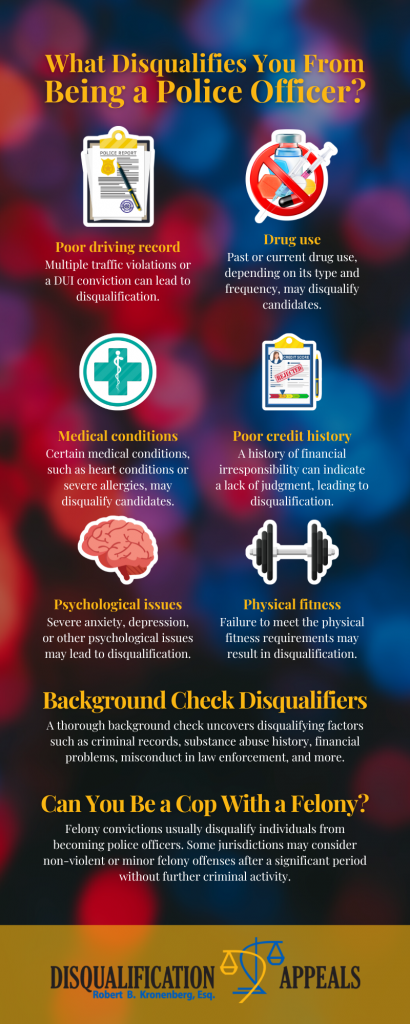
    Can You Be a Cop With a Felony?

    In many jurisdictions, a felony conviction is a major barrier to becoming a police officer. Some departments treat certain convictions as automatic disqualifiers, especially those involving violence, weapons offenses, serious drug distribution, or dishonesty-related conduct.

    The NYPD is widely understood to apply strict standards in this area. Even when the underlying event is old, agencies typically evaluate whether the record suggests a risk to public trust. In practice, felony-related disqualifications are often difficult to overcome, and cases turn heavily on disclosure, context, and supporting documentation.

    If a felony or arrest history triggers a proposed determination, it may appear in a notice of proposed disqualification (NOPD), and the response must be handled with extreme care and timeliness.

    Psychological Disqualifications

    Psychological screening is a major part of police hiring, especially for agencies tasked with high-stress, high-consequence decision-making. The goal is not to eliminate candidates who have ever experienced stress, anxiety, or life challenges. The goal is to determine whether the agency believes the candidate can safely perform the job under pressure and maintain judgment, integrity, and emotional control.

    A proposed psychological disqualification can stem from written testing, clinical interviews, treatment history, medication use, or the way an applicant answers questions about employment history and relationships. Some candidates describe the triggering event as a failed NYPD oral psych exam. Even when candidates feel the evaluation went fine, the agency may interpret patterns or responses differently.

    These cases often require a disciplined explanation, clean documentation, and a clear narrative that addresses the department’s stated concerns.

    Medical Disqualifications and Fitness for Duty

    Medical screening evaluates whether a candidate can perform the physical demands of the job safely and reliably. Disqualifications can involve vision or hearing standards, orthopedic limitations, respiratory issues, cardiac findings, or other conditions that the agency believes create a safety risk.

    Some medical determinations can be clarified or challenged with updated records, specialist evaluations, or additional testing. When that is possible, candidates may pursue medical disqualification appeals supported by medical documentation that directly addresses the agency’s stated concerns.

    Medical issues also commonly appear alongside other concerns in the same case, which can change how the overall response should be structured.

    Physical Fitness Disqualifications

    Physical capability is not optional in policing. If a candidate cannot meet physical benchmarks at the required time, the agency may remove the candidate from consideration.

    Sometimes these outcomes are straightforward. Other times, they are shaped by temporary injury, timing, or inconsistent testing conditions. Where policy permits, candidates may seek review or retesting. When a physical readiness issue is tied to a broader medical finding, it may be treated as part of the medical determination rather than a simple fitness failure.

    What Disqualifies You From Being a Police Officer?

    Here are the categories related to the most common police officer disqualifications during the hiring process:

    • Background investigation concerns and credibility issues, including inconsistent disclosures and problematic patterns uncovered through background checks.
    • Criminal records concerns, especially felony convictions and offenses involving violence or dishonesty.
    • Psychological screening concerns that lead to a proposed psychological disqualification.
    • Character and suitability concerns that lead to a proposed character disqualification.
    • Medical findings that result in medical disqualification appeals or further review.
    • Physical fitness failures that are tied to performance standards or medical readiness.

    Why a Notice of Proposed Disqualification Matters

    A notice of proposed disqualification (NOPD) is not always the first document a candidate receives, but when it appears, it matters because it often defines the window for response.

    An NOPD is typically the agency stating, in writing, that it intends to disqualify the candidate unless they submit a persuasive response within the allowed timeframe. That response may involve records, evaluations, explanations, and other supporting material. In many cases, the way a candidate responds to the NOPD shapes what happens next, including whether the agency withdraws the proposed determination or moves toward a final decision.

    This is also where candidates can lose ground quickly. Delay, incomplete documentation, or unfocused explanations can allow the proposed decision to become final.

    How Disqualification Appeals Helps Police Candidates in New York

    Civil service procedures and strict deadlines often govern disqualification decisions. Candidates do not always get unlimited chances to fix the record. That is why structure and precision matter.

    At Disqualification Appeals, Robert B. Kronenberg, Esq., reviews the stated grounds for disqualification, identifies what the agency is actually focusing on, and develops a response strategy that addresses those issues directly. Depending on the case, that work may involve documentation gathering, coordinating medical or psychological evaluations, preparing written submissions, and representing candidates in later administrative proceedings.

    Kronenberg’s background as a former New York City Police Captain adds a practical perspective to cases involving NYPD screening standards and disqualification decisions.

    Speak With a Police Disqualification Attorney

    If you are pursuing a career with the New York City Police Department or another New York agency and have received a disqualification or a notice of proposed disqualification for one of the most common police officer disqualifications, you do not have to guess what the next step should be.

    Call us at 631-234-4434 or contact us online today to schedule a consultation and learn how Disqualification Appeals and Robert B. Kronenberg, Esq., can help you respond to an NOPD and protect your path toward appointment.

  • Medical Screenings for Police Officers

    Medical Screenings for Police Officers

    Information on Disqualifications and How to Win

    Police work places extraordinary physical and psychological demands on the people who serve. Agencies like the New York City Police Department evaluate candidates carefully to ensure that future officers can meet those demands safely and reliably. One of the evaluations is medical screening for police officers, and failing to pass a medical screening can result in an NYPD disqualification notice.

    At Disqualification Appeals, Robert B. Kronenberg, Esq., represents police candidates across New York State who face hiring setbacks tied to medical, psychological, and character screening. As a former New York City Police Captain and an experienced disqualification appeal attorney, Kronenberg understands how departments assess risk and how candidates can respond when their careers are suddenly placed in jeopardy.

    In many cases, after any medical screenings for police officers have been completed, medical concerns appear inside a notice of proposed disqualification, often referred to as an NOPD, which signals the department’s intent to disqualify unless the findings are successfully challenged. This guide explains what police medical screenings involve, why candidates may be removed from consideration, and how appeals are handled when medical findings threaten a career in law enforcement.

    What Medical Screenings for Police Officers Involve

    Although standards vary among agencies, most police departments follow similar evaluation models. Medical screening focuses on whether a candidate can safely perform essential job functions and whether underlying conditions pose unacceptable risk during training or active duty.

    The process typically includes review of medical history, physical measurements, diagnostic testing, and functional examinations.

    Medical History Review

    Candidates are asked detailed questions about past and present health conditions, medications, surgeries, injuries, and family medical history. Accuracy and completeness matter. Departments compare written disclosures with testing results and investigative findings, including information uncovered during background checks.

    Omissions or inconsistencies can raise credibility concerns and, in some situations, contribute to a proposed character disqualification alongside medical findings.

    Vital Signs and Physical Measurements

    Departments record height, weight, body composition, blood pressure, heart rate, and other baseline indicators. These measurements are compared to agency-specific thresholds tied to safety and readiness.

    Results outside acceptable ranges do not always trigger immediate removal, but they can prompt further testing or specialist referrals that delay or jeopardize the appointment.

    Vision Testing

    Because officers rely heavily on situational awareness, vision screening plays a central role. Examinations may assess:

    • Color perception
    • Peripheral awareness
    • Visual acuity
    • Presence of eye disease

    Candidates whose results fall short of standards may face medical review or corrective requirements before continuing in the hiring process.

    Hearing Evaluations

    Audiology testing measures hearing sensitivity, infection history, and structural concerns involving the ears. Hearing loss alone does not always lead to disqualification, but it is evaluated alongside every other medical factor when departments assess operational readiness.

    Musculoskeletal and Mobility Exams

    Police work requires strength, coordination, and full use of the body under stressful conditions. Examinations evaluate joints, spine, muscle groups, reflexes, balance, and range of motion.

    Limitations that could interfere with defensive tactics, pursuit situations, or emergency response may trigger medical scrutiny and, in some cases, a proposed determination.

    Blood and Urine Testing

    Laboratory testing screens for metabolic disorders, infectious diseases, cardiovascular risk markers, and substance use. Departments commonly test for conditions such as diabetes, hepatitis, or HIV, as well as prohibited drug use.

    Unexpected findings can lead to temporary holds, further evaluation, or inclusion in a notice of proposed disqualification while the agency seeks additional information.

    Do Medical Findings Always End a Police Career?

    Medical findings don’t necessarily always end a police career before it starts. Departments are generally required to consider applications as a whole. Some medical conditions are manageable, treatable, or temporary. Others may be misinterpreted without context or updated documentation.

    Still, when agencies conclude that a condition creates unacceptable risk, candidates may receive a notice of proposed disqualification (NOPD) that lists medical grounds for removal. That notice opens a narrow window to respond with medical records, specialist reports, testing updates, and legal arguments.

    Medical concerns can also appear alongside psychological findings that lead to a proposed psychological disqualification, or investigative issues that produce a proposed character disqualification. The combination of categories often complicates the appeal strategy and increases the importance of precision in the response.

    Appealing Medical Disqualifications in New York

    When a police candidate is removed from consideration based on health findings, the next steps are governed by civil service rules and strict deadlines. Appeals often require:

    • An analysis of the agency’s stated medical concerns
    • Coordination with your treating physicians or specialists
    • Preparation of written submissions
    • Evaluation of testing standards and protocols
    • Advocacy during administrative review

    At Disqualification Appeals, Robert B. Kronenberg, Esq., brings nearly two decades of legal experience to these matters, along with firsthand insight from his service as a New York City Police Captain. His practice focuses on challenging unjustified determinations and guiding candidates through complex civil service procedures.

    Kronenberg regularly assists applicants who face NYPD hiring setbacks and helps them present the strongest possible case for reconsideration.

    Protecting Your Path to the Police Career You Want

    Medical screening is a critical part of police hiring, but it is not always the final word. When a candidate receives a notice of proposed disqualification, swift and informed action can preserve opportunities that might otherwise disappear.

    If you are pursuing a career with the New York City Police Department or another New York agency and have encountered medical, psychological, or character-related concerns, Disqualification Appeals can help you understand your options and prepare a response that protects your future.

    Call us at 631-234-4434 or contact us online today to schedule a free consultation and learn how Robert B. Kronenberg can help you fight an NOPD and continue moving toward an appointment.


    SOURCE:

    NYPD Online – What to Expect