
Tag: NYPD Disqualifications

  • What Is a Notice of Proposed Disqualification (NOPD)?

    What Is a Notice of Proposed Disqualification (NOPD)?

    A notice of proposed disqualification is a formal written letter issued during the New York police hiring process. Often shortened to NOPD, this notice informs a candidate that a law enforcement agency intends to remove them from consideration unless a successful response is submitted within a limited period of time. If you received an NOPD from the New York City Police Department, also referred to as an NYPD disqualification notice, understanding exactly what this document is can mean the difference between becoming a police officer and not realizing your dreams.

    For applicants pursuing a career with the New York City Police Department (NYPD), receiving an NOPD can feel sudden and overwhelming. Many candidates assume that once they pass the Civil Service Law Enforcement exam, physical testing, interviews, and screening steps tied to admission into the NYPD police academy, they are close to joining a class. A notice of proposed disqualification signals that the department has identified concerns that could block that goal unless addressed through a formal appeal.

    Understanding what an NOPD means, why it is issued, and how the process works is essential for protecting your opportunity to move forward in the hiring process.

    At Disqualification Appeals, Robert B. Kronenberg, Esq., represents candidates across New York State who face proposed psychological disqualifications, proposed character disqualifications, or proposed medical disqualifications during the police hiring process. As a former New York City Police Captain and an experienced disqualification appeal attorney, Kronenberg brings operational knowledge and legal strategy to cases involving NYPD hiring decisions and civil service appeals.

    What Does a Notice of Proposed Disqualification Mean?

    A notice of proposed disqualification is not a final ruling. The word proposed matters. It reflects a preliminary determination by the NYPD or another New York civil service agency that a candidate may not meet appointment standards.

    The notice typically outlines:

    • The category or categories of concern
    • A summary of the findings
    • Instructions for submitting a written response
    • Deadlines for filing materials

    For NYPD applicants, this letter often represents the only opportunity to challenge the department’s conclusions before a final Notice of Disqualification is issued.

    Why the NYPD Issues Notices of Proposed Disqualification

    The New York City Police Department maintains strict hiring requirements because officers hold positions of public trust. When issues arise during screening, the department may issue an NOPD rather than immediately closing the application.

    Most notices fall into three major categories.

    Psychological Concerns

    A proposed psychological disqualification may follow interviews, written testing, or clinical evaluations. Factors can include treatment history, medication use, patterns in employment or relationships, or what candidates sometimes refer to as a failed NYPD oral psych exam. Departments evaluate whether an applicant demonstrates judgment, emotional stability, and reliability consistent with policing standards.

    Character and Background Concerns

    A proposed character disqualification usually grows out of the background investigation. These reviews involve background checks, examination of criminal records, honesty during interviews, driving history, employment performance, academic discipline, and financial responsibility. Some background checks might even uncover inconsistencies or omissions that trigger additional scrutiny.

    Some cases center on how past conduct is interpreted rather than on disqualifying behavior itself, which is why careful explanation and documentation often become critical during appeals.

    Medical Concerns

    Medical screening can result in records including information related to hearing or vision, orthopedic conditions, pulmonary or cardiac evaluations, or overall readiness for duty. When those findings lead to a proposed medical determination, candidates may pursue medical disqualification appeals supported by outside physicians or updated testing.

    In every category, the notice of proposed disqualification represents the department’s intent to disqualify unless the applicant can present information that changes that conclusion.

    How Long Do You Have to Respond to an NOPD?

    For most NYPD candidates, the deadline to respond to a notice of proposed disqualification is thirty days from the date of the letter.

    That window closes quickly when medical records, psychological evaluations, employment histories, or written explanations must be gathered. Missing the deadline often causes the proposed determination to become final, which can make it far harder to continue pursuing a career with the NYPD or another New York agency.

    Because of this, candidates should treat an NOPD as a serious legal matter rather than a routine administrative letter.

    What Happens After You Submit Your Response?

    After an NOPD response is filed, the hiring agency reviews the materials and decides whether to withdraw the proposed disqualification or proceed toward a final decision.

    If the NYPD issues a final Notice of Disqualification, additional administrative remedies may exist through the civil service commission review board. In some cases, matters proceed to hearings before commissions or boards that evaluate whether the department followed proper procedures and standards.

    Applicants from other jurisdictions across the state, including those tied to county departments or Nassau County Civil Service exams, may encounter similar structures.

    This multi-stage process is why the initial submission carries so much weight. A well-prepared response shapes how the case unfolds at every later phase.

    Why a Notice of Proposed Disqualification Should Never Be Ignored

    Some candidates assume the department has already made up its mind. Others hesitate because they are unsure how to respond or what documentation matters most.

    An NOPD formally opens the appeal window. Failing to act, submitting incomplete materials, or overlooking critical explanations can allow the proposed determination to become permanent.

    For candidates who invested months preparing for academy admission, ignoring a notice of proposed disqualification can mean losing the chance to begin the police career they worked toward.

    How Disqualification Appeals and Robert Kronenberg Help NYPD Candidates

    Once the foundation of the process is understood, candidates often seek legal guidance to navigate the complexity that follows.

    At Disqualification Appeals, Robert B. Kronenberg, Esq., represents applicants across New York State who face proposed psychological, character, and medical determinations during the hiring process for police officers. As a former New York City Police Captain and an experienced police disqualification attorney, Kronenberg understands how agencies evaluate applicants and what documentation and arguments carry weight during review.

    His work frequently involves analyzing the NOPD in detail, coordinating independent medical or psychological evaluations when appropriate, preparing written submissions, and ensuring deadlines are met. In complex cases, he may represent candidates during interviews or later administrative proceedings tied to NYPD disqualification challenges.

    Does an NOPD Apply Only to the NYPD?

    Although the term is most closely associated with the New York City Police Department, notices of proposed disqualification are used throughout New York civil service hiring systems.

    Municipal agencies, county departments, and other law enforcement organizations across the state rely on similar procedures. Whether a candidate is seeking a career with the NYPD or another agency, the need for a prompt and carefully prepared response remains the same.

    Speak With a Disqualification Appeal Attorney About Your NOPD

    If you have received a notice of proposed disqualification or an NOPD from the NYPD or another New York law enforcement agency, acting quickly can protect your opportunity to continue in the hiring process.

    Disqualification Appeals represents candidates facing:

    • A proposed psychological disqualification
    • A proposed character disqualification
    • Any medical disqualification determinations

    Robert Kronenberg works with qualified medical and psychological professionals when needed and prepares each case with the precision these matters demand.

    Call us at 631-234-4434 or contact us online today to schedule a free phone consultation and get additional information regarding how Disqualification Appeals can help you pursue the NYPD career you worked toward.

  • Most Common Police Officer Disqualifications

    Most Common Police Officer Disqualifications

    Many people pursue law enforcement because they want to serve their community, build a stable career, and join a respected profession. Candidates pursuing a career with the New York City Police Department (NYPD) often spend months preparing for exams, background investigation steps, medical screening, psychological evaluation, and physical testing. Then, sometimes late in the process, the application stops moving forward when an NYPD disqualification notice is received, often due to one of the most common police officer disqualifications.

    At Disqualification Appeals, Robert B. Kronenberg, Esq., represents police candidates across New York State who face disqualifications during hiring. As a former New York City Police Captain and an experienced police disqualification attorney, Kronenberg understands how agencies evaluate candidates and how to respond when a determination threatens a candidate’s future.

    This guide explains the most common reasons candidates are disqualified, how agencies typically evaluate those issues, and why the first response matters. In some cases, the first formal notice is a notice of proposed disqualification, also known as an NOPD, which signals the agency’s intent to disqualify unless the candidate responds effectively and on time.

    Why Police Candidates Get Disqualified

    Disqualification decisions rarely come from one single detail viewed in isolation. Police departments screen for suitability across multiple areas at once, including honesty, judgment, reliability, medical readiness, psychological fitness, and physical capability.

    A disqualification can appear as a final decision, or it can begin as a proposed determination. For example, a candidate may receive a proposed psychological disqualification tied to mental health findings or a proposed medical disqualification related to a previous or existing medical condition. In both scenarios, the underlying issue is usually how the agency interprets risk, credibility, and readiness for duty.

    Background Investigation Disqualifiers

    Background investigation issues are among the most common drivers of police officer disqualifications. Departments look well beyond whether someone has ever been arrested. The review board looks for patterns of conduct over time, and they pay close attention to credibility.

    A background investigation can raise concerns when there are inconsistencies in the application, omissions, conflicting statements, problematic employment history, repeated disciplinary issues in school or work settings, a history of domestic violence, or financial instability that suggests poor judgment. Agencies also evaluate whether an applicant’s statements match what is uncovered through background checks, including driving history and prior interactions with law enforcement.

    When background investigation findings create doubts about honesty or overall suitability, a candidate may face a proposed character disqualification, even when there is no single automatic disqualifier in the file.

    Criminal Records and Police Hiring

    Questions about criminal records are common, and the answer is almost always fact-specific. The type of offense, the age of the offense, the circumstances, and the pattern of conduct that follows all matter. Agencies also evaluate whether the applicant disclosed everything clearly and consistently.

    Can You Be a Cop With a Felony?

    In many jurisdictions, a felony conviction is a major barrier to becoming a police officer. Some departments treat certain convictions as automatic disqualifiers, especially those involving violence, weapons offenses, serious drug distribution, or dishonesty-related conduct.

    The NYPD is widely understood to apply strict standards in this area. Even when the underlying event is old, agencies typically evaluate whether the record suggests a risk to public trust. In practice, felony-related disqualifications are often difficult to overcome, and cases turn heavily on disclosure, context, and supporting documentation.

    If a felony or arrest history triggers a proposed determination, it may appear in a notice of proposed disqualification (NOPD), and the response must be handled with extreme care and timeliness.

    Psychological Disqualifications

    Psychological screening is a major part of police hiring, especially for agencies tasked with high-stress, high-consequence decision-making. The goal is not to eliminate candidates who have ever experienced stress, anxiety, or life challenges. The goal is to determine whether the agency believes the candidate can safely perform the job under pressure and maintain judgment, integrity, and emotional control.

    A proposed psychological disqualification can stem from written testing, clinical interviews, treatment history, medication use, or the way an applicant answers questions about employment history and relationships. Some candidates describe the triggering event as a failed NYPD oral psych exam. Even when candidates feel the evaluation went fine, the agency may interpret patterns or responses differently.

    These cases often require a disciplined explanation, clean documentation, and a clear narrative that addresses the department’s stated concerns.

    Medical Disqualifications and Fitness for Duty

    Medical screening evaluates whether a candidate can perform the physical demands of the job safely and reliably. Disqualifications can involve vision or hearing standards, orthopedic limitations, respiratory issues, cardiac findings, or other conditions that the agency believes create a safety risk.

    Some medical determinations can be clarified or challenged with updated records, specialist evaluations, or additional testing. When that is possible, candidates may pursue medical disqualification appeals supported by medical documentation that directly addresses the agency’s stated concerns.

    Medical issues also commonly appear alongside other concerns in the same case, which can change how the overall response should be structured.

    Physical Fitness Disqualifications

    Physical capability is not optional in policing. If a candidate cannot meet physical benchmarks at the required time, the agency may remove the candidate from consideration.

    Sometimes these outcomes are straightforward. Other times, they are shaped by temporary injury, timing, or inconsistent testing conditions. Where policy permits, candidates may seek review or retesting. When a physical readiness issue is tied to a broader medical finding, it may be treated as part of the medical determination rather than a simple fitness failure.

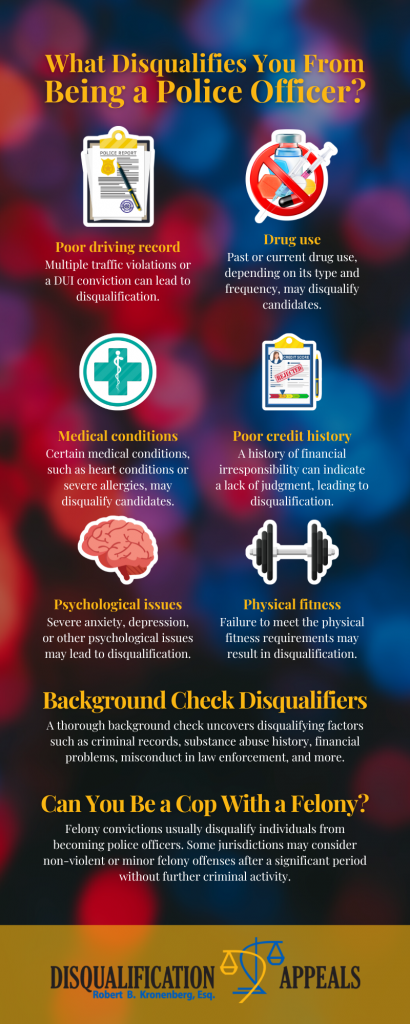
    What Disqualifies You From Being a Police Officer?

    Here are the categories related to the most common police officer disqualifications during the hiring process:

    • Background investigation concerns and credibility issues, including inconsistent disclosures and problematic patterns uncovered through background checks.
    • Criminal records concerns, especially felony convictions and offenses involving violence or dishonesty.
    • Psychological screening concerns that lead to a proposed psychological disqualification.
    • Character and suitability concerns that lead to a proposed character disqualification.
    • Medical findings that result in medical disqualification appeals or further review.
    • Physical fitness failures that are tied to performance standards or medical readiness.

    Why a Notice of Proposed Disqualification Matters

    A notice of proposed disqualification (NOPD) is not always the first document a candidate receives, but when it appears, it matters because it often defines the window for response.

    An NOPD is typically the agency stating, in writing, that it intends to disqualify the candidate unless they submit a persuasive response within the allowed timeframe. That response may involve records, evaluations, explanations, and other supporting material. In many cases, the way a candidate responds to the NOPD shapes what happens next, including whether the agency withdraws the proposed determination or moves toward a final decision.

    This is also where candidates can lose ground quickly. Delay, incomplete documentation, or unfocused explanations can allow the proposed decision to become final.

    How Disqualification Appeals Helps Police Candidates in New York

    Civil service procedures and strict deadlines often govern disqualification decisions. Candidates do not always get unlimited chances to fix the record. That is why structure and precision matter.

    At Disqualification Appeals, Robert B. Kronenberg, Esq., reviews the stated grounds for disqualification, identifies what the agency is actually focusing on, and develops a response strategy that addresses those issues directly. Depending on the case, that work may involve documentation gathering, coordinating medical or psychological evaluations, preparing written submissions, and representing candidates in later administrative proceedings.

    Kronenberg’s background as a former New York City Police Captain adds a practical perspective to cases involving NYPD screening standards and disqualification decisions.

    Speak With a Police Disqualification Attorney

    If you are pursuing a career with the New York City Police Department or another New York agency and have received a disqualification or a notice of proposed disqualification for one of the most common police officer disqualifications, you do not have to guess what the next step should be.

    Call us at 631-234-4434 or contact us online today to schedule a consultation and learn how Disqualification Appeals and Robert B. Kronenberg, Esq., can help you respond to an NOPD and protect your path toward appointment.

  • Police Background Check Errors: Steps to Correct Mistakes

    Police Background Check Errors: Steps to Correct Mistakes

    Background checks are a critical component of the hiring process for law enforcement agencies, ensuring that only candidates with the highest integrity are selected. However, these checks are not infallible. Police background check errors seen on reports can unfairly disqualify otherwise qualified candidates. When this happens, it is essential to act quickly to correct the mistakes and pursue an appeal.

    If you want to learn more about what you can do if you’ve applied for the NYPD and received a notice of disqualification due to a background error check, continue reading to learn more from the experts at Disqualification Appeals.

    What Types of Errors Can Occur?

    Errors in background checks can take various forms. Outdated or incorrect criminal records are among the most common issues, but mistakes can also occur in areas such as employment history, education verification, or credit reports. These inaccuracies can raise concerns about a candidate’s character and lead to disqualification if not promptly addressed.

    Appealing a Background Check Error

    The first step in appealing a background check error is to obtain a copy of the report and review it thoroughly. Identifying the specific areas of concern will help candidates determine what documentation is needed to correct the record. For example, if the issue involves an incorrect criminal record, obtaining court documents or police reports may be necessary to prove the error.

    Once the relevant documents have been gathered, candidates should submit a formal appeal to the department or agency responsible for the background check. This process often involves providing a written explanation along with supporting evidence to demonstrate the inaccuracies in the report.

    Do Specialized Disqualification Attorneys Help?

    Working with a police disqualification attorney can greatly improve the chances of a successful appeal. Attorneys understand the nuances of the appeals process and can help candidates present their case effectively. They can also assist with follow-up communications to ensure the appeal is handled in a timely manner.

    Moving Toward Your Future Career With Disqualification Appeals

    Time can be of the essence when appealing background check errors. Many departments have strict deadlines for submitting appeals, and missing these deadlines can result in permanent disqualification. Candidates should act quickly and stay organized throughout the process to avoid unnecessary delays.

    Disqualification Appeals has extensive experience helping candidates correct background check errors and navigate the appeals process. Whether you are facing a character, medical, or psychological disqualification, or you need assistance with documentation, legal guidance, or follow-up communications, our team is here to support you. Contact us online today. With the right preparation and persistence, you can correct background check mistakes and continue pursuing your career in law enforcement.

  • What Is a Civil Service Law Enforcement Exam?

    What Is a Civil Service Law Enforcement Exam?

    A Civil Service Law Enforcement Exam is a standardized test that potential candidates must pass to qualify for positions in various law enforcement agencies, including police departments, sheriff’s offices, and state law enforcement organizations. This exam is part of the civil service system, which ensures that hiring, promotion, and other personnel processes are fair and based on merit rather than personal connections or other non-merit factors. If you are looking to answer, “What is a civil service law enforcement exam?” Disqualification Appeals is here to help.

    We will begin by explaining what this test is. The civil service exam assesses skills and knowledge essential for law enforcement roles. This can include reading comprehension, problem-solving, memory, situational judgment, and reasoning abilities. It can also test a candidate’s knowledge of laws, regulations, and general police procedures. The aim is to determine whether candidates have the intellectual and psychological capabilities required to perform effectively and responsibly in a law enforcement capacity.

    If you want to join the NYPD, passing the civil service law enforcement exam is one of the first steps in the hiring process. The exam scores usually determine a candidate’s placement on an eligibility list, from which departments select individuals for further evaluation and potential employment. You should be prepared. In addition to these questions, there will be other assessments such as physical fitness tests, psychological evaluations, and background checks.

    Does the NYPD Require Candidates to Take a Civil Service Law Enforcement Exam?

    Candidates of the NYPD are required to take a civil service law enforcement exam. This exam is a crucial part of the selection process for becoming a police officer in New York City. Known as the Police Officer Entrance Exam, it is designed to assess the cognitive abilities, decision-making skills, and personality traits necessary for effective performance in law enforcement roles.

    The NYPD’s entrance exam evaluates several competencies, including problem-solving, memory, reading comprehension, and data interpretation. The exam aims to ensure that candidates have the basic skills required to undergo further training at the police academy and to perform the duties of a police officer effectively.

    Those candidates who pass the exam are placed on an eligibility list, and their scores determine their rank on this list. Higher scores improve a candidate’s chances of being called for further assessments, which include physical tests, medical exams, psychological evaluations, and background checks. The hiring process is competitive and structured to select individuals who demonstrate the potential to uphold the law and serve the community as members of the NYPD.

    Specifics to Know About the NYPD Police Officer Entrance Exam

    Now that we’ve answered, “What is the civil service law enforcement exam?” you likely have more questions. Below, the experts at Disqualification Appeals have gathered some of the most frequently asked questions related to the NYPD Police Officer Entrance Exam. Continue reading to learn what you can expect if you sign up to take this test.

    How many questions are on the NYPD exam?

    The exam consists of 100 multiple-choice questions.

    What is an NYPD exam passing score?

    The passing score for the NYPD exam is 70 out of 100. Candidates must achieve at least this score to be considered eligible for further processing in the recruitment stages.

    Is the NYPD test verbal, written, or a combination of both?

    The NYPD Police Officer Entrance Exam is primarily a written test administered by the Department of Citywide Administrative Services (DCAS) for New York City. The exam assesses a range of abilities, including reading comprehension, memory, problem-solving, and data interpretation, which are crucial for effective law enforcement duties.

    Is There a Specific Grade Which Is Considered Passing?

    Regarding scoring, candidates must achieve a passing mark to be considered for further processing. The NYPD does not publish a specific passing score publicly, as the passing threshold can vary depending on the specific exam and the competitive scoring system used. Typically, exams are scored on a scale, and a minimum score is set that candidates must meet or exceed to pass.

    How are the exam results used?

    Once the exam is scored, candidates are ranked based on their performance. This ranking becomes crucial as it determines the order in which candidates are called for further assessments in the hiring process. High scorers are placed higher on the eligibility list, giving them a better chance of advancing through the rigorous selection process, which includes additional assessments like physical tests, medical exams, psychological evaluations, and background checks. This structured approach ensures that only the most qualified candidates make it to potential appointments as NYPD officers.

    When was the most recent NYPD civil service exam?

    The most recent NYPD civil service exam was held on February 8, 2024.

    When is the next NYPD Civil Service Exam?

    The NYPD provides opportunities to take the civil service exam, also known as the Police Officer Entrance Exam, throughout the year. The Department of Citywide Administrative Services (DCAS) releases a civil service exam schedule annually every July and also publishes a monthly exam schedule. For the most current information and upcoming exam dates, prospective candidates can subscribe to the NYC Jobs Newsletter. With this, they will receive updates on exam schedules and other city job opportunities​​. Regarding the next NYPD test, this has not yet been scheduled.

    What Is the NYPD Recruitment Process?

    The NYPD recruitment process is a comprehensive, multi-step procedure designed to assess the suitability of candidates for roles within the New York Police Department. Here’s an overview of the typical stages involved:

    Civil Service Exam

    Candidates must first register and pass the NYPD Police Officer Entrance Exam, which tests cognitive abilities and personality traits relevant to police work. They are generally first given a written civil service exam, which tests their cognitive skills and knowledge pertinent to police work.

    List number and initial ranking

    After the exam, candidates receive a list number based on their scores. This ranking determines the order in which they are processed.

    Physical agility test

    This test evaluates candidates’ physical fitness to ensure they can handle the job’s physical demands. It can include running, jumping, sit-ups, push-ups, and other physical tasks.

    Medical assessment

    Candidates undergo a thorough medical examination to ensure they meet the role’s required health standards. This includes vision, hearing tests, and a general physical exam.

    Psychological assessment

    Candidates undergo psychological testing, which includes written tests and a follow-up interview with a psychologist. This helps to assess their mental fitness and emotional stability for police duties.

    Background investigation

    A detailed background check is conducted, including checking criminal records, previous employment, education, and character references. Candidates must demonstrate integrity and a clean legal record.

    Character assessment

    Investigators conduct in-depth interviews to assess candidates’ personality traits, integrity, and moral and ethical standards. This process may include interviews with acquaintances and family members to verify or gain insight into the candidate’s character.

    Drug screening

    All potential recruits are tested for illegal substance use.

    Hiring and appointment

    Successful candidates who pass all stages are offered a position in the NYPD Academy.

    Police Academy training

    Once successfully passing the initial stages, candidates are admitted to the Police Academy for training. This rigorous training, which typically lasts around six months, covers the law and law enforcement techniques, behavioral science, physical training, NYPD protocols, and practical skills necessary for policing.

    Probationary period

    After graduating from the academy, new officers typically undergo a probationary period. During this time, their performance and adaptation to the role are closely monitored and evaluated.

    Throughout the recruitment process, candidates must demonstrate the necessary skills, physical fitness, moral integrity, and psychological stability to handle the policing responsibilities in New York City. Each stage of the process is specifically designed to ensure that only the most suitable candidates are selected to serve as NYPD officers, upholding the department’s integrity, discipline, and community service standards.

    Secure Your Future With Expert Guidance

    Navigating the process of becoming an NYPD officer, from preparing for the civil service law enforcement exam to understanding the recruitment stages, can be daunting. At Disqualification Appeals, we understand the intricacies of these challenges and are here to support your journey.

    Our expert team, led by our NYPD disqualification appeal lawyer Robert Kronenberg, Esq., specializes in helping candidates overcome various NYPD disqualifications, including NYPD character disqualifications, medical disqualifications, and psychological disqualifications. With our team by your side, you can get back on track to smoothly transition through each step of the NYPD hiring process.

    If you need advice on handling a disqualification notice or require professional representation during appeal proceedings, Disqualification Appeals is your dedicated partner. We bring years of experience and a thorough understanding of NYPD procedures to ensure that every candidate receives fair treatment and the best possible chance to overcome these obstacles.

    Take the First Step Toward Your NYPD Career

    Don’t let a disqualification notification deter you from pursuing your dream. Contact Disqualification Appeals today to schedule a consultation. We’re ready to help you with your NYPD recruitment process and provide the guidance you need to prepare effectively for your future in law enforcement.

    Reach out to us online or call us at 631-234-4434 for personalized support tailored to your unique situation. Let us help you turn your aspirations of serving as an NYPD officer into reality.

  • What Disqualifies Applicants From the NYPD?

    What Disqualifies Applicants From the NYPD?

    Common NYPD Disqualifications

    Applicants who want to become NYPD officers face a high bar for entry because they hold such an important role when hired. While this can be frustrating at first, it also means successful applicants will hold all of the benefits of being a public servant, along with competitive pay and a pension. Prospective NYPD officers need to know some factors that could potentially result in an NYPD disqualification so that they can be prepared to confront them or work to correct them. Below, Mr. Robert. B. Kronenberg, an experienced disqualification appeal attorney, examines some of the most pertinent factors that may lead to an NYPD disqualification. 

    What are Popular NYPD Disqualifications? 

    NYPD disqualifications occur when the NYPD believes that an applicant should be disqualified based on their medical history (medical disqualification), psychological history (psychological disqualification), or character (character disqualification). 

    A disqualification based on medical history usually occurs thanks to a facet of an applicant’s health that hinders their ability to perform the regular duties of an NYPD officer. These could be pulmonary issues, physical disabilities, not meeting weight requirements, and more. An applicant who receives a medical disqualification is recommended to get a second opinion from another medical professional before or during the medical disqualification appeal process. 

    Another kind of disqualification that applicants typically receive is psychological disqualification. Police officers are under immense pressure, especially in a jurisdiction such as New York, so applicants need to be deemed psychologically fit to manage the pressure and anxiety that accompany the job. Public servants, including NYPD officers, undergo both oral and written assessments to determine if they are anxious, depressed, or exhibit poor judgment. When applicants feel that they need to start the psychological disqualification appeal process, they should get a second opinion from a professional and partner with a police disqualification attorney like Mr. Kronenberg. 

    The final disqualification appeal that candidates should be aware of is an NYPD character disqualification. A character disqualification is based on the candidate’s arrest history, financial history, or driving history. Someone who has had their candidacy disqualified should look to undergo the process of a character disqualification appeal with the help of an experienced lawyer like Robert B. Kronenberg. 

    Robert B. Kronenberg is an experienced NYPD disqualification appeal lawyer who is ready to help applicants appeal the decision to disqualify their application. Contact us today to learn more.