Tag: NYPD

  • Failure to Disclose Information on an NYPD Application

    Failure to Disclose Information on an NYPD Application

    What Candidates Should Know About Disclosure Issues

    Failure to disclose information on an NYPD application can create serious problems for NYPD candidates, especially when the missing information appears during a background investigation, character review, or later stage of the hiring process. For candidates applying to the New York City Police Department, an omission may raise questions about judgment, honesty, consistency, and whether the candidate fully understood what the application required.

    The specialists at Disqualification Appeals help candidates review concerns raised during NYPD character disqualification, psychological disqualification, and medical disqualification matters. When an omission leads to a Notice of Proposed Disqualification (NOPD), the response should be specific, organized, and tied to the facts in the candidate’s record.

    Why Disclosure Issues Matter in the NYPD Hiring Process

    Police candidates are expected to provide complete and accurate information during the hiring process. That does not mean every omission is intentional, but it does mean the NYPD may review missing information carefully.

    A disclosure issue may involve employment history, prior discipline, school records, driving history, arrests, summonses, financial concerns, substance use, medical history, or other background information. In some cases, the concern is not only the underlying issue. The concern may be that the candidate did not disclose it when asked.

    That distinction matters. A candidate may believe the issue itself was minor, old, sealed, dismissed, misunderstood, or not worth mentioning. The department may focus on whether the candidate answered the question fully, whether the application matched the background record, and whether later explanations are consistent with earlier statements.

    How an Omission Can Become a Character Concern

    A character assessment looks at more than whether a candidate has made mistakes. It may also consider how the candidate explains those mistakes, whether the candidate accepted responsibility, and whether the candidate was complete and consistent during the process.

    If the NYPD believes information was left out, the issue may be treated as a concern about honesty or reliability. That can happen even when the missing information would not have automatically disqualified the candidate on its own.

    For example, a prior employment issue may be explainable. A financial problem may have context. A dismissed arrest may not tell the whole story. But if the candidate did not disclose the issue when the application asked for it, the department may view the omission as part of the character review.

    What Candidates Should Review Before Responding

    Before responding to a Notice of Proposed Disqualification, candidates should carefully review the exact question that was asked, the answer they gave, and the record the department later found. The goal is to understand whether the issue involved a true omission, a misunderstanding, an unclear question, a records mismatch, or a mistake that needs to be explained.

    Candidates should also review whether the same issue appeared anywhere else in the file. A missing detail on one form may look different if the candidate disclosed it during another part of the process. On the other hand, a repeated omission across multiple forms or interviews may require a more detailed explanation.

    Failure to disclose information on an NYPD application should not be answered with a vague statement. The response should explain what happened, why the information was missing, whether the candidate misunderstood the question, what the complete facts are, and what documentation supports the explanation.

    Why Consistency Matters Across the Record

    Consistency is important because the hiring file may include multiple sources of information. The NYPD may compare the application, background forms, interview answers, records checks, employment history, school history, financial records, and other materials.

    If those records do not match, the candidate may need to explain the difference. A strong response should not ignore inconsistencies or assume they will be overlooked. It should identify the issue clearly and provide context that helps the reviewer understand what happened.

    This is especially important for candidates in the Bronx, Brooklyn, Manhattan, Queens, Staten Island, Nassau County, or Suffolk County who may be responding to a local or NYPD-related disqualification matter. The stronger the documentation, the easier it may be to separate an honest mistake from a more serious character concern.

    What Documentation May Help Explain an Omission?

    The right documentation depends on the issue. Employment records may help clarify dates, job titles, terminations, or disciplinary history. Court records may help explain the outcome of an arrest or summons. School records may clarify academic history. Financial records may explain payment history, debt resolution, or changed circumstances.

    Documentation should be relevant to the concern raised by the department. More paperwork is not always better. A focused response should explain what each document shows and why it matters.

    Candidates should also be careful about submitting explanations that conflict with the record. If the department has documents showing one version of events, the response should not create a new contradiction. The goal is to clarify the record, not make it harder to follow.

    How Disclosure Issues Can Overlap With Other Disqualifications

    Disclosure issues often appear in character disqualification cases, but they can also overlap with psychological or medical concerns. For example, a candidate may fail to disclose prior treatment, medication history, substance use, or a medical issue. If the department later discovers that information, the concern may involve both the underlying condition and the omission.

    That is why candidates should review the full notice carefully. The label on the disqualification may not capture every concern the department has. A psychological disqualification may include a character-related issue if the candidate gave inconsistent answers. A medical disqualification may raise disclosure questions if the records do not match the application.

    Disqualification Appeals helps candidates review these overlapping issues so the response addresses the full record, not only the category name on the notice.

    When Should You Speak With an NYPD Disqualification Appeal Lawyer?

    A candidate should consider speaking with an NYPD disqualification appeal lawyer when an omission, incomplete answer, or inconsistent record becomes part of a proposed disqualification. These issues can be difficult to answer because the candidate may need to explain both the missing information and the reason it was not disclosed earlier.

    Legal guidance does not guarantee an outcome. It can help candidates understand the concern, organize the record, gather relevant documentation, and prepare a response that addresses the department’s reasoning directly.

    This can be especially important when the candidate is unsure whether the omission was the main issue, part of a broader character assessment, or connected to another type of disqualification.

    Moving Forward After a Disclosure Concern

    A disclosure issue does not always mean the end of a candidate’s law-enforcement goals, but it should be taken seriously. Before responding, candidates should review the question asked, the answer given, the records found, and the explanation that best fits the complete file.

    Failure to disclose information on a job application can affect how the NYPD evaluates honesty, judgment, and reliability. A focused response should explain the omission, address any inconsistencies, and provide documentation that helps clarify the record.

    Disqualification Appeals works with candidates who have received a Notice of Proposed Disqualification or need help responding to NYPD character concerns. If you are facing a disclosure-related issue during the hiring process, reach out to our team to review your next steps.


  • Steps to File an Appeal After Receiving an NOPD

    Steps to File an Appeal After Receiving an NOPD

    Receiving a Notice of Proposed Disqualification (NOPD) from the New York City Police Department can feel like a final decision. It is not. It is the beginning of a defined process, and understanding the steps to file an appeal at this stage is critical.

    At Disqualification Appeals, we work with candidates who are navigating this exact moment. The steps to file an appeal after receiving an NOPD are time-sensitive and structured, and how you respond can directly affect the outcome. This is not a general appeal process. It is a specific sequence within the NYPD hiring process that requires attention to timing, documentation, and how your case is presented.

    What Happens After You Receive a Notice of Proposed Disqualification?

    A Notice of Proposed Disqualification means the NYPD has identified an issue that may prevent you from moving forward. This could involve a proposed medical disqualification, a proposed psychological disqualification, or a proposed character disqualification.

    At this stage, the department has not issued a final decision. You have the opportunity to respond. This is where the steps to file an appeal begin, even though it is technically considered an administrative response rather than a court appeal.

    The most important factor here is timing. Candidates are generally given a limited window to respond. Missing that window can result in the proposed disqualification becoming final without further review.

    Steps to File an Appeal After Receiving an NOPD

    Understanding the steps to file an appeal in the correct order helps prevent avoidable mistakes. Each step builds on the previous one, and skipping or rushing any part of the process can weaken your position.

    Step 1: Review the Basis for the Proposed Disqualification

    The first step is to carefully review the reason listed in the Notice of Proposed Disqualification. The NYPD will identify the category and provide a general explanation of the concern.

    This is not just informational. The entire appeal process depends on responding directly to the stated reason. A vague or unfocused response can lead to a final disqualification even when supporting information exists.

    Step 2: Gather Supporting Documentation

    Once the basis for the proposed disqualification is clear, the next step is to gather documentation that addresses the issue. This may include medical records, psychological evaluations, employment history, or other supporting materials, depending on the category.

    Documentation must be relevant and organized. Submitting unnecessary or unrelated information does not strengthen an appeal. It can dilute the focus of your response.

    Step 3: Submit Your Administrative Appeal

    The next step in the process is submitting your response within the required timeframe. This is your administrative appeal at the NYPD level.

    This submission for an administrative appeal should:

    • Directly address the reason for the proposed disqualification
    • Include supporting documentation
    • Present a clear and structured explanation

    This is where many candidates make critical mistakes. A rushed or incomplete submission can lead to a final Notice of Disqualification, even if the underlying issue could have been addressed.

    Step 4: Await the NYPD Determination

    After your response is submitted, the NYPD will review your materials and issue a determination. At this point, the department may either reverse the proposed disqualification or uphold the decision and issue a final disqualification.

    If the disqualification is upheld, the process does not necessarily end, but the next steps change significantly.

    What Happens if Your Administrative Appeal Is Denied?

    If the NYPD issues a final disqualification, you may have the option to continue the appeal process through the Civil Service Commission.

    This stage involves a more formal review of your case. It may include additional documentation, written submissions, or a hearing, depending on the circumstances.

    This is still part of the administrative process. It is not yet a court proceeding, but it is a critical step before any judicial review.

    When Does an Article 78 Appeal Apply?

    An Article 78 proceeding is not the next step after receiving an NOPD. It only becomes relevant after all administrative remedies have been exhausted.

    Once a final determination has been issued and administrative appeals have been completed, a candidate may choose to file an Article 78 proceeding in court. This is a legal challenge to the agency’s decision, not a continuation of the internal review process.

    Article 78 filings are subject to strict timelines, typically within four months of the final decision. Missing this deadline can entirely eliminate the option.

    Understanding the distinction between administrative appeals and an Article 78 proceeding is essential. Many candidates assume they can go directly to court after receiving an NOPD. That is not how the process works.

    Common Mistakes When Filing an Appeal

    Candidates often run into problems not because their case lacks merit, but because the process is misunderstood.

    One of the most common issues is treating the response to an NOPD as a formality. It is not. This is the stage where your case is first evaluated in detail.

    Another frequent mistake is submitting incomplete or unfocused documentation. The response must directly address the reason for the proposed disqualification. General statements or unrelated materials do not strengthen your position.

    Timing is also a critical factor. Waiting too long to respond or misunderstanding deadlines can lead to disqualification without a full review.

    Frequently Asked Questions About Appealing an NYPD Disqualification

    What are the steps to file an appeal after receiving an NOPD?

    The steps to file an appeal begin with reviewing the reason for the proposed disqualification, gathering supporting documentation, and submitting a structured response within the required timeframe. This is followed by an NYPD determination and, if necessary, further administrative review.

    How long do you have to respond to a Notice of Proposed Disqualification?

    Candidates are typically given a limited window to respond. The exact timeframe may vary, but it is generally around 30 days. Acting promptly is essential to preserve your ability to appeal.

    What is the difference between an NOPD and a final disqualification?

    A Notice of Proposed Disqualification is not a final decision. It provides an opportunity to respond. A final disqualification occurs after the NYPD reviews your response and decides to uphold the determination.

    Can you appeal a final NYPD disqualification?

    Yes. After a final disqualification, candidates may pursue further administrative review through the Civil Service Commission. If those remedies are exhausted, an Article 78 proceeding may be available.

    What is an Article 78 appeal?

    An Article 78 proceeding is a court action used to challenge a final agency decision. It is not part of the initial appeal process and only applies after administrative options have been completed.

    Understanding Your Next Step

    Knowing the steps to file an appeal after receiving an NOPD is only part of the process. Applying those steps correctly is what determines the outcome.

    At Disqualification Appeals, we assist candidates in evaluating their situation, organizing their response, and understanding how each stage of the NYPD disqualification process applies to their case. Whether the issue involves a proposed medical disqualification, proposed psychological disqualification, or proposed character disqualification, each case depends on how the response is structured and presented.

    Taking action early, staying within deadlines, and focusing on the specific reason for the proposed disqualification can make a meaningful difference in how your case is reviewed. Learn more on our blog or contact us today to learn how we can help you.

  • Lawyer Cost for NYPD Disqualification Appeals: What to Expect

    Lawyer Cost for NYPD Disqualification Appeals: What to Expect

    When candidates receive a Notice of Proposed Disqualification (NOPD) from the New York City Police Department, their first question often revolves around lawyer cost. They question whether hiring an NYPD disqualification appeal lawyer is worth it and what that investment may look like.

    At Disqualification Appeals, a specialty law firm, we work directly with candidates navigating the NYPD disqualification process. We understand how important pricing is at this point. While every case is different, we can explain how lawyer costs are typically structured, what affects pricing, and what candidates should realistically expect.

    How Much Does a Lawyer Cost for an NYPD Disqualification Appeal?

    Lawyer costs can vary depending on the complexity of the case, the type of proposed disqualification, and how far the appeal process goes. Complexity involves the level of work required, from more limited administrative responses to more involved cases that require additional review or multiple stages. There are no fixed prices, only general ranges based on how much work is done.

    We focus on helping candidates understand their options, including possible costs, before they commit to moving forward. This ensures they can make informed decisions about how to proceed.

    What Affects Lawyer Cost in an NYPD Disqualification Case?

    There is no single price for an appeal. Several factors influence how lawyer costs are determined in an NYPD disqualification appeal. Here we explain three common factors that often affect the pricing.

    The Type of Disqualification

    The category of disqualification plays a major role in cost.

    A proposed medical disqualification may require reviewing records, coordinating with medical professionals, and presenting updated evaluations.

    A proposed psychological disqualification often involves detailed report analysis, independent psychological evaluations, and structured responses that address specific findings.

    A proposed character disqualification may require documentation of background history, employment records, and clarification of past issues.

    Each category involves a different level of preparation, which directly affects cost.

    The Stage of the Appeal Process

    Lawyer costs are also affected by how far the case progresses.

    An administrative response to a Notice of Proposed Disqualification is typically more limited in scope than a case that moves to the Civil Service Commission. If the matter proceeds to an Article 78 proceeding, the level of legal work increases significantly.

    This is why cost can vary widely. Some cases are resolved early, while others require multiple stages of review.

    The Complexity of the Case

    Not all cases are equal. Some involve a single issue that can be addressed with targeted documentation. Others involve multiple concerns that require a more comprehensive response.

    Complex cases often require multiple forms of documentation, coordination with outside professionals, and detailed written submissions.

    As the complexity increases, so does the amount of work involved, affecting the overall cost.

    Appeals Lawyer Cost vs. Doing It Alone

    Some candidates consider handling the appeal on their own to avoid legal fees. While that may seem like a way to reduce cost, it is important to understand what is at stake.

    The response to a Notice of Proposed Disqualification is not a simple form submission. It is a structured argument that must directly address the reason for the proposed disqualification.

    An incomplete or unfocused response can lead to a final disqualification, even in cases where supporting evidence exists. Once a final decision is issued, the process becomes more complex and may involve additional costs at later stages.

    We often work with candidates who have attempted to respond on their own and later needed to correct issues in the process. Addressing the situation early can be more efficient than trying to fix it after a denial.

    What Is Included in the Cost of an NYPD Disqualification Appeal Lawyer?

    Lawyer costs typically reflect the scope of work required to prepare and present the appeal. This may include:

    • Reviewing the Notice of Proposed Disqualification
    • Analyzing supporting documentation
    • Coordinating with medical or psychological professionals when needed
    • Preparing written submissions
    • Advising on timelines and next steps

    In more advanced stages, it may also include representation before the Civil Service Commission or preparation for an Article 78 proceeding.

    Each case is evaluated individually to determine what level of involvement is appropriate.

    Is Hiring an NYPD Disqualification Appeal Lawyer Worth It?

    Whether hiring a lawyer is worth it is one of the most common questions candidates ask when considering lawyer costs. The answer depends on the circumstances of the case, but the key factor is what the outcome represents. For many candidates, the appeal determines whether they can continue pursuing a career with the NYPD.

    The NYPD hiring process is structured, and decisions are based on how information is presented and evaluated. Understanding how to respond to a proposed medical disqualification, proposed psychological disqualification, or proposed character disqualification can influence how the case is reviewed.

    We focus on helping candidates understand their positions and determine the most effective way to move forward based on their specific situations.

    How We Approach Cost Transparency at Disqualification Appeals

    We believe candidates should have a clear understanding of lawyer costs before moving forward. While we do not present one-size-fits-all pricing, we explain what factors affect cost and what level of work may be required.

    Our approach is based on evaluating the case first, then outlining what is involved. This allows candidates to decide how to proceed with full awareness of what the process may require.

    Candidates can review their options and contact our team to discuss their situation before making any decisions.

    Frequently Asked Questions About Lawyer Costs

    How much does a lawyer cost for an NYPD disqualification appeal?

    Lawyer costs for an NYPD disqualification appeal can vary based on the type of disqualification and the complexity of the case. Administrative appeals may generally cost less than more complex cases involving additional stages.

    What affects the cost of an appeals lawyer the most?

    The main factors affecting the cost of an appeals lawyer include the type of disqualification, the amount of documentation required, and whether the case remains at the administrative level or progresses to further review.

    Is it more expensive to file an Article 78 appeal?

    An Article 78 proceeding involves court filings and a higher level of legal work. This amount of work typically increases the overall cost compared to an appeal that only requires administrative work.

    Can I handle an NYPD disqualification appeal without a lawyer?

    It is possible to handle an NOPD appeal by yourself. However, the process requires a structured response that directly addresses the reason for the proposed disqualification. Errors or omissions at this stage can affect the outcome, making hiring a lawyer a valid expense.

    Do all NYPD disqualification cases cost the same?

    Because each case is different, not all NYPD disqualification cases cost the same. Pricing depends on the category of disqualification, the complexity, and the stage of the appeal process.

    Understanding Your Next Step

    Lawyer cost is an important consideration, but it is only one part of the decision. The outcome of an appeal can affect whether you are able to continue in the NYPD hiring process.

    At Disqualification Appeals, we provide legal advice to candidates across the Bronx, Brooklyn, Manhattan, Queens, and Staten Island, as well as Nassau County and Suffolk County, to evaluate their cases and explain their options. Whether the issue involves a proposed medical disqualification, a proposed psychological disqualification, or a proposed character disqualification, each situation requires a tailored approach.

    Candidates who want to better understand their position can learn more about the NYPD disqualification process on our blog or contact our team to review their case and discuss next steps.

  • When Should You Hire a Lawyer for a Police Disqualification Appeal?

    When Should You Hire a Lawyer for a Police Disqualification Appeal?

    Becoming a police officer is a lifelong goal for many, but the path isn’t always straightforward. A police officer disqualification can feel like the end of the road, but it doesn’t have to be. Whether you’re facing issues with a psychological evaluation, background check, or academy rejection, knowing when to take legal action is critical. That’s where Disqualification Appeals come in. With deep experience handling NYPD and other law enforcement appeals, their team provides the legal clarity and support needed to challenge unjust decisions and get your application back on track.

    A police officer disqualification can feel like the point where everything changes. For many candidates, it raises immediate questions about whether the decision can be challenged, whether the record is complete, and whether hiring a lawyer may improve the way the response is presented.

    If the disqualification involves the New York City Police Department, those questions often begin after a Notice of Proposed Disqualification (NOPD) is issued. At that stage, candidates are not just trying to understand why the decision was made. They are also trying to determine whether legal help may matter before the disqualification becomes final.

    At Disqualification Appeals, our team assists candidates throughout Bronx, Brooklyn, Manhattan, Queens, and Staten Island, as well as Nassau County and Suffolk County, in evaluating when legal representation may be useful in a police officer disqualification case and what steps should come next.

    Understanding a Police Officer Disqualification

    A police officer disqualification can happen at different stages of the hiring process and for different reasons. In some cases, it arises from a psychological evaluation. In others, it may stem from medical findings, background concerns, or issues that surface during the agency’s review of the application.

    For NYPD candidates, a police officer disqualification may take the form of a proposed psychological disqualification, a proposed medical disqualification, or a proposed character disqualification. Each category creates different response needs, different evidentiary concerns, and different risks if the record is not handled carefully.

    That is why the first question is not always whether a candidate needs to go to court. The first question is usually what stage the case is in and whether the candidate is still responding within the administrative process.

    If you have received a Notice of Proposed Disqualification from the New York City Police Department, you are still in the response stage. That means you may still have an opportunity to challenge the department’s reasoning before a final police officer disqualification decision is made.

    Situations Where Hiring a Lawyer May Matter Most

    Not every police officer disqualification requires the same level of legal involvement. Some matters are narrow and document-driven. Others involve more interpretive or procedural issues, which can make legal guidance much more important.

    A proposed psychological disqualification often requires close attention because the decision may be based on interviews, testing, evaluator impressions, or records that the candidate has not fully seen or addressed. Appealing a psychological disqualification may require coordination with an independent professional and a carefully structured response that speaks directly to the agency’s findings.

    A proposed medical disqualification can also create serious problems when the record is incomplete, outdated, or based on conclusions that do not fully reflect the candidate’s present condition. In those cases, the issue is not just obtaining records. It is making sure the response is organized in a way that addresses the department’s stated concerns clearly and persuasively.

    A proposed character disqualification may involve background issues, employment history, alleged inconsistencies, or concerns raised during an NYPD character assessment. These cases often require more than a simple explanation. They may require documentation, context, and a response strategy that anticipates how the agency is likely to interpret the record.

    In all three situations, a police officer disqualification can become more difficult to challenge when the response is rushed, incomplete, or poorly framed.

    Why the Administrative Stage Matters

    Candidates sometimes assume that if a police officer disqualification is unfair, they can correct the problem later. In reality, the administrative stage often becomes the foundation for everything that follows.

    A response submitted after a Notice of Proposed Disqualification does more than answer the immediate concerns. It helps shape the record that may later be reviewed if the matter becomes final. That is one reason many candidates choose to speak with an NYPD disqualification appeal lawyer before submitting a response, even if they are not yet certain they want full representation.

    The goal at this point is not to overreact. It is to understand whether the disqualification appears straightforward or whether it raises issues that should be handled with greater care.

    A police officer disqualification tied to disputed facts, a complex medical issue, a background concern, or a psychological finding may call for a more deliberate response than a candidate could reasonably prepare alone.

    When You Might Not Need Full Representation Right Away

    There are situations in which a police officer disqualification may not require immediate, full-scale legal intervention. If the issue is narrow, well-documented, and easily corrected, a candidate may decide to begin with a consultation rather than full representation.

    For example, a candidate who was disqualified from the police academy or flagged over a limited documentation issue may simply need help understanding what the agency is asking for and how to respond without creating new problems.

    That said, even an issue that appears small can become more serious if the agency interprets it broadly. A brief legal review can often help determine whether the response is likely to remain simple or whether the matter has enough risk to justify more involved representation.

    What Happens If the Police Officer Disqualification Becomes Final?

    If the agency affirms the disqualification after reviewing the candidate’s response, the posture changes. At that point, the issue is no longer just whether the department can be persuaded internally. It becomes a question of whether the final decision should be challenged further and whether judicial review may be available.

    That analysis is very different from the earlier response stage. It involves reviewing the record, the process, the stated basis for the disqualification, and the legal standards that may apply if the final decision is contested.

    This is another point at which working with an NYPD disqualification appeal lawyer may become especially important. A final police officer disqualification can affect future opportunities, and deadlines may become stricter once the matter moves beyond the initial agency review.

    Candidates in New York City, Nassau County, and Suffolk County

    We have focused on NYPD disqualification matters within the five boroughs of New York City. However, Robert B. Kronenberg also represents candidates in Nassau County and Suffolk County, where separate departments and civil service systems apply their own standards.

    Although the terminology and procedures may vary, similar concerns arise in police officer disqualification cases across these jurisdictions. Medical issues, psychological findings, and character-related concerns can all affect whether a candidate moves forward, and each situation requires careful review of the governing rules and deadlines.

    How Our Team Approaches Police Officer Disqualification Cases

    At Disqualification Appeals, we evaluate the actual posture of the case before recommending a path forward. We do not assume that every police officer disqualification should immediately lead to litigation or that every candidate needs the same level of representation.

    Instead, we review whether the matter involves a proposed psychological disqualification, proposed medical disqualification, or proposed character disqualification, how the New York City Police Department framed its concerns, and what kind of response may be most effective at that stage.

    If you received a police officer disqualification from the NYPD, or if you are trying to decide whether hiring a lawyer makes sense after receiving an NOPD, contact Disqualification Appeals today. We can review your situation and help you determine the next appropriate step.

  • What Is a Notice of Proposed Disqualification (NOPD)?

    What Is a Notice of Proposed Disqualification (NOPD)?

    A notice of proposed disqualification is a formal written letter issued during the New York police hiring process. Often shortened to NOPD, this notice informs a candidate that a law enforcement agency intends to remove them from consideration unless a successful response is submitted within a limited period of time. If you received an NOPD from the New York City Police Department, also referred to as an NYPD disqualification notice, understanding exactly what this document is can mean the difference between becoming a police officer and not realizing your dreams.

    For applicants pursuing a career with the New York City Police Department (NYPD), receiving an NOPD can feel sudden and overwhelming. Many candidates assume that once they pass the Civil Service Law Enforcement exam, physical testing, interviews, and screening steps tied to admission into the NYPD police academy, they are close to joining a class. A notice of proposed disqualification signals that the department has identified concerns that could block that goal unless addressed through a formal appeal.

    Understanding what an NOPD means, why it is issued, and how the process works is essential for protecting your opportunity to move forward in the hiring process.

    At Disqualification Appeals, Robert B. Kronenberg, Esq., represents candidates across New York State who face proposed psychological disqualifications, proposed character disqualifications, or proposed medical disqualifications during the police hiring process. As a former New York City Police Captain and an experienced disqualification appeal attorney, Kronenberg brings operational knowledge and legal strategy to cases involving NYPD hiring decisions and civil service appeals.

    What Does a Notice of Proposed Disqualification Mean?

    A notice of proposed disqualification is not a final ruling. The word proposed matters. It reflects a preliminary determination by the NYPD or another New York civil service agency that a candidate may not meet appointment standards.

    The notice typically outlines:

    • The category or categories of concern
    • A summary of the findings
    • Instructions for submitting a written response
    • Deadlines for filing materials

    For NYPD applicants, this letter often represents the only opportunity to challenge the department’s conclusions before a final Notice of Disqualification is issued.

    Why the NYPD Issues Notices of Proposed Disqualification

    The New York City Police Department maintains strict hiring requirements because officers hold positions of public trust. When issues arise during screening, the department may issue an NOPD rather than immediately closing the application.

    Most notices fall into three major categories.

    Psychological Concerns

    A proposed psychological disqualification may follow interviews, written testing, or clinical evaluations. Factors can include treatment history, medication use, patterns in employment or relationships, or what candidates sometimes refer to as a failed NYPD oral psych exam. Departments evaluate whether an applicant demonstrates judgment, emotional stability, and reliability consistent with policing standards.

    Character and Background Concerns

    A proposed character disqualification usually grows out of the background investigation. These reviews involve background checks, examination of criminal records, honesty during interviews, driving history, employment performance, academic discipline, and financial responsibility. Some background checks might even uncover inconsistencies or omissions that trigger additional scrutiny.

    Some cases center on how past conduct is interpreted rather than on disqualifying behavior itself, which is why careful explanation and documentation often become critical during appeals.

    Medical Concerns

    Medical screening can result in records including information related to hearing or vision, orthopedic conditions, pulmonary or cardiac evaluations, or overall readiness for duty. When those findings lead to a proposed medical determination, candidates may pursue medical disqualification appeals supported by outside physicians or updated testing.

    In every category, the notice of proposed disqualification represents the department’s intent to disqualify unless the applicant can present information that changes that conclusion.

    How Long Do You Have to Respond to an NOPD?

    For most NYPD candidates, the deadline to respond to a notice of proposed disqualification is thirty days from the date of the letter.

    That window closes quickly when medical records, psychological evaluations, employment histories, or written explanations must be gathered. Missing the deadline often causes the proposed determination to become final, which can make it far harder to continue pursuing a career with the NYPD or another New York agency.

    Because of this, candidates should treat an NOPD as a serious legal matter rather than a routine administrative letter.

    What Happens After You Submit Your Response?

    After an NOPD response is filed, the hiring agency reviews the materials and decides whether to withdraw the proposed disqualification or proceed toward a final decision.

    If the NYPD issues a final Notice of Disqualification, additional administrative remedies may exist through the civil service commission review board. In some cases, matters proceed to hearings before commissions or boards that evaluate whether the department followed proper procedures and standards.

    Applicants from other jurisdictions across the state, including those tied to county departments or Nassau County Civil Service exams, may encounter similar structures.

    This multi-stage process is why the initial submission carries so much weight. A well-prepared response shapes how the case unfolds at every later phase.

    Why a Notice of Proposed Disqualification Should Never Be Ignored

    Some candidates assume the department has already made up its mind. Others hesitate because they are unsure how to respond or what documentation matters most.

    An NOPD formally opens the appeal window. Failing to act, submitting incomplete materials, or overlooking critical explanations can allow the proposed determination to become permanent.

    For candidates who invested months preparing for academy admission, ignoring a notice of proposed disqualification can mean losing the chance to begin the police career they worked toward.

    How Disqualification Appeals and Robert Kronenberg Help NYPD Candidates

    Once the foundation of the process is understood, candidates often seek legal guidance to navigate the complexity that follows.

    At Disqualification Appeals, Robert B. Kronenberg, Esq., represents applicants across New York State who face proposed psychological, character, and medical determinations during the hiring process for police officers. As a former New York City Police Captain and an experienced police disqualification attorney, Kronenberg understands how agencies evaluate applicants and what documentation and arguments carry weight during review.

    His work frequently involves analyzing the NOPD in detail, coordinating independent medical or psychological evaluations when appropriate, preparing written submissions, and ensuring deadlines are met. In complex cases, he may represent candidates during interviews or later administrative proceedings tied to NYPD disqualification challenges.

    Does an NOPD Apply Only to the NYPD?

    Although the term is most closely associated with the New York City Police Department, notices of proposed disqualification are used throughout New York civil service hiring systems.

    Municipal agencies, county departments, and other law enforcement organizations across the state rely on similar procedures. Whether a candidate is seeking a career with the NYPD or another agency, the need for a prompt and carefully prepared response remains the same.

    Speak With a Disqualification Appeal Attorney About Your NOPD

    If you have received a notice of proposed disqualification or an NOPD from the NYPD or another New York law enforcement agency, acting quickly can protect your opportunity to continue in the hiring process.

    Disqualification Appeals represents candidates facing:

    • A proposed psychological disqualification
    • A proposed character disqualification
    • Any medical disqualification determinations

    Robert Kronenberg works with qualified medical and psychological professionals when needed and prepares each case with the precision these matters demand.

    Call us at 631-234-4434 or contact us online today to schedule a free phone consultation and get additional information regarding how Disqualification Appeals can help you pursue the NYPD career you worked toward.

  • Most Common Police Officer Disqualifications

    Most Common Police Officer Disqualifications

    Many people pursue law enforcement because they want to serve their community, build a stable career, and join a respected profession. Candidates pursuing a career with the New York City Police Department (NYPD) often spend months preparing for exams, background investigation steps, medical screening, psychological evaluation, and physical testing. Then, sometimes late in the process, the application stops moving forward when an NYPD disqualification notice is received, often due to one of the most common police officer disqualifications.

    At Disqualification Appeals, Robert B. Kronenberg, Esq., represents police candidates across New York State who face disqualifications during hiring. As a former New York City Police Captain and an experienced police disqualification attorney, Kronenberg understands how agencies evaluate candidates and how to respond when a determination threatens a candidate’s future.

    This guide explains the most common reasons candidates are disqualified, how agencies typically evaluate those issues, and why the first response matters. In some cases, the first formal notice is a notice of proposed disqualification, also known as an NOPD, which signals the agency’s intent to disqualify unless the candidate responds effectively and on time.

    Why Police Candidates Get Disqualified

    Disqualification decisions rarely come from one single detail viewed in isolation. Police departments screen for suitability across multiple areas at once, including honesty, judgment, reliability, medical readiness, psychological fitness, and physical capability.

    A disqualification can appear as a final decision, or it can begin as a proposed determination. For example, a candidate may receive a proposed psychological disqualification tied to mental health findings or a proposed medical disqualification related to a previous or existing medical condition. In both scenarios, the underlying issue is usually how the agency interprets risk, credibility, and readiness for duty.

    Background Investigation Disqualifiers

    Background investigation issues are among the most common drivers of police officer disqualifications. Departments look well beyond whether someone has ever been arrested. The review board looks for patterns of conduct over time, and they pay close attention to credibility.

    A background investigation can raise concerns when there are inconsistencies in the application, omissions, conflicting statements, problematic employment history, repeated disciplinary issues in school or work settings, a history of domestic violence, or financial instability that suggests poor judgment. Agencies also evaluate whether an applicant’s statements match what is uncovered through background checks, including driving history and prior interactions with law enforcement.

    When background investigation findings create doubts about honesty or overall suitability, a candidate may face a proposed character disqualification, even when there is no single automatic disqualifier in the file.

    Criminal Records and Police Hiring

    Questions about criminal records are common, and the answer is almost always fact-specific. The type of offense, the age of the offense, the circumstances, and the pattern of conduct that follows all matter. Agencies also evaluate whether the applicant disclosed everything clearly and consistently.

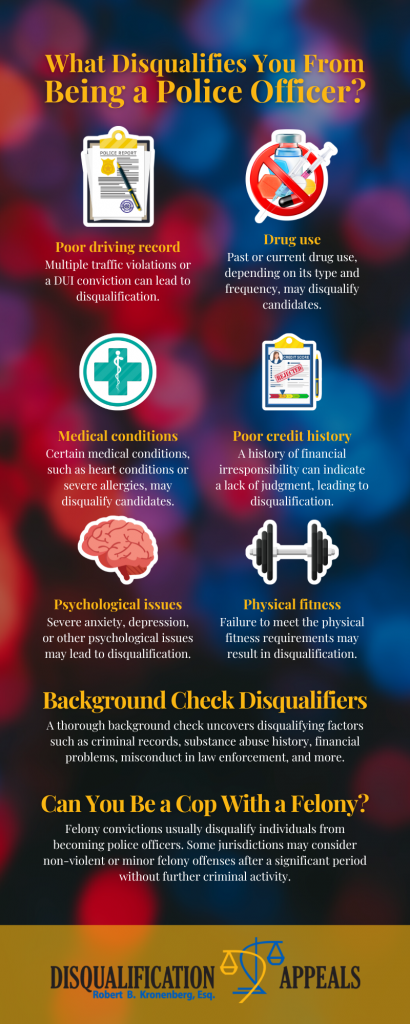
    Can You Be a Cop With a Felony?

    In many jurisdictions, a felony conviction is a major barrier to becoming a police officer. Some departments treat certain convictions as automatic disqualifiers, especially those involving violence, weapons offenses, serious drug distribution, or dishonesty-related conduct.

    The NYPD is widely understood to apply strict standards in this area. Even when the underlying event is old, agencies typically evaluate whether the record suggests a risk to public trust. In practice, felony-related disqualifications are often difficult to overcome, and cases turn heavily on disclosure, context, and supporting documentation.

    If a felony or arrest history triggers a proposed determination, it may appear in a notice of proposed disqualification (NOPD), and the response must be handled with extreme care and timeliness.

    Psychological Disqualifications

    Psychological screening is a major part of police hiring, especially for agencies tasked with high-stress, high-consequence decision-making. The goal is not to eliminate candidates who have ever experienced stress, anxiety, or life challenges. The goal is to determine whether the agency believes the candidate can safely perform the job under pressure and maintain judgment, integrity, and emotional control.

    A proposed psychological disqualification can stem from written testing, clinical interviews, treatment history, medication use, or the way an applicant answers questions about employment history and relationships. Some candidates describe the triggering event as a failed NYPD oral psych exam. Even when candidates feel the evaluation went fine, the agency may interpret patterns or responses differently.

    These cases often require a disciplined explanation, clean documentation, and a clear narrative that addresses the department’s stated concerns.

    Medical Disqualifications and Fitness for Duty

    Medical screening evaluates whether a candidate can perform the physical demands of the job safely and reliably. Disqualifications can involve vision or hearing standards, orthopedic limitations, respiratory issues, cardiac findings, or other conditions that the agency believes create a safety risk.

    Some medical determinations can be clarified or challenged with updated records, specialist evaluations, or additional testing. When that is possible, candidates may pursue medical disqualification appeals supported by medical documentation that directly addresses the agency’s stated concerns.

    Medical issues also commonly appear alongside other concerns in the same case, which can change how the overall response should be structured.

    Physical Fitness Disqualifications

    Physical capability is not optional in policing. If a candidate cannot meet physical benchmarks at the required time, the agency may remove the candidate from consideration.

    Sometimes these outcomes are straightforward. Other times, they are shaped by temporary injury, timing, or inconsistent testing conditions. Where policy permits, candidates may seek review or retesting. When a physical readiness issue is tied to a broader medical finding, it may be treated as part of the medical determination rather than a simple fitness failure.

    What Disqualifies You From Being a Police Officer?

    Here are the categories related to the most common police officer disqualifications during the hiring process:

    • Background investigation concerns and credibility issues, including inconsistent disclosures and problematic patterns uncovered through background checks.
    • Criminal records concerns, especially felony convictions and offenses involving violence or dishonesty.
    • Psychological screening concerns that lead to a proposed psychological disqualification.
    • Character and suitability concerns that lead to a proposed character disqualification.
    • Medical findings that result in medical disqualification appeals or further review.
    • Physical fitness failures that are tied to performance standards or medical readiness.

    Why a Notice of Proposed Disqualification Matters

    A notice of proposed disqualification (NOPD) is not always the first document a candidate receives, but when it appears, it matters because it often defines the window for response.

    An NOPD is typically the agency stating, in writing, that it intends to disqualify the candidate unless they submit a persuasive response within the allowed timeframe. That response may involve records, evaluations, explanations, and other supporting material. In many cases, the way a candidate responds to the NOPD shapes what happens next, including whether the agency withdraws the proposed determination or moves toward a final decision.

    This is also where candidates can lose ground quickly. Delay, incomplete documentation, or unfocused explanations can allow the proposed decision to become final.

    How Disqualification Appeals Helps Police Candidates in New York

    Civil service procedures and strict deadlines often govern disqualification decisions. Candidates do not always get unlimited chances to fix the record. That is why structure and precision matter.

    At Disqualification Appeals, Robert B. Kronenberg, Esq., reviews the stated grounds for disqualification, identifies what the agency is actually focusing on, and develops a response strategy that addresses those issues directly. Depending on the case, that work may involve documentation gathering, coordinating medical or psychological evaluations, preparing written submissions, and representing candidates in later administrative proceedings.

    Kronenberg’s background as a former New York City Police Captain adds a practical perspective to cases involving NYPD screening standards and disqualification decisions.

    Speak With a Police Disqualification Attorney

    If you are pursuing a career with the New York City Police Department or another New York agency and have received a disqualification or a notice of proposed disqualification for one of the most common police officer disqualifications, you do not have to guess what the next step should be.

    Call us at 631-234-4434 or contact us online today to schedule a consultation and learn how Disqualification Appeals and Robert B. Kronenberg, Esq., can help you respond to an NOPD and protect your path toward appointment.

  • Does the NYPD Hire Green Card Holders? The Rules You Need to Know

    Does the NYPD Hire Green Card Holders? The Rules You Need to Know

    Does the NYPD hire green card holders? The NYPD hiring process is strict, and for permanent residents, the answer can determine your future. This guide explains the NYPD’s official position, what roles are available, and how you can stay on track for a law enforcement career. Led by Robert B. Kronenberg, a former NYPD Captain who has represented hundreds of candidates in NYPD disqualification appeals since 2005, our firm provides expert guidance.

    Trying to plan your future in law enforcement? Let’s talk before you apply.

    Can a Green Card Holder Become an NYPD Police Officer?

    Ultimately, the answer to “Can a green card holder become a police officer?” comes down to a clear, non-negotiable requirement. When it comes to law enforcement employment, one of the most significant green card restrictions is the prohibition against becoming a sworn police officer. This is a role that requires the full rights and responsibilities of U.S. citizenship.

    According to the official NYPD recruitment qualifications, “You must be a U.S. citizen at the time of your appointment.” A green card holder is not eligible to be appointed as a full-time, sworn police officer. This is a firm, non-negotiable requirement for all candidates. A green card holder can, however, apply for the NYPD while they are undergoing the citizenship process. They just will not be able to be sworn in until their citizenship is finalized.

    Are There Any NYPD Roles for Green Card Holders?

    The answer to “Can a green card holder join the NYPD in a volunteer capacity?” is yes. You can apply to become an Auxiliary Police Officer, a uniformed, volunteer position available to lawful permanent residents. This allows an NYPD green card holder to contribute to their community while gaining valuable experience as they work toward citizenship. 

    The Auxiliary Police Program is often the source of confusion for those asking, “Does the NYPD hire green card holders?” as it is a uniformed position open to permanent residents. This option is available across all five boroughs: Bronx, Brooklyn, Manhattan, Queens, and Staten Island. This helps candidates build credibility within the NYPD system.

    A Path Forward: How Green Card Holders Can Prepare for the NYPD

    The current answer to “Does the NYPD hire green card holders?” is no. However, for anyone who wants to become a sworn officer, the most important step you can take to change that outcome is to begin the U.S. citizenship process.

    1. Apply for U.S. Citizenship: This is the key eligibility step. You must be naturalized before your appointment date to get hired.
    2. Join the Auxiliary Program: This volunteer role lets you demonstrate interest, commitment, and discipline to the police department.
    3. Stay Disqualification-Free: Maintain a clean record. Misrepresenting your immigration status or history during any official application process can lead to a character-based disqualification.

    Unsure whether your status or history might cause problems later? Contact us before your NYPD assessment begins.

    What to Expect When You Become Eligible

    Once you become a U.S. citizen, you can begin the NYPD’s full hiring process. This includes written, medical, psychological, and background evaluations. Your prior residency status won’t be an issue, but any dishonesty about it could still come up. You will also need to provide a police clearance for green card holders as part of your background file.

    How We Help

    Robert Kronenberg helps applicants navigate not just disqualifications, but the risk factors that lead to them. If you are preparing to apply or have received a Notice of Proposed Disqualification (NOPD), our office can review your situation and help protect your eligibility. A skilled NYPD disqualification appeal lawyer can make all the difference.

    Start Your Path to the NYPD With the Right Legal Help

    The answer to “Does the NYPD hire green card holders?” is no. However, if you want to become a sworn officer, you can still prepare your application the right way. A lawful permanent resident, such as a green card holder, may apply to the NYPD and go through portions of the hiring process, such as exams and preliminary steps.

    U.S. citizenship is required at the time of appointment, which is the point at which the candidate is sworn in as a police officer. A green card holder cannot be sworn in until they have become a U.S. citizen. The wrong step, especially with background disclosures, can disqualify you before you’re even eligible. Let us help you plan for a successful career.

    Contact our office directly at 631-234-4434 or submit your case details online to discuss your situation. For more expert insights on the hiring process, psychological disqualification appeals, character disqualification appeals, and medical disqualification appeals, and how to protect your candidacy, read our blog.

    Frequently Asked Questions About NYPD Green Card Eligibility

    Here are answers to some of the most common questions from candidates hoping to join the NYPD with a green card.

    Can I Lie About My Citizenship Status if I’m Close to Naturalization?

    Never lie! Misrepresenting your status or omitting key facts can result in a character disqualification during the background investigation. Always disclose the truth, even if your naturalization is not yet complete. Honesty is a critical part of the evaluation.

    What Happens if I Apply Before I’m a Citizen?

    You will not pass the initial eligibility screening and may risk having your file flagged for future applications. It is best to wait until you have proof of naturalization and then begin your application properly to avoid any unnecessary complications.

    Can I Join Any Other Departments in NY With Just a Green Card?

    Most police departments in New York State follow similar guidelines, requiring U.S. citizenship for paid, sworn officer positions. A few may have different standards for civilian or part-time roles, including volunteer, unpaid members of the NYPD, such as the Auxiliary Police. The authority of such positions is limited, and the NYPD supervises the roles.

    Will Past Immigration Issues Disqualify Me After I Get Citizenship?

    Past immigration issues can possibly disqualify you after you get citizenship, especially if they involved dishonesty or legal violations. These issues may appear in your DCAS file or federal background screening. It is important to have an experienced attorney review your risk profile before you apply to the New York City Police Department.

    Related Readings:

  • Mental Health Resources for NYPD Members

    Mental Health Resources for NYPD Members

    NYPD officers face unique challenges that can impact their mental well-being. The high-stress nature of police work, plus exposure to traumatic incidents, contributes to anxiety, depression, and post-traumatic stress disorder (PTSD).

    Access to mental health resources is essential. It ensures officers receive the support they need to maintain their well-being and perform their duties effectively. Disqualification Appeals understands the importance of mental health care and how it can impact an officer’s career.

    What Mental Health Resources Are Available for NYPD Officers?

    NYPD members have access to a variety of mental health resources. This includes internal department services and external programs designed specifically for law enforcement personnel. The NYPD offers peer support networks, crisis intervention teams, and wellness programs. These programs were created to assist officers in managing job-related stress.

    Additionally, officers can access independent mental health professionals who specialize in working with first responders. Many of these services provide confidential support, ensuring that officers feel safe seeking help without fear of career repercussions.

    Officers can also benefit from specialized workshops that focus on stress management, emotional resilience, and effective coping strategies. These sessions, often led by mental health professionals experienced in working with law enforcement, help officers process their experiences. They also help the officers develop techniques for managing on-the-job stress more effectively.

    How Can NYPD Officers Access Confidential Counseling?

    Confidentiality is a critical aspect of mental health care. This is especially true for law enforcement officers who may fear stigma or job-related consequences. The NYPD Employee Assistance Unit (EAU) provides free, confidential counseling services to officers and their families.

    Additionally, organizations such as CopLine offer 24/7 crisis hotlines staffed by retired officers. Their experience helps them understand the challenges of the job. Independent therapy options are also available. These sessions allow officers a greater degree of privacy.

    For officers looking for more flexibility, online counseling platforms that cater to law enforcement provide another form of support. These services enable officers to connect with licensed therapists via video calls or messaging. Being online makes it easier to access professional help discreetly and on their own schedules.

    Why Is Mental Health Support Important for NYPD Members?

    Policing in a city as dynamic as New York presents significant psychological challenges. Officers routinely encounter high-pressure situations, from violent crimes to large-scale emergencies. Without proper mental health care, these experiences can lead to burnout, substance use, and long-term psychological distress.

    Mental health resources help officers to be more resilient, have better decision-making skills, and they also help them maintain their ability to serve the public safely and effectively.

    Recognizing the emotional toll of police work, some departments have started integrating mindfulness training and stress-reduction techniques into their professional development programs. Teaching officers how to manage stress before it escalates can lead to better mental health outcomes. It can also help with overall job satisfaction.

    What Programs Help NYPD Officers Manage Stress?

    The NYPD offers several stress management initiatives designed to support officer wellness. The department’s peer support program connects officers with colleagues trained to provide emotional support and guidance.

    Mindfulness and resilience training programs teach officers techniques for managing stress and improving overall well-being. Fitness and wellness initiatives, including exercise programs and nutrition guidance, also play a crucial role in promoting mental health. By using these programs daily, officers can better cope with the demands of the job.

    Some officers also find relief in alternative stress management techniques. These techniques can include yoga, meditation, and breathing exercises. Each of these methods has been shown to help reduce anxiety and improve focus. Providing access to these resources helps officers develop personalized stress management strategies tailored to their unique needs.

    Are There PTSD Resources Specifically for NYPD Officers?

    PTSD is a significant concern for law enforcement officers, particularly those who have experienced traumatic events on duty. The NYPD provides access to trauma-informed therapists who specialize in treating first responders.

    Officers with PTSD can seek support through organizations such as Blue H.E.L.P.. This organization focuses on suicide prevention and mental health advocacy for law enforcement personnel. Crisis intervention services and structured therapy programs help officers process trauma and develop coping strategies to mitigate its effects.

    Support groups for officers with PTSD provide a community where individuals can share their experiences. They can also find additional coping strategies in a safe environment. These groups allow officers to connect with others facing similar challenges, fostering a sense of understanding and representation.

    Get the Support You Need With Disqualification Appeals

    Mental health evaluations can sometimes lead to disqualifications that impact an officer’s career. Disqualification Appeals specializes in psychological, character, and medical disqualifications, helping law enforcement professionals challenge unfair decisions. Attorney Robert B. Kronenberg, Esq. has extensive experience assisting NYPD officers with the appeals process. If you need guidance on protecting your career, contact us online or call 631-234-4434 for a consultation.

  • What Are Some NYPD Psych Disqualification Reasons?

    What Are Some NYPD Psych Disqualification Reasons?

    What Are Some NYPD Psych Disqualification Reasons?

    Psychological screenings are an essential part of the NYPD recruitment process. These evaluations ensure that candidates have the mental and emotional stability needed for law enforcement. More importantly, this is part of the process that helps the NYPD select the best people for the job. Disqualification appeals can help you to understand NYPD psych disqualification reasons.

    From assessing emotional resilience to decision-making abilities, the screening process is both comprehensive and rigorous. Below, we explain some common reasons for psychological disqualifications. We also help you better understand what a screening is and why the NYPD requires one during the application process..

    Common Psychological Disqualifications

    Understanding the reasons behind psychological disqualification can help candidates prepare effectively and address any concerns before applying. Some common reasons include:

    Anxiety and Stress Disorders

    High-stress situations are common for police officers. Employers may view candidates who have trouble managing anxiety or stress as unfit for the job. Demonstrating effective coping mechanisms and seeking professional treatment can help mitigate these concerns.

    Personality Disorders

    Diagnosed medical conditions such as narcissistic personality disorder or borderline personality disorder may hinder a candidate’s ability to interact effectively with colleagues and the public. Agencies prioritize candidates who can maintain composure and professionalism in diverse and challenging situations.

    Substance Abuse

    A history of substance abuse or dependency can raise red flags during the screening process. Candidates should provide evidence of recovery and demonstrate their commitment to a responsible lifestyle.

    Understanding the Purpose of Psychological Screening

    The goal of a psychological screening is to see if a candidate’s mental and emotional characteristics meet the demands of police work. Many people think these screenings check a candidate’s sanity. In reality, they assess how well a person can handle high-pressure and unpredictable situations.

    Key traits evaluated include:

    • Impulse control: The ability to manage immediate reactions under stress.
    • Judgment: Making sound decisions in complex scenarios.
    • Stress tolerance: Remaining composed during high-stakes or emotionally charged situations.

    These traits are extremely important. Law enforcement officers often face situations that need quick thinking, emotional stability, and good judgment.

    Components of the NYPD Psychological Screening Process

    The NYPD’s psychological screening process has several steps. These steps help assess a candidate’s abilities thoroughly.

    Written Assessments

    Candidates complete standardized tests that evaluate personality traits, cognitive abilities, and emotional stability. These tests often have questions to measure ethical reasoning, stress tolerance, and people skills, also called interpersonal skills.

    Psychological Interviews

    Licensed psychologists conduct one-on-one interviews to gain deeper insights into a candidate’s background, experiences, and motivations. These interviews assess how well the candidate’s personality aligns with the demands of law enforcement.

    Scenario-Based Evaluations

    Candidates may be presented with hypothetical scenarios to assess their problem-solving abilities and decision-making skills. For instance, interviewers might ask them how they would handle a volatile situation or de-escalate a conflict.

    Misconceptions About Psychological Screenings

    One common myth is that failing a psychological screening equates to being deemed insane. In reality, these screenings assess specific traits and behaviors related to the demands of police work. Failing the test does not mean a person is unfit for all careers. Rather, not passing a screening only indicates that their characteristics may not align with the requirements of law enforcement.

    Steps to Improve Readiness for Psychological Screening

    Candidates can take several steps to prepare for the psychological evaluation and increase their chances of success:

    • Seek professional guidance: Consulting with a licensed psychologist can help identify areas for improvement and build confidence.
    • Practice stress management: Techniques such as mindfulness, exercise, and counseling can enhance resilience and emotional stability.
    • Understand the process: Familiarize yourself with the types of questions and scenarios you might encounter during the evaluation.

    Appealing a Psychological Disqualification

    Failing the psychological screening does not necessarily mark the end of your law enforcement aspirations. Many candidates successfully appeal disqualifications by addressing concerns and presenting additional evidence. Key steps in the appeal process include:

    Requesting Feedback

    Obtain detailed information about why the disqualification occurred. This insight can help guide your next steps and identify areas that need improvement.

    Consulting an Attorney

    An experienced disqualification appeal lawyer can provide invaluable guidance and representation. They can help you prepare a compelling case, gather supporting documentation, and navigate the appeals process effectively.

    How Disqualification Appeals Can Help

    Disqualification Appeals, led by attorney Robert B. Kronenberg, specializes in helping candidates overcome psychological, character, and medical disqualifications. With almost twenty years of experience, our team knows the details of the NYPD hiring process. We dedicate ourselves to helping you through each step of the appeals process.

    Contact Disqualification Appeals today to learn how we can assist you in challenging a psychological disqualification. With our expertise, you can present a strong case and move closer to achieving your dream of becoming an NYPD officer. Let us help you turn obstacles into opportunities.


    SOURCE:

    NYC Civil Service Commission – Disqualification Appeals FAQs

  • NYPD Exam: Failing Psychological Testing

    NYPD Exam: Failing Psychological Testing

    At Disqualification Appeals, we understand how the NYPD oral psych exam is integral to the selection process. It evaluates candidates’ psychological readiness to handle the responsibilities and stresses of police work. This NYPD exam ensures that all NYPD officers are mentally able to perform their duties effectively, ethically, and safely. 

    Failing the NYPD oral psych exam can feel like a setback for anyone looking to be part of New York’s finest. This NYPD entrance exam is a crucial step in the NYPD hiring process. It assesses a candidate’s psychological status. It also helps the NYPD determine the person’s ability to handle the demanding role of a police officer. 

    What happens if you have found yourself in this situation? Many choose to address the issue and potentially reverse these decisions through psychological disqualification appeals. In this blog, we’ll explore the steps you can take to address a failed NYPD oral psych exam. We also review how you can strengthen your appeal with the help of an experienced NYPD disqualification appeal lawyer.

    Understanding the NYPD Oral Psych Exam and Why Candidates Fail

    The NYPD oral psych exam is a large component of the police selection process.

    This exam evaluates a candidate’s psychological readiness. It also determines their ability to handle the stresses and responsibilities of law enforcement work.

    Failing doesn’t mean you’re unfit or unqualified for all police work. The exam shows where further testing or skills development might be necessary.

    Among the various reasons why candidates might not pass the oral psych exam are:

    • Giving responses that suggest difficulty in handling stress.
    • Being unable to cope with the demands of law enforcement.
    • Concerns about judgment and decision-making abilities.

    Why Do Candidates Fail?

    Candidates can fail the oral psych exam for various reasons. These reasons include demonstrating a lack of understanding of the job’s psychological demands and showing potential for poor stress management. Recognizing the specific areas of concern can help you prepare for an appeal or take other steps. 

    Steps to Take After Failing

    If you’ve failed the oral psych exams, there are steps you can take, including:

    Request a Detailed Review

    Obtain as much information as possible about the reasons for your disqualification. Understanding the specifics will guide your next actions and appeal. Review any feedback provided by the NYPD regarding your exam. Reflect on your responses and consider areas where your responses might have been misunderstood by the people processing them.

    Seek Professional Guidance and Consider an Appeal

    Consult with an NYPD disqualification appeal lawyer. Consulting with a lawyer can provide clarity and direction. An NYPD disqualification appeal lawyer can offer invaluable advice on the appeal process. They specialize in character disqualification appeals, NYPD psychological disqualification appeals, and more, providing the expertise needed to challenge the decision effectively.

    A skilled NYPD disqualification appeal lawyer, like Robert Kronenberg, Esq., can offer invaluable advice on how to proceed. If the exam result does not illustrate how you are an ideal candidate for the NYPD, an appeal might be the right next step. 

    Gather Supporting Documentation

    Collect documentation that supports your appeal. This documentation includes letters of recommendation, evidence of past achievements, or records of psychological evaluations by licensed professionals. An NYPD disqualification appeal lawyer can help you. They will highlight your strengths and address any areas of concern raised during the NYPD police officer exam.

    Consider Retesting

    You might qualify to retake the oral psych exam. This qualification depends on the NYPD’s policies and the effectiveness of your NYPD disqualification appeal lawyer. The process could involve further psychological testing or presenting evidence of mitigating circumstances.

    Preparing for Your Appeal

    Working with our team, you’ll receive personalized guidance. We’ll help you effectively communicate your readiness and ability to fill the role of an NYPD officer. Our guidance might include evidence of previous employment stability, character references, or professional psychological assessments.

    At Disqualification Appeals, we can:

    • Help you navigate the complex appeals process.
    • Advocate for you through the process on your behalf. 
    • Present a compelling case for your being well-suited for the NYPD.

    We will start by helping you prepare your initial appeal letter. We continue our aid until we represent you in any hearings or interviews and everything in between. Working with an experienced attorney specializing in NYPD Psychological Disqualification Appeals and Disqualification Appeal New York can significantly strengthen your appeal.

    Appeal the Decision With Disqualification Appeals

    Though you failed the NYPD oral psych exam, this isn’t the end of your law enforcement career aspirations. Use the right approach along with support from experts. Then, you can make a strong case for your candidacy.

    At Disqualification Appeal New York, our specialty is assisting candidates who have faced setbacks in becoming NYPD officers, including when they fail an NYPD exam. Our dedicated police disqualification attorney has extensive experience with NYPD character disqualification and psychological disqualification appeals.

    We understand the ins and outs of the NYPD’s evaluation process. Our understanding is why we are committed to helping you present the strongest possible appeal.

    Failing the NYPD oral psych exam is undoubtedly challenging, but it’s not the end of the road. With the right approach and expert support, you can get beyond this. To follow your dream of becoming an NYPD officer, you need to address the issues raised and appeal the decision.

    Have professionals at your side while you navigate the appeal process. If you’ve failed an NYPD police exam and are considering an appeal, contact us online today or call us at 631-234-4434.

    Our team is ready to assist you with your NYPD psychological disqualification appeal. Together, we can work towards overturning your disqualification and moving closer to your goal of joining the NYPD. Let us help you turn this setback into a stepping stone towards your future in law enforcement.

    Reapplying After a Denial: What You Need to Know

    Did you fail the NYPD oral psych exam but have your disqualification appealed successfully? If so, you might be wondering whether you can reapply and what steps are necessary. As long as the formal disqualification process is complete and the appeals and review process has concluded, you can begin a new application. Ensuring the formal disqualification process is complete helps confirm that any issues or concerns raised during the initial evaluation won’t need to be readdressed.

    What Are the Next Steps?

    When reapplying, there are certain steps you will need to repeat, while others may not be necessary. For instance, you will need to submit a new application with all required documentation and prepare for psychological testing again, as this is a critical part of the hiring process. Additionally, parts of the background check, such as updating your employment history or personal information, will also need to be revisited.

    However, depending on NYPD policy and how much time has passed since your initial application, some steps might not need to be repeated. 

    Physical and Academic

    Physical or academic qualifications may remain valid if they were completed recently and meet current standards, and certain prior documents, such as transcripts or certifications, may still be on file.

    Show Improvement

    It is important to address the factors that led to your disqualification to strengthen your reapplication and demonstrate meaningful improvement. 

    Seeking additional psychological evaluations to highlight readiness and growth can be beneficial, as can gathering new letters of recommendation or character references. Enrolling in stress management or professional development courses may also demonstrate your commitment to self-improvement. Taking these steps can help position you as a stronger candidate when reapplying.

    Reapply

    Reapplying after a denial may feel daunting, but with careful preparation and the right support, it is possible to succeed. Robert B. Kronenberg of Disqualification Appeals is an attorney experienced in NYPD disqualifications. He and his team can guide you through the process, ensuring that you are fully prepared and that your reapplication addresses any previous concerns.

    Whether you are taking the first steps toward a disqualification appeal or your appeal is complete, and you are ready to reapply, the team at Disqualification Appeals is here to help.


    SOURCE:

    NYC – Police Office Hiring FAQs