Many people pursue law enforcement because they want to serve their community, build a stable career, and join a respected profession. Candidates pursuing a career with the New York City Police Department (NYPD) often spend months preparing for exams, background investigation steps, medical screening, psychological evaluation, and physical testing. Then, sometimes late in the process, the application stops moving forward when an NYPD disqualification notice is received, often due to one of the most common police officer disqualifications.
At Disqualification Appeals, Robert B. Kronenberg, Esq., represents police candidates across New York State who face disqualifications during hiring. As a former New York City Police Captain and an experienced police disqualification attorney, Kronenberg understands how agencies evaluate candidates and how to respond when a determination threatens a candidate’s future.
This guide explains the most common reasons candidates are disqualified, how agencies typically evaluate those issues, and why the first response matters. In some cases, the first formal notice is a notice of proposed disqualification, also known as an NOPD, which signals the agency’s intent to disqualify unless the candidate responds effectively and on time.
Why Police Candidates Get Disqualified
Disqualification decisions rarely come from one single detail viewed in isolation. Police departments screen for suitability across multiple areas at once, including honesty, judgment, reliability, medical readiness, psychological fitness, and physical capability.
A disqualification can appear as a final decision, or it can begin as a proposed determination. For example, a candidate may receive a proposed psychological disqualification tied to mental health findings or a proposed medical disqualification related to a previous or existing medical condition. In both scenarios, the underlying issue is usually how the agency interprets risk, credibility, and readiness for duty.
Background Investigation Disqualifiers
Background investigation issues are among the most common drivers of police officer disqualifications. Departments look well beyond whether someone has ever been arrested. The review board looks for patterns of conduct over time, and they pay close attention to credibility.
A background investigation can raise concerns when there are inconsistencies in the application, omissions, conflicting statements, problematic employment history, repeated disciplinary issues in school or work settings, a history of domestic violence, or financial instability that suggests poor judgment. Agencies also evaluate whether an applicant’s statements match what is uncovered through background checks, including driving history and prior interactions with law enforcement.
When background investigation findings create doubts about honesty or overall suitability, a candidate may face a proposed character disqualification, even when there is no single automatic disqualifier in the file.
Criminal Records and Police Hiring
Questions about criminal records are common, and the answer is almost always fact-specific. The type of offense, the age of the offense, the circumstances, and the pattern of conduct that follows all matter. Agencies also evaluate whether the applicant disclosed everything clearly and consistently.
Can You Be a Cop With a Felony?
In many jurisdictions, a felony conviction is a major barrier to becoming a police officer. Some departments treat certain convictions as automatic disqualifiers, especially those involving violence, weapons offenses, serious drug distribution, or dishonesty-related conduct.
The NYPD is widely understood to apply strict standards in this area. Even when the underlying event is old, agencies typically evaluate whether the record suggests a risk to public trust. In practice, felony-related disqualifications are often difficult to overcome, and cases turn heavily on disclosure, context, and supporting documentation.
If a felony or arrest history triggers a proposed determination, it may appear in a notice of proposed disqualification (NOPD), and the response must be handled with extreme care and timeliness.
Psychological Disqualifications
Psychological screening is a major part of police hiring, especially for agencies tasked with high-stress, high-consequence decision-making. The goal is not to eliminate candidates who have ever experienced stress, anxiety, or life challenges. The goal is to determine whether the agency believes the candidate can safely perform the job under pressure and maintain judgment, integrity, and emotional control.
A proposed psychological disqualification can stem from written testing, clinical interviews, treatment history, medication use, or the way an applicant answers questions about employment history and relationships. Some candidates describe the triggering event as a failed NYPD oral psych exam. Even when candidates feel the evaluation went fine, the agency may interpret patterns or responses differently.
These cases often require a disciplined explanation, clean documentation, and a clear narrative that addresses the department’s stated concerns.
Medical Disqualifications and Fitness for Duty
Medical screening evaluates whether a candidate can perform the physical demands of the job safely and reliably. Disqualifications can involve vision or hearing standards, orthopedic limitations, respiratory issues, cardiac findings, or other conditions that the agency believes create a safety risk.
Some medical determinations can be clarified or challenged with updated records, specialist evaluations, or additional testing. When that is possible, candidates may pursue medical disqualification appeals supported by medical documentation that directly addresses the agency’s stated concerns.
Medical issues also commonly appear alongside other concerns in the same case, which can change how the overall response should be structured.
Physical Fitness Disqualifications
Physical capability is not optional in policing. If a candidate cannot meet physical benchmarks at the required time, the agency may remove the candidate from consideration.
Sometimes these outcomes are straightforward. Other times, they are shaped by temporary injury, timing, or inconsistent testing conditions. Where policy permits, candidates may seek review or retesting. When a physical readiness issue is tied to a broader medical finding, it may be treated as part of the medical determination rather than a simple fitness failure.
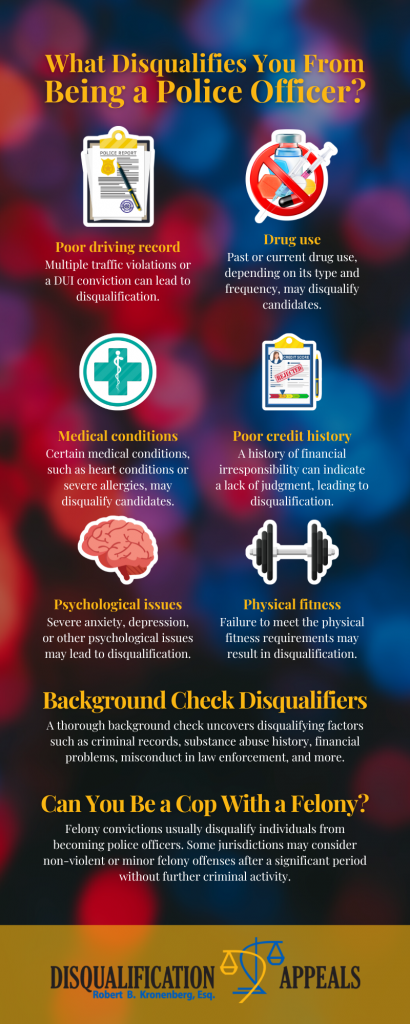
What Disqualifies You From Being a Police Officer?
Here are the categories related to the most common police officer disqualifications during the hiring process:
- Background investigation concerns and credibility issues, including inconsistent disclosures and problematic patterns uncovered through background checks.
- Criminal records concerns, especially felony convictions and offenses involving violence or dishonesty.
- Psychological screening concerns that lead to a proposed psychological disqualification.
- Character and suitability concerns that lead to a proposed character disqualification.
- Medical findings that result in medical disqualification appeals or further review.
- Physical fitness failures that are tied to performance standards or medical readiness.
Why a Notice of Proposed Disqualification Matters
A notice of proposed disqualification (NOPD) is not always the first document a candidate receives, but when it appears, it matters because it often defines the window for response.
An NOPD is typically the agency stating, in writing, that it intends to disqualify the candidate unless they submit a persuasive response within the allowed timeframe. That response may involve records, evaluations, explanations, and other supporting material. In many cases, the way a candidate responds to the NOPD shapes what happens next, including whether the agency withdraws the proposed determination or moves toward a final decision.
This is also where candidates can lose ground quickly. Delay, incomplete documentation, or unfocused explanations can allow the proposed decision to become final.
How Disqualification Appeals Helps Police Candidates in New York
Civil service procedures and strict deadlines often govern disqualification decisions. Candidates do not always get unlimited chances to fix the record. That is why structure and precision matter.
At Disqualification Appeals, Robert B. Kronenberg, Esq., reviews the stated grounds for disqualification, identifies what the agency is actually focusing on, and develops a response strategy that addresses those issues directly. Depending on the case, that work may involve documentation gathering, coordinating medical or psychological evaluations, preparing written submissions, and representing candidates in later administrative proceedings.
Kronenberg’s background as a former New York City Police Captain adds a practical perspective to cases involving NYPD screening standards and disqualification decisions.
Speak With a Police Disqualification Attorney
If you are pursuing a career with the New York City Police Department or another New York agency and have received a disqualification or a notice of proposed disqualification for one of the most common police officer disqualifications, you do not have to guess what the next step should be.
Call us at 631-234-4434 or contact us online today to schedule a consultation and learn how Disqualification Appeals and Robert B. Kronenberg, Esq., can help you respond to an NOPD and protect your path toward appointment.